




With the June 16 vote on a proposed agreement selling the town’s mineral rights approaching, debate in Erie is shifting from fracking itself to the process behind the deal. In particular, residents and some council members are asking whether the negotiations followed the expectations laid out in the town’s contract and purchasing policies.
The proposed agreement is tied to the Draco oil and gas project, a state-approved development operated by SM Energy, formerly Civitas. The project would drill 26 horizontal wells extending roughly five miles underground beneath portions of Erie. In exchange for selling town-owned mineral rights that lie in the path of the project, officials say Erie would receive a package of cash, royalties, land and environmental concessions from SM Energy, while critics continue to press for details on both the value of the deal and the process used to negotiate it.
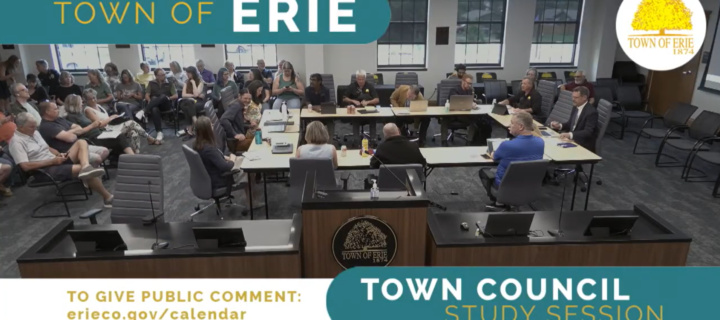
Residents crowded into a June 2 public study session seeking answers about well locations, groundwater impacts, wastewater disposal and what a mineral-rights sale could mean for the town’s future development.
Beyond the drilling itself, the agreement could shape how Erie grows in the coming years. In exchange for its mineral interests, the town would receive a package of cash, royalties, land and other concessions that officials say could support future development. Some residents, however, remain concerned about potential environmental and public health impacts, as well as whether selling town-owned mineral rights outright is preferable to retaining or leasing those assets for future revenue.
Mayor Andrew Moore has consistently framed the mineral-rights agreement as an economic-development opportunity rather than solely an oil and gas debate. In his April State of the Town meeting, Moore argued that Erie’s infrastructure and growth needs were going to outpace available capital funding and portrayed the deal as an important source of future revenue. However, previous Yellow Scene reporting found that Erie’s capital reserves and projected revenues appeared stronger than suggested during those discussions, raising questions about how essential the agreement is to the town’s long-term financial plans.
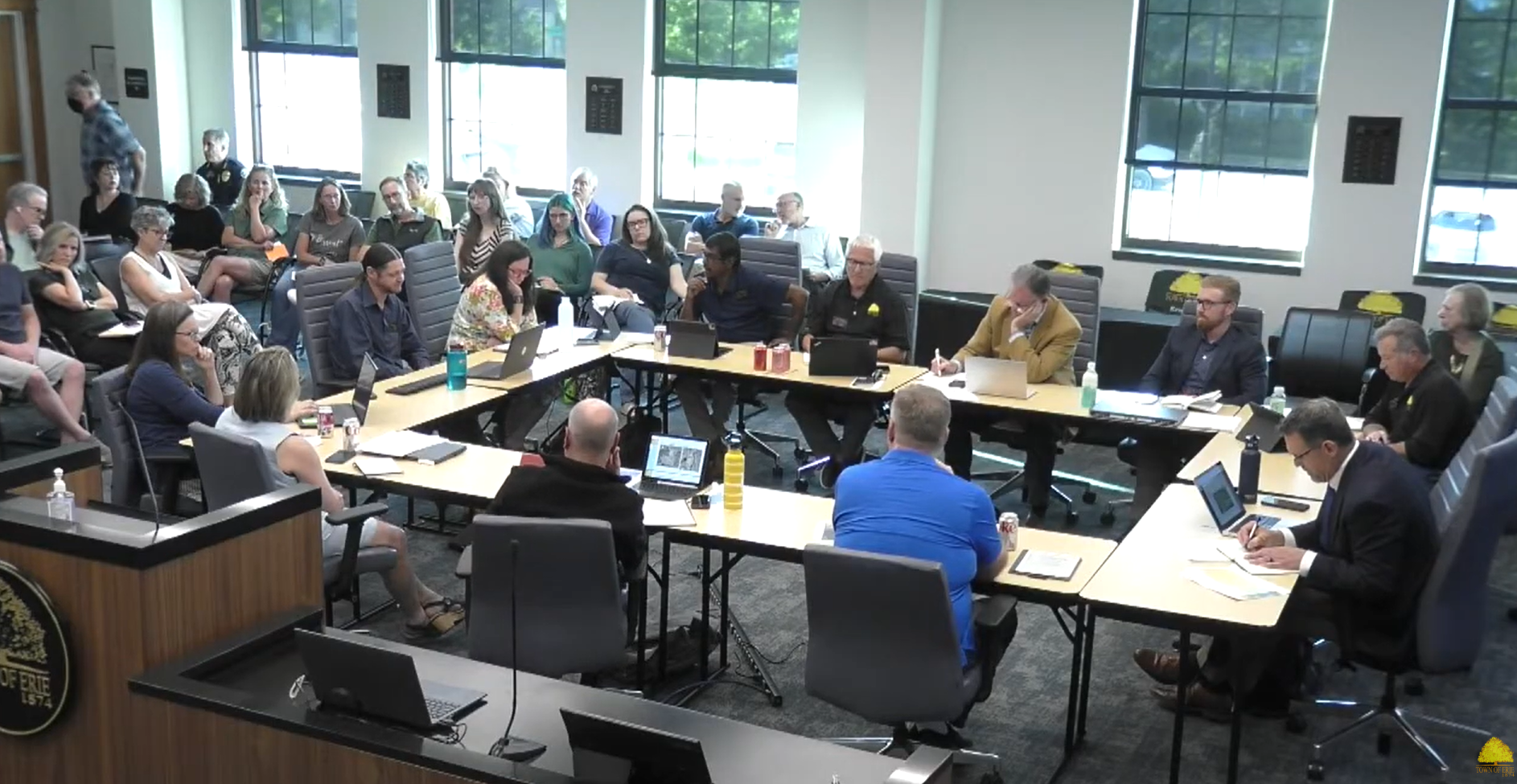
Moore reiterated that argument during the June 2 study session.
“Yeah, I guess the way I look at this is the first offer was $2.85 million, which is that land. And now we’re up to roughly $35 million plus the value of the land going forward, which goes to over $200 million,” Moore said. “And so, yeah, maybe this isn’t the best deal we can get, but maybe it is by far the best deal we can get.”
Town officials repeatedly emphasized that rejecting the agreement would not necessarily stop the Draco project. During the June 2 study session, Environmental Services Director David Frank said the town’s unsold mineral rights would have to be “avoided,” but what that means in practice remains uncertain. “It could be that the overall direction of those laterals changes to avoid physically contacting those areas,” Frank said. “It’s also possible that they may drill right through our mineral rights and simply not perforate and frack those sections of the casing.” Later in the discussion, Frank acknowledged that the state has not provided a definitive answer on how such a scenario would be handled. “It’s highly unlikely that Draco, which is a $1.5 billion operation, is going to go away,” he said. “Their attorneys told me that they will go forward without the town’s minerals.”
Toward the end of nearly two hours of discussion, however, council members began asking whether the consultant hired by the town to assist with the negotiations had fulfilled a contractual requirement to solicit bids and whether the town’s purchasing guidelines had been followed when he was hired. Discussion focused heavily on uncertainties about the process itself alongside the specifics of the proposed agreement.
Currently, council is considering an agreement with SM Energy that town officials have described as one of the largest mineral-rights transactions in Erie’s history. According to information presented during the negotiations, the wellbores would be the longest ever proposed in Colorado and would be drilled beneath an established suburban community rather than a remote oil and gas field, which has been a cause for concern for many residents.
The proposed deal would involve the town selling mineral interests associated with the approved Draco Pad development in exchange for a package of cash payments, production revenue, land transfers, additional monitoring provisions and commitments to plug aging wells. While officials have argued that the agreement would provide significant benefits to the community, residents and council members alike have continued to ask how the town determined that this proposal represented the best available option.
The town’s selection of Alameda Mineral Advisors has itself become a subject of scrutiny, as public explanations of how the firm was identified and brought into the process have shifted over time.
During a March 10 council meeting, Mayor Andrew Moore said Alameda had been recommended by town staff and that council had not played a role in identifying the firm.
“With Alameda Minerals … they were recommended to us by staff and that’s how that contract came about,” Moore said. “There is nobody that personally advocated for them … nobody on council … that was brought to us by staff.”
A different account emerged during an April 21 discussion. Responding to a question from Councilmember Emily Baer about how Owens became involved, Director of Environmental Services David Frank said Moore had provided Owens’ contact information to town staff.
“Mayor Moore sent me an email and said, ‘here’s some contact information from a gentleman. I think it would be a good idea to reach out to him and hear him out,'” Frank said. “I gave him a call. He gave me his pitch…”
Moore offered another explanation during the June 2 study session, describing Owens as someone uniquely positioned to help the town negotiate with Civitas because of his previous experience inside the company.
“Matt was brought in for his unique knowledge of knowing the inside workings of a Civitas,” Moore said. “If you’re negotiating, you always want to have information from those you’re negotiating against.”
Those explanations are not necessarily contradictory, but they describe different accounts of how Alameda entered the process, ranging from a staff recommendation to a referral that originated with the mayor.
When asked about the hiring process for Alameda Mineral Advisors, Town Attorney Breena N. Meng focused on the town’s procurement policy.
“There is a requirement that was adopted in a purchasing policy that was approved by council to conduct RFPs or solicitations for services like this,” Meng said. “That did not happen.”
In other words, Erie’s purchasing policy requires a public Request for Proposal, where the town publicizes the need for services and companies can submit proposals explaining how they would perform the work in hopes of being selected for the contract. The town is then supposed to choose the best proposal for the services needed.
The admission means Alameda was hired outside the process the town’s purchasing policy requires.
Scrutiny of how Alameda entered the process was compounded by a second issue raised during the June 2 study session: whether the firm completed a key responsibility outlined in its contract with the town.
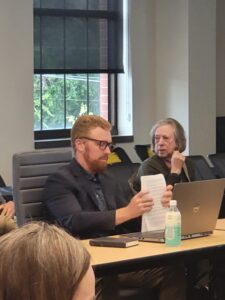
Matthew Owens of Alameda Mineral Advisors
At the center of the discussion is the scope of work agreed upon when Erie hired Matthew Owens of Alameda Mineral Advisors in December 2025. The contract’s scope of work states that the consultant shall solicit bids for the sale of town-owned mineral rights and property with comparative analyses of upfront proceeds versus projected cash flows.
The contract language requires more than finding a buyer. It requires that Alameda Mineral Advisors reaches out to a variety of companies that might be interested in buying the mineral rights. Then, all of the offers have to be presented to the town with comparisons of up-front profits, future royalties, and other non-monetary terms.
That requirement became the focus of a tense exchange between Councilmember Hoback and Owens.
“How did you actually solicit bids?” Hoback asked. (1:19:23)
Owens responded by describing work he had performed before being hired by the town.
“Before you guys hired me, I worked for a client in this unit, who had a whole bunch of minerals at the end of last year,” Owens said. “So I solicited a whole bunch of bids for him to lease or to monetize them. I followed up in early January and got back to the same folks to ask them about their bids and if they were still in the same range… it was substantially lower than what this deal would be. And so at that point, I was determined to just focus on this deal, since the value discrepancy was so great.”
Hoback immediately questioned whether that satisfied the contract’s requirements.
“That does not sound like a competitive bid to me,” he said.
He continued pressing the issue.
“It’s one thing to have, you know, prior discussions, going back to them. That still is not a competitive bidding process. And your scope of work says you’ll complete a competitive bidding process.”
Owens began to respond. (1:19:30)
“It does, that is why in that Executive Session, we had been specifically asked…”
Before he could finish, Town Attorney Breena N. Meng interrupted him, saying the answer would pertain to matters discussed in executive session.
The topic resurfaced later in the meeting when Councilmember Emily Baer attempted to revisit it. Mayor Pro Tem Brandon Bell objected.
“I want to make a point of order… we cannot talk about what was talked about in an executive session. I feel this line of questioning is completely disingenuous because you all know what you heard.”
Baer disputed that characterization.
“I have never heard another offer from any other entity… That’s good that we can’t talk about executive session things because that is not something we’ve ever talked about.”
After the study session adjourned, Owens was again asked whether he had completed the solicitation of competitive bids described in his contract.
“I was instructed not to… by the people who hired me,” Owens said. Owens did not identify who gave the instruction.
The statement prompted council members to discuss whether the town’s procurement practices had been followed and whether the contract’s scope of work had been fulfilled.
Councilmember Baer said she wasn’t sure whether the consultant had met the contract’s expectations.
“I do have concerns that the contract, scope of work for the contract hasn’t been met with a competitive bid,” she said. “I would like to understand more about that. Was that a violation of our expected scope of work of the contract that we signed? That’s what people in the community are asking me.”
The issue raised during the study session was not whether the town ultimately received a favorable offer, but whether the process outlined in the contract was completed in the manner council expected when it approved the agreement.
The discussion continued when Mayor Andrew Moore suggested that auditors review the issue. Interim Town Manager Meredyth Muth responded that auditors had already identified it.
“[Auditors] have noted it as a finding or possible finding,” Muth said. Neither Muth nor other officials elaborated during the study session on the nature of the finding or whether it related specifically to procurement procedures, contract administration or another aspect of the process.
None of the officials suggested rejecting the proposed agreement because of these discrepancies.
Town officials continued to argue that the agreement would provide substantial value to the community. According to information presented by the town, Erie owns approximately 183 acres of mineral rights associated with the Draco area. Of that total, roughly 103 acres remain unleased while about 80 acres are already subject to existing leases. Officials repeatedly emphasized that the town’s unleased mineral interests represent only a small percentage of the overall drilling unit and argued that recent changes in Colorado law increased the town’s negotiating leverage by limiting the circumstances under which municipal mineral interests can be pooled into development without the town’s consent.
Officials also argued that the proposed agreement would convert that leverage into tangible benefits for residents. According to town presentations, the package includes a multimillion-dollar upfront payment, future royalty revenue, approximately 158 acres of land along County Line Road, commitments to plug additional wells and inspection access at the Draco facility.
Representatives of the negotiating team argued that the town would forgo significant benefits if it rejected the agreement. They also noted that the Draco project has already been approved by the Colorado Energy and Carbon Management Commission, meaning the debate before council is no longer whether the project will be drilled, but whether Erie should seek compensation and concessions tied to that development.
Not everyone on council accepted the negotiating team’s assessment of the town’s leverage. Throughout the study session, questions surfaced about whether Erie had adequately tested the market, whether other operators may have been interested and whether the town’s mineral position provided more bargaining power than officials suggested.
For many residents, however, the conversation extended beyond the financial terms of the deal. Residents repeatedly focused on where water used for hydraulic fracturing would come from, how wastewater would be handled, whether groundwater resources could be affected and what authority Erie would have if environmental problems occurred in the future.
Officials acknowledged that while the town negotiated monitoring and inspection provisions, much of the regulatory authority over drilling operations remains with state agencies. Residents also asked whether the proposed land parcels are worth as much as stated and how much of the transferred acreage could realistically be developed.
Several residents noted that council is expected to vote on the agreement only weeks after the first major public discussion of its details, which they noted as a major issue they wanted addressed.
Those continuing worries come after months of criticism regarding how much of the process occurred in executive session and how little information was publicly available before the proposed agreement reached council. During the June 2 discussion, questions surrounding executive session matters were redirected, renewing the public’s concern about the confidentiality of the negotiations.
Council is scheduled to vote on the proposed agreement June 16.
By the conclusion of the meeting, many of the concerns raised by residents remained unresolved. Alongside issues of water, drilling and future development, council members found themselves conflicted over procurement, transparency and accountability.