



The sun set hours ago. Despite it being a Sunday night, the coffee shop crowd continues to sip their hot beverages, smoke cigarettes, and chat amongst themselves. Their energy ripples through the dark sidewalks where people walk to the bus stop, glancing at their phones as they head to their evening’s next destination. Just down the street, a small group of 20-somethings are gathered on a bar patio, their excitement palpable, chattering away below billowing Black Lives Matter, Trans Pride, and Progress Pride flags.
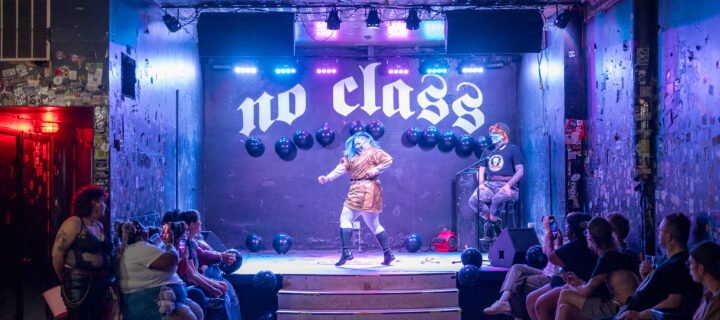
Only blocks from a quiet residential neighborhood, separated by an active railroad track, in the Rust Belt city of Cleveland, they were there for an evening of art, community, and political discourse. As the first sounds of the show start to drift past the security at the door, the group disappears inside the venue, No Class.
Cleveland’s second-best gay bar, the space’s dive-y aesthetic and all-black sticker-covered interior sets the expectation immediately that you’re there to see a punk or metal band on stage. Any other night, you probably could, venue owner Emma Jochum has a lifetime of experience booking and producing shows for bands who play what she calls “extreme music.”
Tonight, though, Cleveland’s queer scene is here for a drag show. Ostensibly set to celebrate the birthday of host Bram Stroke-Her, you’re asked at the door to make a contribution to TransOhio, an organization dedicated to protecting and advancing the rights of trans, nonbinary, intersex, and gender nonconforming people in the Buckeye State.
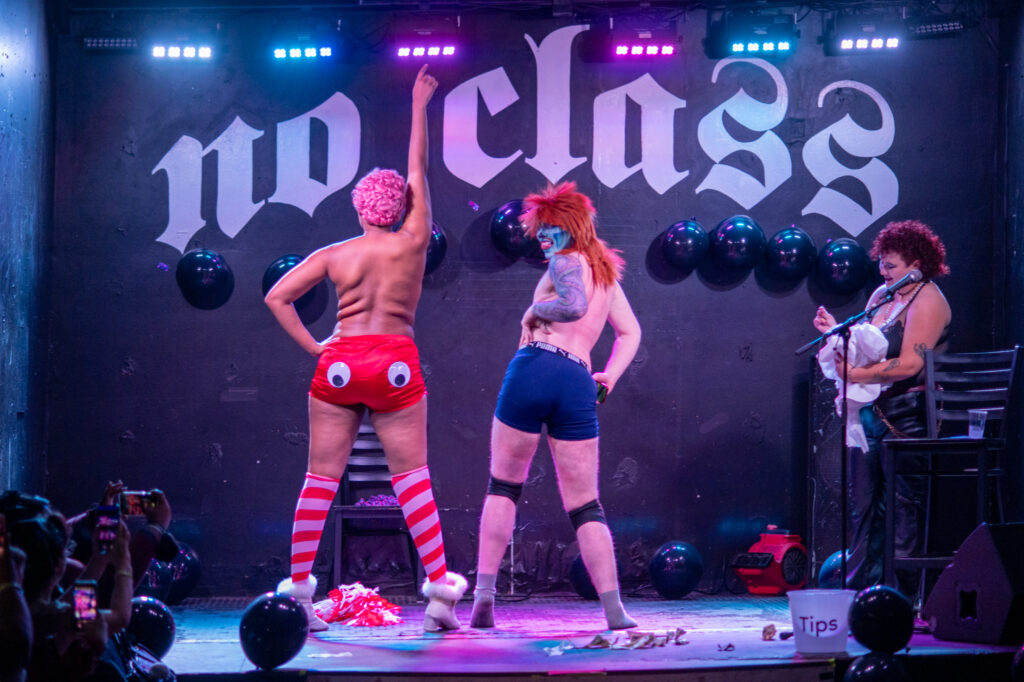
Drag performer Homer E. Rodick points to the sky while show host Bram Stroke-Her faces the audience during a performance raising funds for TransOhio at No Class in Cleveland, Ohio. (Photo by Vince Chandler / Yellow Scene Magazine)
Oil tycoon John D. Rockefeller re-established Cleveland as a prosperous city of wealth during the second Industrial Revolution, building the city in his image of splendor while creating distinct divides between the baron class owners and the workers who generated his fortune. Like other industrial cities in the region, it has felt the impact of the departure of manufacturing, slipping into disrepair bearing signs of dilapidation.
Clevelanders in this eastern gateway to the Heartland insist, however, that their city is worth fighting for. Cognizant that they’ve been left picking up the tab for political corruption, they see the wealth gap that fuels the profits of billionaire developers and energy conglomerates, while leaving themselves and their neighbors behind. Recently, there has been a push back at the continued exploitation of the lakefront midwest metropolis, as the people work to build community first campaigns and organizations to reinvigorate and revitalize their town from the grass roots.
To do that, it takes people. Those people need the place to gather safely. At No Class, they find solidarity in a space where art and conversation can thrive. Existing for years as Now That’s Class before Jochum took ownership, the space organically transformed from crust punk hovel to its current existence as No Class, what can only be described as a gay metal bar. Show attendees may not know it when they walk through the door, but they’ve entered a political space.
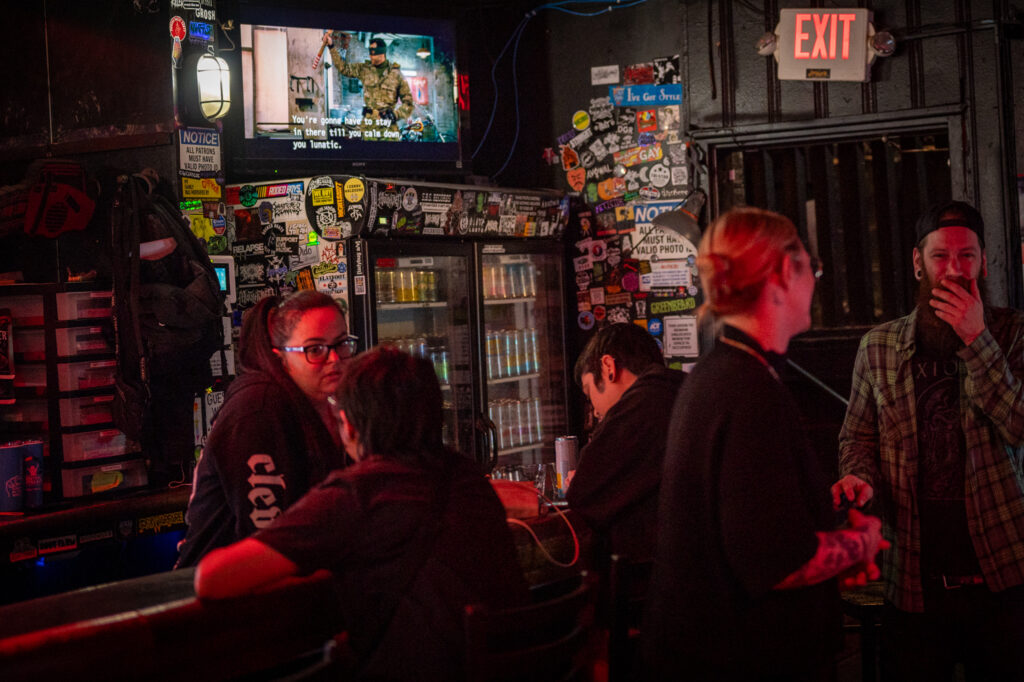
No Class owner Emma Jochum speaks with people at her bar during a drag performance benefitting TransOhio on Sunday, September 14 in Cleveland, Ohio. The metal and punk venue hosts queer performances and politican functions, as well as local and nationally touring music acts. (Photo by Vince Chandler / Yellow Scene Magazine)
“It’s really hard to make people care, and I just care,” Jochum says, sitting on the venue’s back porch moments after finishing a board meeting with a local community development corporation. “Trying to get other people to give a shit about stuff has been a struggle, but we’re working on it.”
Tonight, the effort to combat ennui would be through drag. Stroke-Her produced their birthday show with the TransOhio fundraiser attached and invited queens and kings to take the stage – and microphone – advocating for their rights, to discuss political violence, and to keep the community organized. The sounds of bumping dance music pulsed through the doors to the quieting avenue outside, while inside cheers erupted and joy was shared.
No one can enter this space without feeling the impact of local politics. Naloxone hydrochloride is available at the bar, a brochure rack near the restrooms is laden with notices for upcoming mutual aid group meetings, protest and direct action flyers adorn the wall. The drag show will obviously bring its own messaging of liberation and resistance, and on nights when heavy metal or punk rock acts take the stage canvassing and campaigning will be entwined.
“A lot of metal dudes are not into politics at all, or if they are, they’re into the wrong politics,” Jochum continued. “I’ve definitely caught some heat for being public about my opinions but ultimately, I don’t care. We do a lot of extreme metal, black metal and stuff, and there have been a few times where I didn’t vet the bands properly and had to cancel a gig.”
Platforming voices she feels need to be heard isn’t the only direct action the bar and venue owner takes. Serving on the Northwest Neighborhood CDC, covering Cleveland’s Edgewater and Gordon Square neighborhoods, is where she sees her impact the most. Combatting gentrification while advocating for community-driven growth through affordable housing and locally-owned business anchoring their neighborhood, she makes the time between her day job and No Class duties on the evenings and weekends to lend her voice.
Knowing she can’t do it alone, she utilizes the platform she’s built in No Class to raise the voices of local leaders, political candidates, and issues organizers. In June, her bar hosted a Punk is Political meet-and-greet for city council candidate Tanmay Shah. An Indian immigrant, union organizer, lawyer, and truck driver, Shah is a democratic socialist with popular support who has spent his fifteen years in Cleveland defending tenants against unethical landlords in housing court and organized a union at the Legal Aid Society of Cleveland.
Hosting canvass launches and candidate meet-and-greets isn’t enough for Jochum, though, she wants every person who passes through her venue to remember that punk rock is most certainly rooted in politics. In the months to come, as city and state elections near, she intends to host candidates like Shah and local organizers like Justin Strekal on-stage during shows, between sets, to tell the moshing crowds where else they can direct that energy.
“When we have bigger shows, bigger punk shows or even bigger drag shows, where I know that people give a shit about politics and will sit and listen, I want to get people on stage in the middle of the show and hopefully introduce a wider audience to candidates, let them hear what they’re running for and why and hopefully mobilize some more voters,” Jochum says. “It’s dangerous, and it’s hard, and it sucks a lot, but it needs to be done and the work is important.”
In Vice President JD Vance’s home state, where President Trump won by twelve points, organizing for progressive issues and candidates can be an uphill journey. The community identifying and supporting a safe venue for that work is important, and whether it was set up with intention, or completely by accident as is the case with Emma’s No Class, they fill a vital role in red states. She stresses the importance of not waiting until you’re told to do something, or think you have all the resources, but working with what you have, mobilizing, and getting to work.
Tonight, on an otherwise innocuous Sunday evening, the crowd came together to cheer on drag performers, to laugh after a week fraught with national stories of targeted violence and fear, and raised more than $500 for an organization which will continue to carry that message. Tears were shared, proverbial cups filled, and through joy and celebration of life, their mission continued.
Best known for capturing striking content from the frontlines of social movements, Heartland EMMY-nominated filmmaker and photographer Vince Chandler has spent 20 years creating art and documentary visuals across the U.S. They served as Communications Director for Denver City Councilwoman Shontel Lewis, and Vince has earned national recognition for their work as a visual journalist for The Denver Post. Vince was the principal cinematographer for the feature documentary film Running With My Girls, which premiered at the 2021 Denver Film Festival.
______________________________
What does resistance & resilience look like in the Heartland of America?
Sometimes it’s a protest outside an ICE detention center. Sometimes it’s a rural nurse explaining how Medicaid cuts will shutter the town hospital. Sometimes, it’s a law professor teaching systemic racism at a University in a state where CRT is banned in public schools.
As Trump’s second term unfolds — and the One Big Beautiful Act guts healthcare, empowers ICE, and reshapes American life — independent journalism is more vital than ever. However, the national press rarely shows up in the places where policy has the most impact.
We do.
These American Crossroads is a collaboration between Vince Chandler, Emmy-nominated visual journalist, and Yellow Scene Magazine, Boulder County’s only independent newsroom.
Become a sustaining supporter for just $8/month: https://fundrazr.com/Crossroads