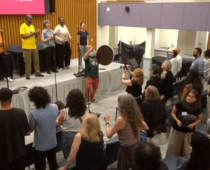





The room was tense, despite the late hour energies were running high and colliding as voices mixed and ideas flowed. The overlapping noise intermixed conversations, the group exchanging their thoughts in a twining mix. A ringing crescendo culminating in the decision to designate a remote control the talking stick.
Slowed down, the group of leaders listened intently as individual voices rang through sudden silence, discussing how to get their friend out of jail.
Seven in the room had been arrested earlier that day at the Dirksen Senate Building Cafeteria, one remained behind bars for allegedly resisting arrest during the nonviolent protest they’d staged. They had travelled to their nation’s capital to spend a week raising their voices for the Heartland, sent by their neighbors in Kansas to be heard.
The Free State Advocates, a coalition of political action groups from the Sunflower State, were going to be sure they were.
“I feel like in my local group, there’s only so much you can do holding a sign and attending a rally, or making phone calls, and we’ve done a lot locally but we don’t feel heard,” says Michelle Jones. “I wanted to make a statement not just for myself, but to show the people in my local area that you can do big things. You can be scared, and it’s OK to be scared, but it’s simple actions and it’s daring moves. I want to be able to give a voice to the voiceless to those who are afraid.”
One day earlier, they were a group of virtual strangers, many meeting for the first time as they boarded planes or arrived at Washington, D.C. hostels. Some flew, others drove their trademark Freedom Van over a thousand miles filled with supplies sent from home. Protest signs, a sizable collection of homemade buttons, stacks and stacks of zines to be distributed, hundreds of handwritten notes from Kansans to their Senators scrawled on yellow notecards.
Arriving in Arlington, Virginia the first task in getting to know one another was dinner. Heading to the grocery store they pulled the list of dietary restrictions and shopped cautiously, adhering to meet the group of fourteen’s needs with as broad a selection as possible. Plant-based dairy free cheese was found while ingredient labels read twice to be sure they were free from mushrooms.
The care taken in the early stages reflects the intentional, careful consideration that had united these organizers, activists and fueled the trip to D.C. Weeks earlier, an article discussing the initial decision by President Trump to deploy National Guard troops into Washington was shared into a statewide group chat. Shelby Hermosillo, from Salina seized her Jerry Maguire moment and asked who was going with her.
“It all just happened so fast, it was kind of like ‘are you kidding me?’” Hermosillo told Yellow Scene, reflecting on the quick build and immediate reception of her idea. “It was my last straw, because we’d been standing out there protesting every week, doing the things, making yard signs, doing all these little things and as much as it matters I didn’t feel like we were getting anywhere. I was ready to go to DC and face it. I messaged the group chat and just asked ‘anyone want to go to DC? Let’s rally together, let’s go.’”
Soon, the group had leadership from twelve statewide organizations equaling fourteen people were confirmed. Reigning the momentum, the group of experienced organizers transitioned from ideation to activation. Immediately, fundraising began and plans were made.
A rental home in their budget was found only miles from the Capitol, one they could all share. Virtual meetings were set to share personal experiences and plan for everyone’s role. For some, this would be their first time traveling to the east coast, their experiences building movements at home were extrapolated and applied. Representatives from Leading Kansas, Midwest Unrest, Sunflower Coalition, Noisy but Necessary, Kansas Impact Coalition, Central Kansas Activists, Arc of Justice, Franklin County Action Network, KC Women’s Action Collective, 50501 Kansas, Boots on the Ground, Indivisible, and “likely more,” coordinated and collaborated, concluding in an action plan.
“It was just inspiring, ” Malice, an organizer in Kansas City for KC Women’s Action Collective, told Yellow Scene. “We had so many people from different backgrounds, from different areas with different levels of experience and reasons for being involved. We had queer people, we had disabled people, we had young people, we had old people, seeing people that were so diverse coming together for the same purpose is what we want to see around the country. This was an example that it could happen.”
“I’m biracial, and looking back in history at the civil rights movement, we’re following the pathway that has created change, movement, for the rights we have now. I felt as though I was doing a very similar thing protesting in this way, causing civil unrest like my grandparents and great grandparents stood with in the 60’s.” says Olivia Philips, who was one of the eight arrestees on September 10. “ We come from the center of the country and we’re not getting heard. I feel like it’s monumental for us to travel all the way to D.C. and make a stand like this.”
The first question to be answered: what would they like to accomplish? They wanted to carry the voices of their neighbors, the messages from the signs which surround them in their separate corners of Kansas, to their elected leaders. They wanted to confront the National Guard and Immigration and Customs Enforcement. They wanted to speak directly with their representatives in Congress. Some were willing to risk arrest to take a stand.
“I’m not the leader of any particular organization, I’m just somebody who shows up and jumps in where I see something that can be done,” Sara Gillum, of Lawrence, Kansas, said. “If you had told me that I would be doing this four months I would’ve wondered who you were talking about.”
Her family, her husband and children, encouraged her to attend despite her reservations. Once she was in, Gillum was all in.
“If you’re feeling helpless and messed up, to create something out of nothing is such a good way to make sure you don’t feel hopeless, to fight back against feeling inadequate,” she reflects. “Especially with resisting this whole situation, to feel like you’re just a drop in an ocean, to have something tangible to hold is progress.”
For those who were fired up to take the legendary John Lewis advice to get into good trouble, a new partnership arrived a week after word spread of their impending adventure. Popular Democracy, a nationwide group who “unapologetically demand transformational change” approached Leading Kansas team leader Josh Fredrick asking if they wanted help.
Leading Kansas is a nonpartisan group of Kansans dedicated to holding elected officials accountable to the people, they stage regular readings of the U.S. Constitution in a weekly rotation outside of their Senators’ offices and coordinate town halls with officeholders. Planning to travel with the newly forming Free State Advocates, Fredrick brought the offer to the group.
“I wasn’t even initially a part of the group, to be honest. I saw the GoFund Me being advertised, reached out and asked if I could come, I’d like to do anything I can do to help” Fredrick says reflecting on how he joined the Free State Advocates coalition. “I had someone approach me at a protest and it really was a game changer. We wouldn’t have been able to bring as many people as we did without them, getting fourteen people there.”
They now had the institutional knowledge and organizational support to take their action to the next level. The first stop after arriving in D.C. would be a training on staging nonviolent civil disobedience on federal property, including what to expect as Capitol Police affix zip ties or handcuffs. To be sure their efforts wouldn’t go unnoticed they’d participate in a press conference with a member of Congress and activists from across the country sharing the stories of what brought them to this moment.
For the first night, though, ahead of tomorrow’s excitement the attention was on what was for dinner. The first four off the plane, shopping to fill the fridge for the week and paying so much attention to allergy concerns, landed on a spaghetti dinner. For this group from Kansas, of course corn would also be included.
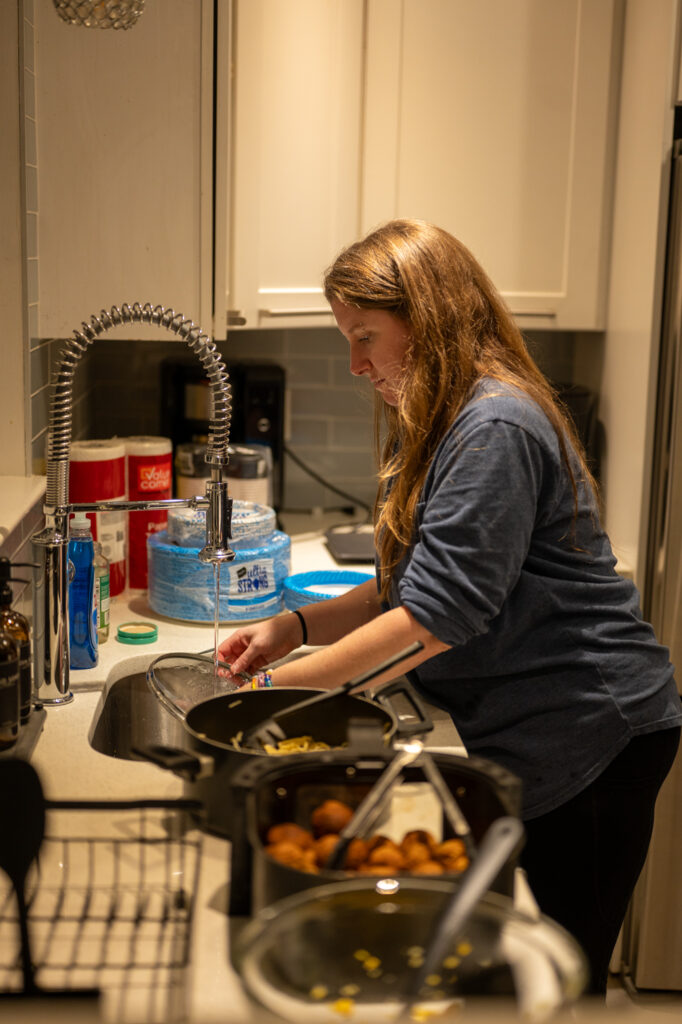
Sara Gillum, of Lawrence, Kansas, finishes preparing a spaghetti dinner on her first night in Washington, D.C. with the Free State Advocates. Free State Advocates is a Kansas grassroots network of powerful leaders and activists traveling nationwide to uplift Kansans & fight for human rights. (Photo by Vince Chandler / Yellow Scene Magazine)
Around the dinner table that evening, conversation turned to the events ahead. Concerns were shared about the consequences of their actions, hopes exchanged about how they could have impact. There to fight against proposed cuts in the proposed appropriations bill before Congress to Housing and Urban Development, personal experiences were passed around. Some had experienced varying levels of unsheltered homelessness, all carried the weight of housing insecurity.
At eleven, the stove was restarted and the meal reheated in anticipation of the Freedom Van’s arrival. Making the 22-hour trek from the midwest, four more Free State Advocates arrived at the house bringing a fresh spark to the evening, unloading their supplies for the week and chattering hurriedly about next steps as they fixed their plates with the hot meal ready for them. Only staying to introduce themselves and to fill their stomachs, they soon departed to meet the other half of the group in downtown Washington, where they were staying a stone’s throw from the Capitol.
In the morning, with the excited sense of a child’s first sleepover, the house buzzed with an eager energy. Today was the first day of a long week of coordinated actions, ranging from nonviolent civil disobedience to scheduled meetings with their lawmakers. A cold breakfast was foraged by those for whom coffee alone didn’t suffice, and with the sun barely breaking behind the grey, raining clouds they set off.
Walking into the basement of a church, it could be Bingo night. Rows of folding tables and chairs are arranged before a small lectern, the walls lined with additional seating, spare a/v equipment, and a short buffet where breakfast was being laid out. In minutes, the quiet space is transformed to a boisterous, busy meeting room. From across the country – from Colorado, Florida, California, Pennsylvania, and of course Kansas – activists were learning how their day would go, through conversation, instruction, and role play.
Introductions are brief, there’s a loaded agenda and getting to the heart of the planned action was centered in the palpable urgency. Today, the group was gathering to fight for housing. The National Low Income Housing Coalition estimates that under the U.S. House’s proposed 2026 spending bill, 181,900 fewer households would be served, while under the Senate’s proposed bill 107,800 fewer households would receive rental assistance. The loss of these vouchers would disproportionately affect older adults, people with disabilities, and families with children.
Highlighting the need for the average American to take a united stand against the removal of the social safety net for the nation’s most vulnerable populations, a member of each state represented was selected and asked to speak. With rain still pouring outside the basement windows, the scheduled press conference was moved at the last moment from the Capitol grounds to the church basement.
Eyes turned to watch members of the media stream through the door, placards distributed to the activists as they gathered in a semi circle under a large banner set behind a lone microphone. A murmur of gasps and a wave of excitement rippled as their keynote speaker entered the room: Michigan Congresswoman Rashida Talib, the first Palestinian American elected to federal office.
“In my community the housing has gotten so bad,” Congresswoman Talib told the gathered crowd. “You’re here to tell people ‘you’ve got us in survivor mode, and we’re tired.’ We should be able to thrive, we shouldn’t have to worry like this. I don’t care who is in the White House, this housing crisis has not been addressed with the urgency that’s needed.”
Congresswoman Talib continued her rally cry, highlighting policy positions she has introduced to assist with home ownership, food and medicine assistance, and better education opportunities. She passed the mic to speakers from Philadelphia, PA, Little Rock, AR, Oakland, CA, and – of course – Salina, Kansas. Shelby Hermosillo approached the lectern taking a deep breath.
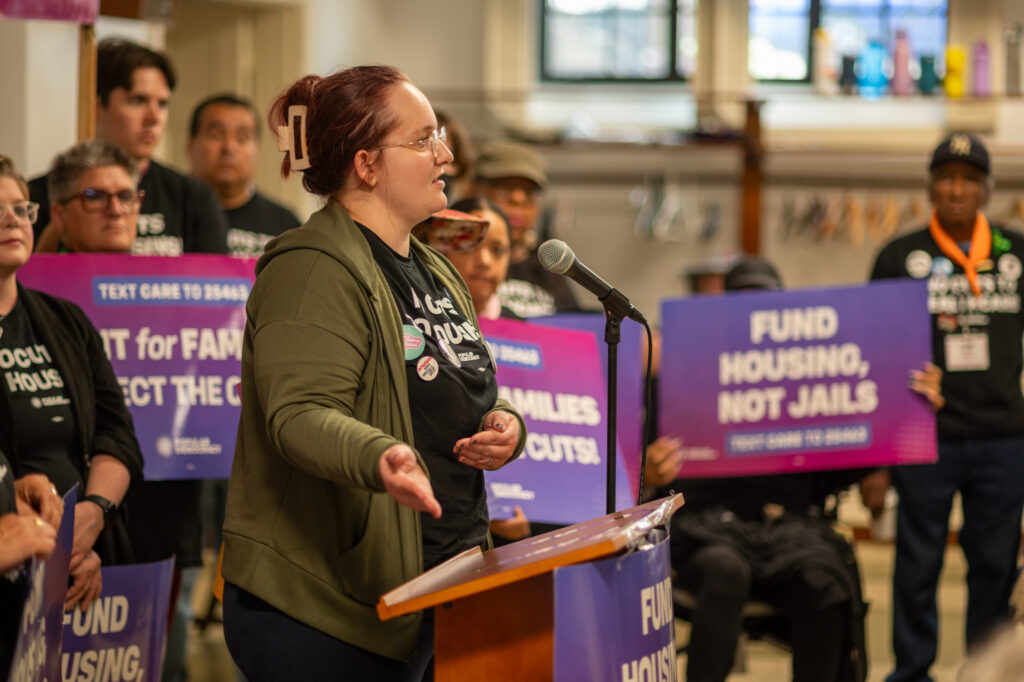
Shelby Hermosillo, of Salina, Kansas, speaks following Congresswoman Rashida Talib during a Popular Democracy press conference before staging an act of nonviolent civil disobedience at the Capitol. “I had this weight over me, knowing that I was leaving my family back home, losing money because I’m here to do this, but it matters more than making sure we had a check at the end of the week,” Hermosillo said. (Photo by Vince Chandler / Yellow Scene Magazine)
“This comes from the heart,” she started. “A year ago I had a great life. We were living life comfortably, and then life happened and it wasn’t. We started getting behind, and we got so far behind on our rent and behind on our bills that we could never catch up. Our electric got shut off. Our gas got shut off. Our internet got cut off. Our kids couldn’t play the games that were the only distraction from what Mom and Dad were going through. Having to watch our kids watch their Mom and Dad cry together because we lost our home…and now fighting with HUD.”
“This fight is personal for me, I speak for many people I know and love who are also going through the same thing, as embarrassing as it is to admit my own story I hope it can help bring awareness and help others find hope and stand with us,” she concludes as the crowd around her closed in embracing the Kansas mother and chanting to answer the call, find dignity for all.
Fired up and ready to go the group split into two, some headed to occupy Senators’ offices demanding they recognize the needs of their constituents and some headed to the Dirksen Senate Building to disrupt a quiet lunch cafeteria.
A packed room of tables, the sounds of cutlery scraping on plates while smells of pizza and hamburgers waft through the air, office staff, lobbyists, and lawmakers sit together to eat. Sharing space and talking in low voices, this is a moment to pause from the day’s stresses and find some nourishment. Suddenly, voices start ringing across the room shouting that housing is a human right.
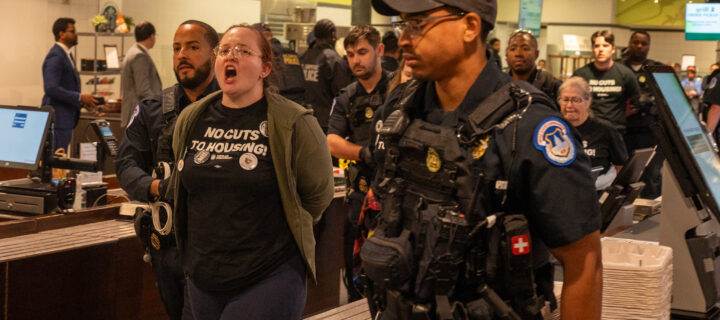
Deploying two large pop-out tents, representing the shelter that so many Americans find from harsh outdoor conditions while living unhoused across the country, the activists sat down making noise and sharing their stories in a united voice. Within minutes, Capitol Police had surrounded them, warning that if they didn’t desist they’d be detained. After a third warning, they began to arrest the group of fourteen people from across the country, many strangers to one another only a few hours earlier, now united in their cause.
Becky Norlin was the last person removed, and as she was pulled from the cafeteria she found every camera she could, being sure her voice was clear. For her effort, she was given an enhanced charge for resisting arrest, the only member of the group who wouldn’t be processed and released that day she’d spend the evening in a jail cell in D.C.
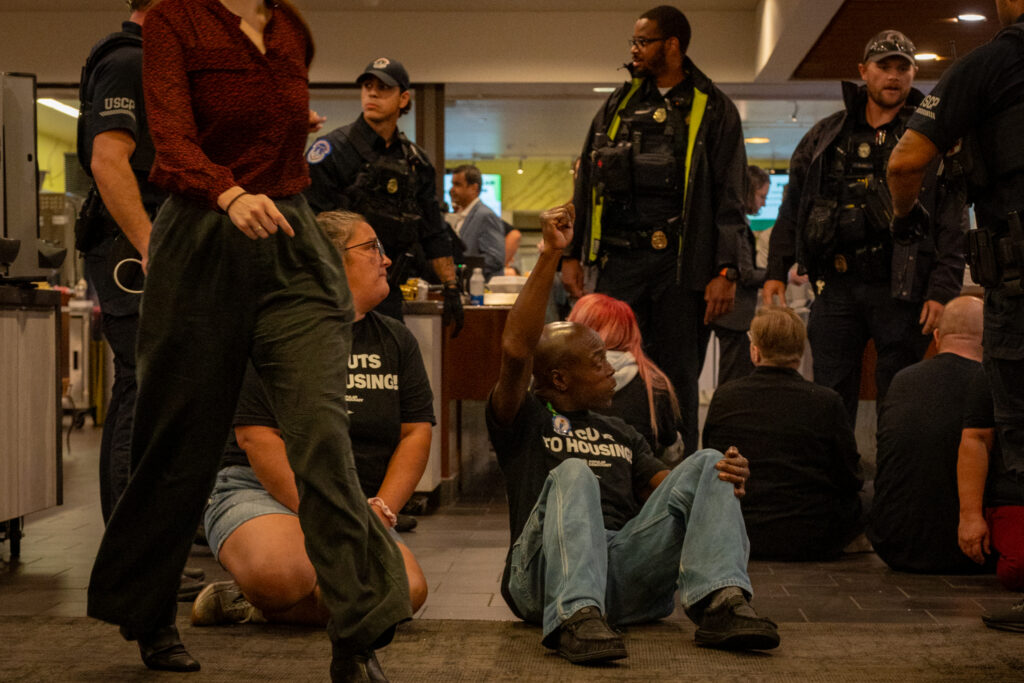
Gary Phillips, of Salina, Kansas, raises his fist overhead while surrounded by Capitol Police arresting his group for staging a nonviolence sit-in in the Dirksen Senate Building Cafeteria. he Free State Advocates travelled to Washington D.C. to join Popular Democracy for an act of civil disobedience protesting proposed cuts to the Housing and Urban Renewal in the recently proposed appropriations bills. Congress has until September 30 to reach a temporary funding agreement to avoid a federal government shutdown. (Photo by Vince Chandler / Yellow Scene Magazine)
The decision would alter the plans for the Free State Advocates, forcing them back to the drawing board for the next day’s planned protest. Suddenly, they had to offer court support.
“I am from the heartland of America, the middle of America, the line in Kansas and I want the world to know that there is a spark in the middle – even – of the United States,” Norlin told Yellow Scene following her release. “I am in love with the people in my country and my community, and the people that I work with every day. This was a no-brainer for me.”
Knowing that their peer would not be proud of them pausing, the Free State Advocates decided to continue with their efforts to meet with law makers and continue to strive toward equitable policy decisions benefitting their midwest neighbors, meeting their needs.
The next day, after a short break in the hot late-summer afternoon sun, the swampy humidity forcing a stop for water and some shade, the Kansans mount their scooters and head off toward the White House. The only evidence they had been there: a single homemade zine left tacked to the wall they’d been resting on, waiting to be found and read.
Access to medical care, cuts to education, the loss of SNAP benefits, and an impending cut to housing assistance compounding their concerns and pushing a ripple of anticipatory anxiety about whether their voices would suffice with their Senators, they headed back to Capitol Hill, where a majority of the group had been detained and charged fewer than 24 hours earlier. With a meeting scheduled with Senator Jerry Moran’s office, they decided to attempt to drop-in with Senator Roger Marshall and their members of the House.
“If you knew what was going on, you would be fighting for us,” said Norlin, who would not be making the trip with the group because of a personal ban from the property stemming from her additional charges. “We’re not gonna stop, and we could travel all the way to D.C. because we have a wonderful team of people in Kansas that we represent who got us here. We’re trying to sound the alarm bell, wave the flag.”
Only hours before they’d been in the D.C. Municipal Courts, providing support for the final member of their group who had been held in jail overnight. They had travelled across the country to their nation’s capital city to raise a united voice, bringing to the forefront of national politics their crisis in the center of the country.
The Free State Advocates travelled from House offices to Senate offices, popping in to ask to talk with their leadership or aides. In Congresswoman Sharice Davids’s office, they were allowed a comfortable impromptu meeting with Senior staff who heard feedback on the needs to protect immigrants, the poor, and the queer community.
“Right now, the only people they’re listening to are the people who can drop a dime and fly across the country on a moment’s notice and that doesn’t represent the majority of American people,” says Josh Fredrick. “If that’s all they’re listening to, that’s all they’ll know. We need to make sure that the underrepresented has a voice in this conversation.”
In Ron Estes’s offices aides met the group with a sense of reservation, asking them to state their issues and were quickly asked to depart. For their meeting with Senator Moran’s staff, they were brought to an internal conference room where they sat around the table discussing concerns about National Guard deployments to Wichita – where the crime rate is four times worse than in D.C. – about education, and about preservation of the federal safety net.
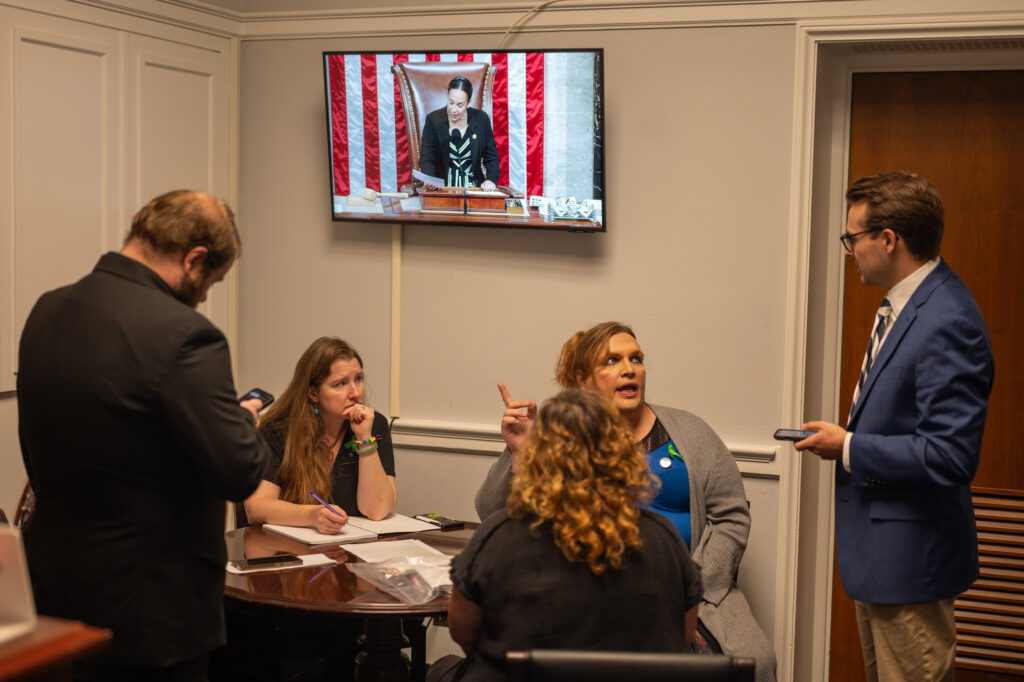
Jesseka Greene speaks with Congresswoman Sharice Davids’s staff in their Capitol office, where they were allowed a comfortable impromptu meeting with Senior staff who heard feedback on the needs to protect immigrants, the poor, and the queer community. (Photo by Vince Chandler / Yellow Scene Magazine)
“I’m the only trans member of the group, I need to push my voice just as much as I’m helping to push everyone else’s,” says Jesseka Greene, from Abilene, who travelled with the group to advocate for special education funding. “There is no difference between my civil rights and your civil rights. Some people feel uncomfortable with me, but that’s their deal and has nothing to do with me. In Moran’s office, I felt heard. I felt the emotional response I got when I got into the details of my experience as a trans woman looking for a job, after a lifetime of struggling through school needing more support.”
Following what they saw as a successful day on Capitol Hill, where some members of Congress gave them time to talk and others left them feeling unheard and frustrated, the group paused for a human moment. Finding a Thai restaurant, they took a moment to celebrate Becky being released, and group member Mary’s birthday. Around the table, stories were shared about the excitement of participating in civil disobedience which resulted in arrest and hope was eschewed that not only could they individually have impact but that their efforts could inspire their neighbors at home to follow their lead.
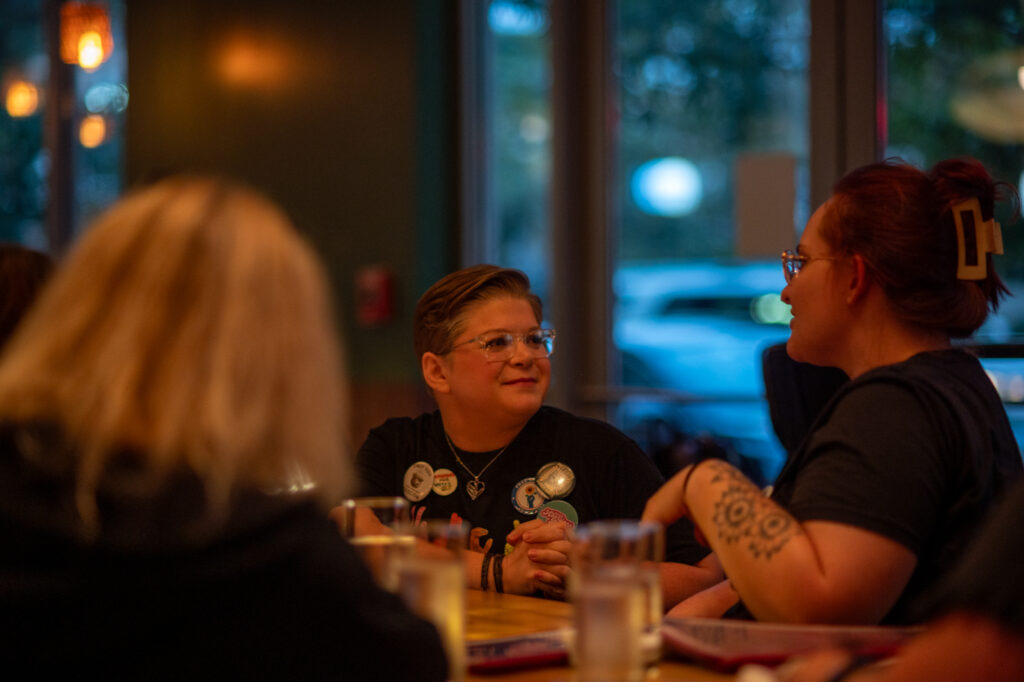
Becky Norlin smiles during a pause in conversation at a dinner celebrating group member Mary’s birthday and Norlin’s release from police custody. Eight of the Free State Advocates were arrested the previous day and released in hours, Becky was held overnight on additional charges of AOP Resisting Arrest. Arraigned the next day she was released to an enthusiastic cheer from the crowd for her action. (Photo by Vince Chandler / Yellow Scene Magazine)
After dinner, they weren’t done. With such limited time in the capital city, there was little rest or recovery to be found in the week. Not with work to be done. The final day of the 30-day deployment order originally issued by President Trump and the sun now sinking below the horizon, the group readied themselves to again hit the streets. They were going to get first-hand experience of night time in what they called “occupied D.C.”
In a silent city, absent from the normal late-night clamor of lobbyist cocktails and tourists, they rented scooters and bikes and set out. Rolling across the streets, their eyes peeled for ICE vehicles or armed Guardsmen, there was a tense sense of unease. They were not certain what they would find, and they were most certainly not in Kansas anymore. MAGA Republicans had rallied outside the White House earlier that day, with J6 activists leading the charge for further liberation for those who supported the administration.
All was quiet, though, and hours later as the Freedom Van returned to bring them back to their rental their attention was now on the next morning and their final protest action: guiding their legislators back to heartland value. In classic Kansas style, they’d be doing it by building a yellow brick road for them to follow home.
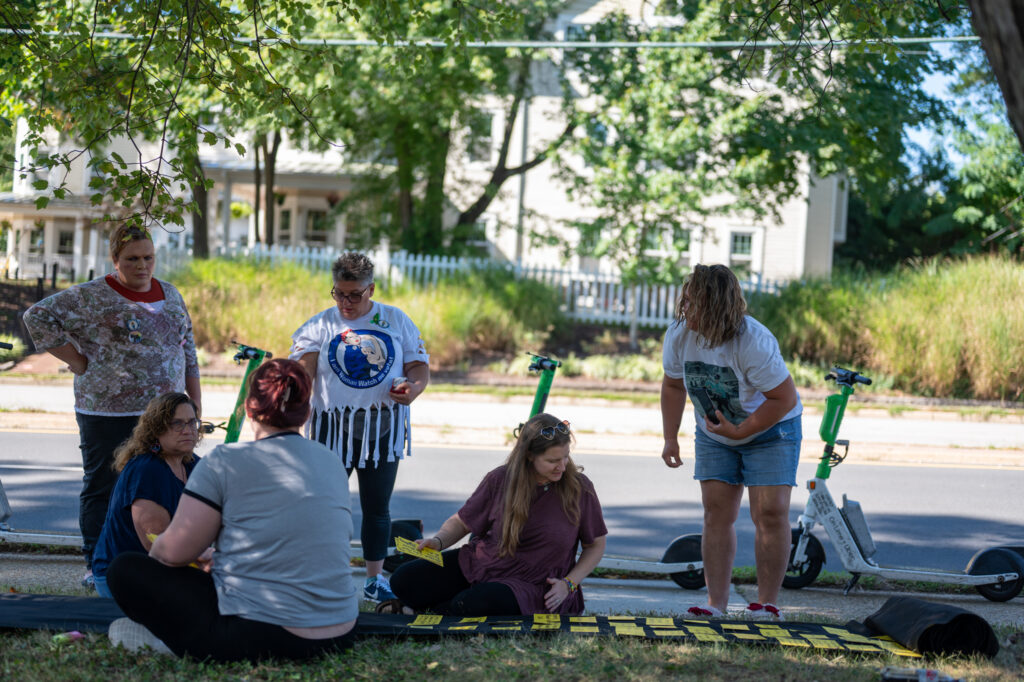
Jesseka Greene, Christie Peterson, Michelle Jones, Sara Gillum, and Miranda Bachman (L-R) work to construct a yellow brick road, built with “bricks” carrying messages from Kansas constituents, to bring to their representatives in the U.S. Senate. (Photo by Vince Chandler / Yellow Scene Magazine)
For weeks, they had gathered hundreds of handwritten notes on yellow note cards asking Kansans to share what they’d like their lawmakers to focus on. Healthcare, housing, humanity, the topics ranged far and represented the red state’s people’s priorities. Some included asks to end the genocide and occupation in Palestine, others called for protection for immigrant workers. At daybreak the work was begun to build the road.
50 feet of “road” was made by laying the cards as bricks across cloth, something easy to roll up and carry to the Capitol. The Free State Advocates headed back to The Hill for the third straight day carrying the concerns of Kansas, off to see the wizard. Debuting the reference to Dorothy’s iconic pathway, they took a group photo and spoke to tourists and curious passersby about their project before beginning its rapid deconstruction to deliver the notes to their Senators.
Jesseka Greene and Christie Peterson were selected to represent the group in the offices.
“People on the coast tend to have more power, because of access. They are closer to where the decisions are being made, I think here in the middle we have to raise our voices really really loud to be heard. I don’t think the plight of the farmers is being heard by politicians on the coast.” Peterson, who is a State Organizer for Kansas 50501, and had been arrested at the Dirksen Senate Cafeteria only days earlier, told Yellow Scene. “The call is for people who believe in upholding the Constitution, ending executive overreach, maintaining the three coequal branches of government, and equality for all. As far we’re concerned these should be no-brainers.”
Their first stop would be Senator Moran. Entering the office with a shaking, calm voice, she explained the yellow note cards came from constituents in Kansas asking for their Senator to be heard. She played a video of the yellow brick road being constructed and displayed at the Capitol, explaining that this won’t work if it’s just a cool video – they need people to join the call and they need their representatives to hear them. Within minutes, a silent alarm had been pushed and she found herself again surrounded by Capitol Police.
“It was like a gut punch. The fact that they couldn’t even talk to me, or tell me that they’d like me to leave the office… I was talking to them so reasonably and as a constituent, to have them call the police on me really felt like feeling the voices of Kansans to their office was somehow a threat,” Peterson reflects. “They did allow me on my mission to continue my mission of bringing the voices to Senator Marshall’s office.”
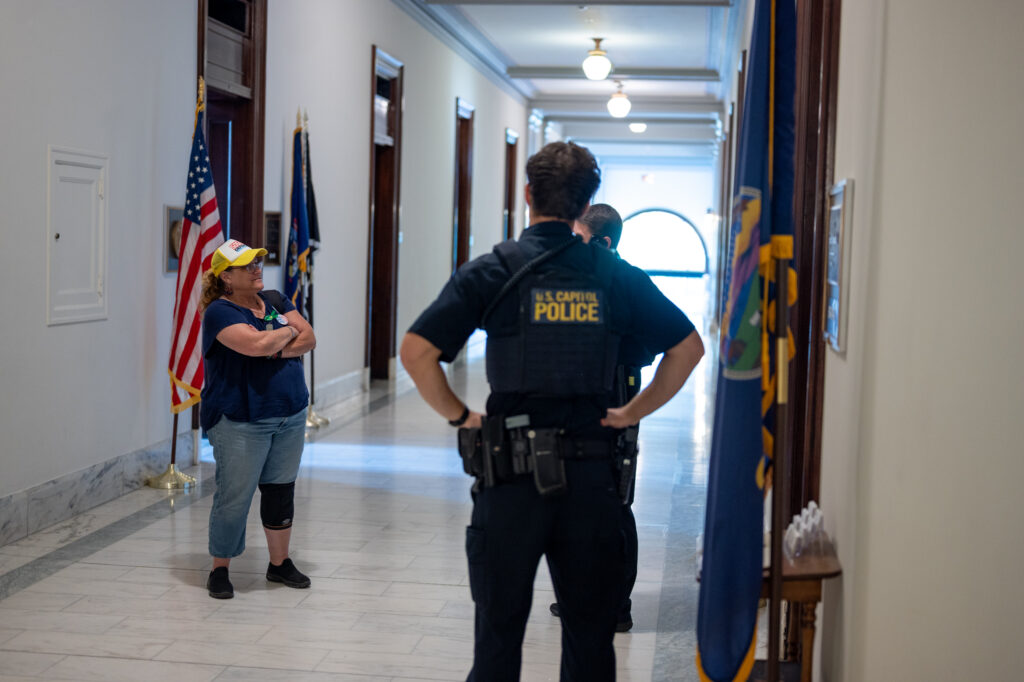
Christie Peterson, of Kansas 50501, talks with Capitol Police outside of Senator Roger Marshall’s office. They had escorted her to deliver messages from constituents after being called to remove her from the office of Senator Josh Moran moments earlier. The Free State Advocates had carried hundreds of handwritten messages to their Senators from neighbors in Kansas, written on yellow paper and briefly turned into a yellow brick road, hoping to lead their representatives home to heartland values. (Photo by Vince Chandler / Yellow Scene Magazine)
That office was locked and the door remained unanswered. Christie signed the guest book outside, leaving a note promising to mail the Senator his collection of cards, thanked the officers for their personal escort through the building, and departed.
“I wanted to go into this with an open mind, I wanted to meet with other organizers and learn what next steps could be,” Miranda Bachman, of Salina, told Yellow Scene after the week’s events. “I was really happy with being able to spread our message and there’s no way that [Senator] Marshall didn’t know we were out there.”
Since the event, Senator Marshall has responded to press inquiries spinning his constituent’s messages asking for attention to be paid to their values as threats of political violence.
“I think it’s important for people to realize that as red as some of these states or cities vote, there are people out here who didn’t vote for this,” Bachman continued. “Medicaid cuts are really going to hit rural Kansas, and as we feel this we’re going to be more in your face. I think that’s what we need, it’s important to write your legislators and call them, but they’re not listening. We need to stay peaceful, but speak with a loud voice until we’re heard.”
“You’re capable, you can do it,” Malice said after returning home already planning the next direct action in her hometown of Kansas City. “Organizing in Kansas isn’t the same as organizing in large cities like Chicago or New York, but I don’t want anyone to think that’s a reason to not do it.”
The work that could be done now done, the group retreated to their shared temporary home for a final evening of reflection. Sitting together while the Freedom Van was packed, they stayed up late into the night talking about what they felt they’d accomplished, discussing lessons learned, and sharing ideas for what to do next. Some went to bed as the clock ticked past midnight and others swapped stories as those who had driven started to ready their departure.
“It was a little hard to say goodbye to each other, especially recognizing that we may never be in the same room again,” said Josh Fredrick, looking back at the sudden end and departure after three days of intense direct action and police interaction.
With promises that they’d do all they could to build on their momentum, tears were shed and embraces held for more than a few beats. In the dark of night, the first group started their trek back to Kansas with Becky Norlin starting the van’s engine and taking the wheel. They’d return, and they’d do it with more of their neighbors.
This November, with a shared pulse from the Heartland, the Free State Advocates plan to bus hundreds of Kansans to Washington D.C. carrying their demands and raising their united voice insisting to be heard.
Best known for capturing striking content from the frontlines of social movements, Heartland EMMY-nominated filmmaker and photographer Vince Chandler has spent 20 years creating art and documentary visuals across the U.S. They served as Communications Director for Denver City Councilwoman Shontel Lewis, and Vince has earned national recognition for their work as a visual journalist for The Denver Post. Vince was the principal cinematographer for the feature documentary film Running With My Girls, which premiered at the 2021 Denver Film Festival.
______________________________
What does resistance & resilience look like in the Heartland of America?
Sometimes it’s a protest outside an ICE detention center. Sometimes it’s a rural nurse explaining how Medicaid cuts will shutter the town hospital. Sometimes, it’s a law professor teaching systemic racism at a University in a state where CRT is banned in public schools.
As Trump’s second term unfolds — and the One Big Beautiful Act guts healthcare, empowers ICE, and reshapes American life — independent journalism is more vital than ever. However, the national press rarely shows up in the places where policy has the most impact.
We do.
These American Crossroads is a collaboration between Vince Chandler, Emmy-nominated visual journalist, and Yellow Scene Magazine, Boulder County’s only independent newsroom.
Become a sustaining supporter for just $8/month: https://fundrazr.com/Crossroads