





Three months after Longmont residents packed city council chambers to push back against Flock Security Systems, the city has a new surveillance technology vendor, but many of the same questions remain unanswered.
During Tuesday night’s council meeting, the Longmont Police Department presented Axon as its preferred alternative for automated license plate recognition (ALPR) technology. Public Safety Chief Zach Ardis and his team spoke on Axon’s data encryption processes and superior security protocols as compared to Flock. Assistant Chief Phil Piotrowski highlighted the department’s longstanding relationship with Axon. He noted that the 25-year partnership began when taser technology was first implemented in 2000 and has grown to be a trusted vendor for the department.

Public Safety Chief, Zach Ardis, describing Axon’s data encryption technology.
“They’ve been integral in police operations throughout that time” Piotrowski explained, “They’ve built their product in a way that they understand what we need for security from them.” He added that Axon operations align with Longmont Police Department’s best practices.
Council voted shortly after to move forward with the contract, a decision that landed quickly enough to catch many residents off guard. The pivot followed a December 2025 meeting in which council voted 5-1 to reject any expansion of its contract with Flock, responding to hours of public testimony about privacy violations, data misuse, and concerns about mass surveillance. Since then, DeFlock Longmont, a local movement opposing the city’s use of Flock Safety, has remained active in organizing around surveillance issues in the city.
Though many residents welcomed the departure from Flock, several said the council should have allowed more public comment before approving the new contract. Andrew Palmer, a member of DeFlock Longmont, said he was disappointed that residents had no opportunity to rebut the Axon proposal before the vote was called. He also supports some form of technology oversight, which was discussed in the December meeting, but did not factor into the council’s deliberations that evening. “The police did not present much of a case for why they need this technology,” Palmer said, adding that he would have preferred the council to wait at least one additional session before voting.
Kellen Lesk, a software engineer who also spoke at the December meeting, returned with pointed questions about Axon’s technical architecture. He noted that Axon operates on Azure Government, a cloud environment built for U.S. government compliance, but said the structure of that system still raises concerns for him. “In order to make updates to the system, they need access to the system,” Lesk said. He expressed concern that terms like “encrypted data” and “access” can become slippery in practice, and that important questions about metadata and system configuration were never put to the company during the presentation. He explained that he had hoped council members would press harder on those specifics before voting.
A recurring theme in public comment was the need for a formal city framework to evaluate AI-powered tools before they are adopted. Emily Astranova took issue with Axon Draft One, an AI tool that generates police report narratives from body camera audio, arguing that it removes human judgment from a process that requires it.
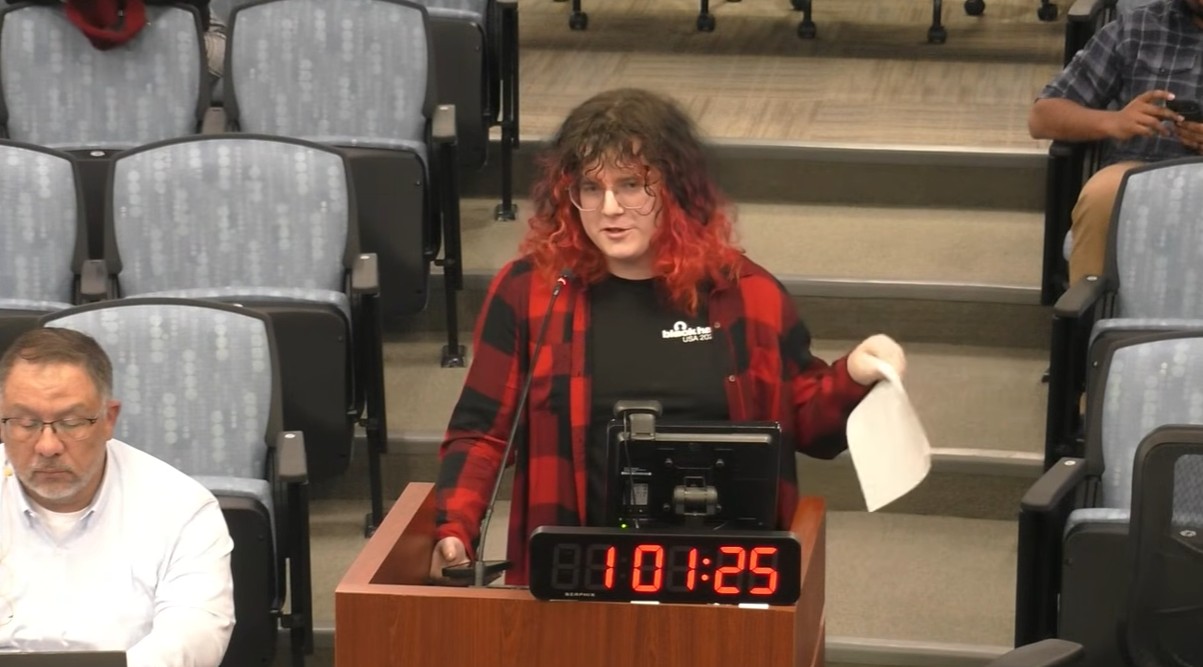
Resident Emily Astranova
She also cautioned against treating “AI” as a catch-all term. Large language models, machine vision, facial recognition, and optical character recognition are distinct technologies with distinct risks, she said, and city policy should reflect that. Another DeFlock member called for an oversight body that puts community interests ahead of vendor relationships.
Those calls may be gaining traction, as Council members Popkin and Marsing both indicated openness to forming a technology oversight or advisory committee to help council navigate AI-related decisions going forward. Marsing was candid in his closing remarks. “I have deep-seated concerns, as I think most of the community does, about the existence of ALPR tech, generally,” he said. He acknowledged residents’ frustration with the pace of the decision and encouraged the community to stay engaged, drawing on the technical expertise that has shown up repeatedly in public comment. “The conversation is not over,” he said.