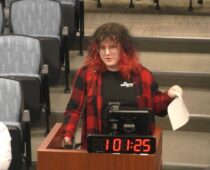






Longmont has long prided itself on being ahead of the curve. It was the first city in Colorado to offer municipal broadband, provides the majority of public utilities, and has been a community that has never shied away from embracing what comes next. But in December, residents packed city council chambers and forced a reckoning over surveillance cameras, pushing out one ALPR vendor in Flock and setting off three months of hard conversations about privacy, data and power. Now a new vendor is in, 15 cameras are headed back up, and Longmont finds itself with a chance to prove that being ahead of the curve means more than just adopting technology first: it also means governing it well.
To understand what that actually looks like, I spoke with two anti-surveillance activists, two city council members and the police department’s leadership.
Andrew Palmer has been a fixture at the public comment stand in recent months. Raised by two educators, he was drawn to science and technology from a young age, eventually becoming a systems engineer at Advanced Space. He has spent his career studying complex systems, and pertinently, how they fail.
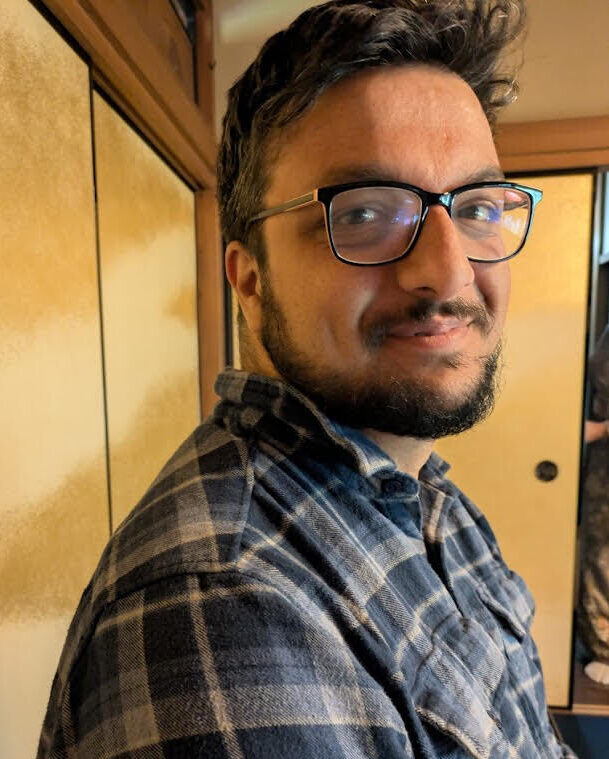
Andrew Palmer
“Sometimes failures are an unknown consequence of actions that you couldn’t possibly have foreseen,” he said, citing his work on Boeing 737s.
That lens brought him to city council meetings. “The most complex and most important systems in our lives are the ones made up of both technology and people,” he told me.
“Failures in those systems are critical and catastrophic and can affect people’s lives, even be life and death.”
Palmer stressed the importance of “systems thinking” and believes the city should be applying it to the surveillance conversation. He is not alone. His efforts to raise the alarm about risks to citizen privacy led him to the Visible Government League, an activist group whose mission is to “encourage caution, transparency, and public oversight regarding government use of surveillance and other emerging technologies.”
For Palmer, the central ask is not necessarily the removal of cameras, it’s sequencing.
“By the time these technologies are implemented and part of city strategy, it’s often too late to do much about it,” he said.
In his view, an emerging technologies advisory board is a prerequisite for smart policy. A board seated before the next technology arrives means the city can evaluate it on the front end, with civil rights lawyers and technical experts at the table, rather than scrambling to catch up after the fact.
“If we can’t satisfy certain requirements for this technology,” he said, “we shouldn’t have it.”
He wants residents who aren’t following this closely to understand what’s at stake:
“These are not simply CCTV cameras. These are networked and capturing personal information of everyone entering and leaving the city.”
And he has a message for anyone who thinks one voice doesn’t matter. “I have found that I’ve had a much greater impact than I thought I would,” he said. “One visit with a city council member, one email, one time attending one of these meetings can be hugely impactful.”
Palmer sees Longmont’s response to surveillance pushback as an opportunity for broader influence. “Denver watches us. All the cities around us watch us. And then the nation watches Denver and the Front Range,” he said. “I want Longmont to continue being the leader in what good use of technology looks like for other cities.”
Council member Matthew Popkin also considers himself a systems thinker. With a day job at Rocky Mountain Institute, this is not his first rodeo when it comes to approaching new technology on a municipal scale. He tracks emerging technologies across the energy, sustainability and municipal functions spaces, and one thing he keeps seeing is how much data management and data protection matter regardless of the sector.

Matthew Popkin
“We manage a lot of data,” he told me.
“How we manage that matters, and how we protect that data is critical.”
Popkin pointed out that ALPR technology reduces the number of direct interactions between officers and the public, because if a camera can determine whether a vehicle is even relevant to a case, an officer doesn’t need to make that stop.
“You can have a black Subaru with this license plate and suddenly you’re no longer concerned with all the rest of the black Subarus,” he said. “It allows our officers to focus just on that, and go into those situations more prepared.”
Kellen Lask, a local software engineer and member of Visible Government League, sees that differently. For Lask, a safer community isn’t built by officers surveilling it from a distance but rather from officers embedded in it, connecting with the people they serve. Lask is not reflexively anti-technology. In fact, he was the kid programming games on his graphing calculator in school and describes himself as fascinated with technology.
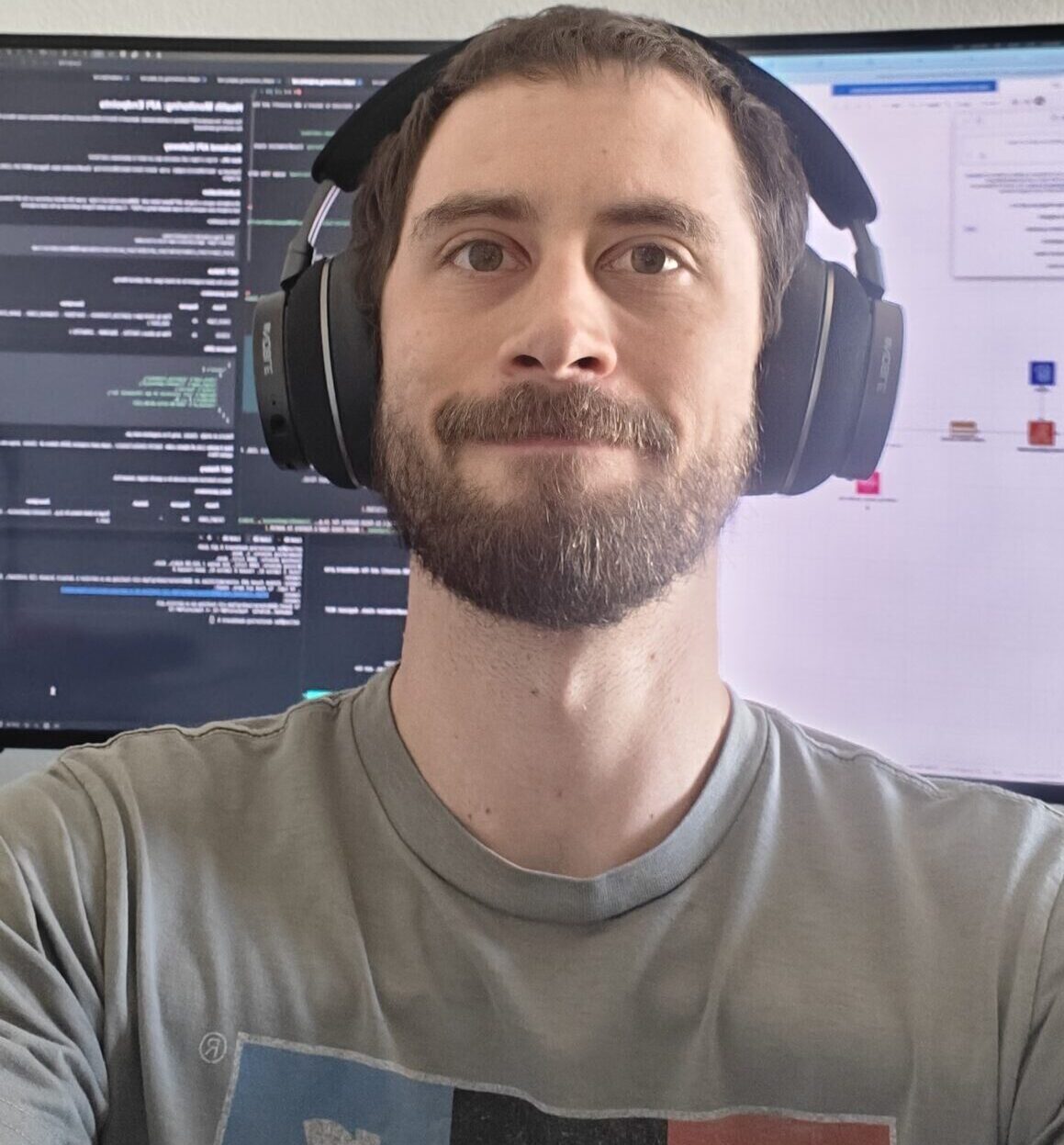
Kellen Lask
Even so, he has doubts that the efficiency that comes with this surveillance technology will equate to safety.
As a fourth-generation Longmonter, former legislative staffer and teacher, Councilmember Jake Marsing comes at this from a different angle. He campaigned on fighting for working families, and when I asked him how that shapes his view on surveillance, you could tell the question carried real weight for him. He was also the one to make the motion to terminate the city’s contract with Flock during the December council meeting. Popkin seconded it.
Marsing considers the surveillance topic akin to issues like housing affordability in the sense that it begs the question: “What kind of governance are we doing, and what kind of community are we leaving our kids?” He expressed the desire to do everything he can to protect citizens’ privacy in an era where that is increasingly difficult. At a minimum, he believes, the city should ensure resident’s data is protected and not accessible to other jurisdictions except in active investigations.
Lask echoed this sentiment, but frames the stakes more broadly. “What kind of community are we building?” he asked.
“An automated eye in the sky tracking every single person? That feels like a very paranoid and distrustful community. That doesn’t feel like a happy, ‘I go help my neighbor’ kind of community.”
If people assume the cameras are watching, he argues, they may stop watching out for each other. “We’re offloading the responsibility to our community to keep an eye out for each other” Lask maintains “Like ‘Oh the cameras will do that.’”
A more disconnected community, Lask fears, could be one of the quieter, unintended consequences of building a future around this technology. He also worries about the impact on expression itself, and that perhaps the persistent awareness of being tracked suppresses behavior in ways that go beyond what any policy intends, leaving people less comfortable simply being out in the world.
During his conversation with Yellow Scene Magazine, Council member Marsing spoke frankly about the fine balance a councilmember must strike.

Jake Marsing
“We sit in this cross section of legislative branch policymaking and executive branch oversight, where we are also obligated to support our public safety department, to make sure the public safety team has the resources they need.”
That tension is personal for him. His father was a Longmont officer for 14 years, retiring in 2010. The department’s headcount hasn’t grown meaningfully since, even as the population has increased by approximately 16%. “So when our public safety chief says, ‘If you’re going to take away these cameras, I need more bodies, I agree with them.”
When I asked Marsing about his vote to approve the Axon contract, which struck some community members as a hasty decision, he was direct.
“It’s not that my thinking changed at all. It’s that my understanding of the reality here on the ground maybe shifted. I did not believe it was going to be possible for us to get cameras fully removed from the city. But what is possible is for us to work with a vendor that has significantly stronger data protection and does not involve a national data sharing model.”
He has heard the argument that Axon and Flock are the same thing.
“They’re not the same thing. Yes, the core camera tech is similar, but the back-end data sharing policies, the way that Axon has operated as a company for 20-plus years, do not have the same kind of data sharing practices that made me significantly more uncomfortable with Flock.”
Lask, who is particularly interested in trying to understand Axon’s architecture, agrees that the distinction matters, but stresses that the picture remains frustratingly incomplete. The questions he keeps returning to are technical and specific: when the data is transferred, is it encrypted? What encryption standard applies once it lands on a server? Who has access at that point? How much more secure is Azure Government than Azure?
“The details are just so deep and difficult to explore, even as a technical person,” he said.
One grey area Lask pointed out is the possible use of an Axon platform called Fusus, marketed as a cloud-based, real-time crime center (RTCC) designed to unify public safety and community intelligence. The platform would allow the city to integrate privately owned cameras, including residential doorbell cameras such as Ring, into the Axon system when camera owners grant access.
It has not been determined whether Longmont Public Safety will opt-in to this feature.
Both Council members Marsing and Popkin kept coming back to one distinction above all others: the difference between Flock’s opt-out data sharing model and Axon’s opt-in. With Flock, Longmont’s data was visible to any partnering agency by default unless the city actively shut them out. That, Popkin told me, is how data ends up shared without anyone consciously deciding to share it.
“That’s an operational default,” he said. “And that’s what other departments across the country are also realizing “‘hey, we didn’t even think to check that setting.’”
With Axon, the starting point is zero. Longmont has to explicitly grant access agency by agency.
“We’re keeping it tight,” Popkin said. “And that was part of the direction coming out of December.”
For residents whose anxiety centers on federal immigration enforcement, of which there are many, Popkin was measured but clear. The city cooperates with federal authorities on criminal warrants and active investigations. It does not enforce civil immigration violations. “It’s not Longmont’s role to enforce federal immigration law.” The default settings of the vendor, he argued, matter fundamentally to whether that policy holds in practice. It should be noted, however, that according to the Electronic Frontier Foun

dation (EFF), any resolution that claims to protect local data is null when the state and federal government do not allow cities to withhold data.
There are two other distinctions Popkin raised that have gotten less airtime. The first is that unlike Flock, Axon does not sell or share aggregated data collected through the platform. The second is that Axon does not use Longmont’s data to train AI.
The second distinction involves a platform Longmont already knows. All ALPR data through Axon is stored on Evidence.com, the same platform the department has used for seven years to store body camera footage. Popkin noted the significance of that. Body camera footage captures some of the most sensitive, private moments imaginable: officers entering homes during domestic violence calls, medical emergencies, moments of crisis.
“That is some of the most personal, sensitive, and private information that we might have on someone,” he said. The department has trusted Axon with that material for nearly a decade.
The ALPR data, by comparison, Popkin believes, is far less intimate. He notes that this is a photograph of a license plate, and nothing more.
Lask argues that this information, though simple in nature, can still portray an intimate picture of one’s life when aggregated. “Innocuous data adds up to a very personal picture,” he asserted, “your life is small bits of data that in isolation mean nothing, but across time it adds up to context.” The question of who holds that context, and what they can do with it, is where his concern lives.
I wanted to hear what this conversation looks like from inside the Public Safety Department. I sat down with Police Chief David Moore and Assistant Chief Phil Piotrowski, the people who are now navigating one of the most scrutinized technology decisions in the city’s recent memory.
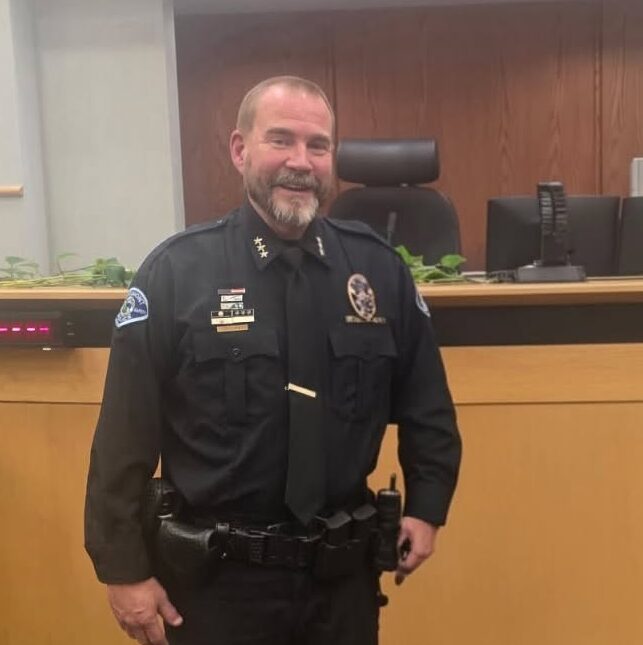
Moore stepped into the chief role in October 2025, walking straight into the Flock controversy. He described the moment the Loveland data-sharing scandal broke that summer: “As soon as we found out about it, we took steps to assure that that wouldn’t happen with us.”
There is also a data misconception both officers were eager to address. When an ALPR camera captures a hit, all that exists in Axon’s system is a photograph of the rear of a vehicle and its license plate. No image of the driver. No personal information. Everything else, including the individual’s name, address and the details that make a plate number mean something, comes from NCIC and CCIC, national and state law enforcement databases that have existed for decades and operate entirely independently of any ALPR platform. Officers must verify a plate hit against those databases before making a stop.
“That’s really important,” Piotrowski said, “because in anything that we do, especially with technology, it’s having that human in the loop to verify and make sure that information is correct, because if we’re not doing that, that’s how we get in trouble.”
At the same time, the national record gives some reason for pause. An 2016 Associated Press investigation found that between 2013 and 2015, more than 325 officers across the country were fired, resigned or suspended for unauthorized database queries, using law enforcement systems to stalk ex-partners, surveil neighbors and dig up dirt on journalists. A decade later, this threat has evolved into a coordinated targeting of constitutional rights. EFF datasets from 2025 reveal that over 50 law enforcement agencies have weaponized ALPRs to physically track protesters and reporters at demonstrations. By bypassing traditional warrant requirements to log hundreds of searches, police are effectively penalizing public assembly and dissenting speech through retroactive surveillance. For some police departments across the country, the human in the loop has been a source of abuse.
Moore isn’t interested in framing ALPR as a replacement for officers.
“It will never be a replacement for an officer doing the work,” he told Yellow Scene Magazine. But the math cuts both ways for Moore. “I can’t have someone standing on a corner, or in our case, in 15 different locations in the city, constantly watching for a stolen vehicle to pass or a homicide suspect to pass, and then alerting their fellow officers that, hey, I just saw that car go by,” Moore said, “It’s just not practical, we can’t do that 24/7.”
The department has 15 cameras, positioned deliberately on main thoroughfares coming in and out of the city, not in residential neighborhoods.
“We want to know if there’s a wanted felon, a stolen vehicle, a missing person- if they’re leaving or entering the city,” Moore said. “That’s really the use case for us[…]It’s just an invaluable tool when used the right way,” he said.
That phrase “used the right way” is exactly where the community’s anxiety lives, and Moore knows it. The department requires individual logins, dual authentication and a mandatory case justification for every search, backed by annual audit trail reviews. An officer can’t run a plate without logging a reason. “If there’s one mistake you can’t make, it’s an integrity issue,” Moore said plainly.

Lask respects the intent but questions the scale. Other municipalities have reported query volumes upwards of 20,000 per month.
“Are we really to believe that, in addition to everything else public safety is doing, someone is going to sit down and read every single entry in an access log and match it to the case and the officer?”
When asked about alternative methods for secure access, Lask brought up his preference for the warrant system. “If you want to query someone’s phone records, you have to convince a judge it serves the public interest. You could build something similar here- some procedural, documented way to get sign-off from someone with no stake in the case. That keeps with the American tradition of following a process rather than just having unlimited access.”
The voice you rarely hear in these council chambers, Moore noted, is the victim. This could be the person whose stolen car was recovered, whose case was closed, whose family got an answer. “What I think is lost in these conversations is bringing closure to victims.” Moore emphasized that community engagement is his No. 1 priority, and that the trusting relationship the department has built with city council is too important to jeopardize, especially over a piece of technology.
City council’s oversight measures reflect that same balancing act. The Axon approval came with a one-year review, regular audits and a transparency portal where the public will be able to see what communities Longmont is sharing data with at any given time, which was never possible with Flock.
Perhaps the most anticipated development is the Technology Policy Advisory Board. Per the draft ordinance presented at the City Council Pre-Session on May 12, 2026, the board will serve to give technology policy recommendations to the council with no administrative or operational authority. Its responsibilities cover three key areas: resident data privacy rights, AI and algorithmic transparency, and camera and surveillance technologies. It will periodically review and update those policies as technology and laws evolve, deliver an annual report with recommendations and weigh in on high-impact technology issues when referred by council.

What surprised me most was learning that the Technology Policy Advisory Board, one of the central demands from the Visible Government League, was something the department itself helped set in motion. “We are not the experts at technology,” Moore said. “What we want are experts in technology that can bring an objective view on what the technology has to offer, what some potholes might be.”
The board is expected to be seated Jan. 1, 2027.
“This board is going to be able to access and look at the back end of our data in a way that other boards can’t,” Marsing said, “and that’s on purpose, because I want them to be able to get the best possible expertise that they can.” Applications are expected to open in November 2026.
For Palmer, the board is the most meaningful outcome of this entire saga as it will allow the city to intelligently respond to emerging technology and its risks.
For Lask, his focus is more personal. As a queer person, he’s acutely aware that the populations most vulnerable to surveillance aren’t always the ones visible in these conversations. “Gender ideology has been declared terrorism-adjacent at the federal level,” he said. “I have friends who are much more vulnerable than I am.” A national network of cameras that can share data across jurisdictions, even informally, is not an abstract threat from where he stands. Recent public records show that when guardrails are weak, local police have used these networks to target specific identities rather than actual crimes. Between 2024 and 2025, over 80 law enforcement agencies across the country used the system to run sweeping searches targeting the Romani community based entirely on racial slurs and stereotypes. For Lask, the worry is how easily a local system can be weaponized against marginalized groups when oversight is left up to the departments themselves.
It’s a reminder that these conversations, however technical they become, are ultimately about the people. While the Axon contract is still being finalized, the advisory board has yet to convene, and privately owned ALPRs continue to operate without the restrictions the city is working to codify, one thing is clear: Longmonters from all walks of life are coming to the table and asking hard questions about the kind of city they want to live in.
Marsing put it simply: “I remain really impressed by the engagement in our community and the care that folks put into our city, because that is what makes Longmont so special.”
Yellow Scene’s 2026 Summer Support Drive is underway with a goal of 1,000 Sustaining Supporters by summer’s end.
For 26 years, we have remained fiercely independent, free from sponsored content and outside editorial influence.
Reader-driven support keeps local journalism unbossed, unbought, and our journalists fed. Become a sustaining supporter for $8/month and get Yellow Scene delivered to your home.
Join the Summer Support Drive and keep local journalism strong.