





For eight years, Rodney Eaves was incarcerated at Bent County Correctional Facility in Las Animas, Colorado. One afternoon, Eaves and other inmates were enjoying their routine recreational time in the facility’s common gym space. Then the facility alarm sounded.
But the alarm was merely triggered by a drill conducted by inspection staff. The workers had tied a CPR dummy by its neck to the gym’s pull-up bar to simulate an inmate in need of immediate medical attention. Upon noticing that the blaring alarm was only a safety drill, Eaves started up his personal stopwatch to time the facility staff. It took six and a half minutes for guards to reach the gym where the inmates were located. After a whopping nine minutes had passed, correctional officers were finally able to lay the dummy flat on the ground.
“After my stopwatch said nine minutes, I remember thinking ‘If this was one of us, it was not going to go very well,’” said Eaves.
Eaves pinned the slow response on the facility’s lack of staff. During his time at Bent County from 2015 to 2023, Eaves recalled a ratio of less than one guard for every 100 prisoners. While staffing issues are present in almost every prison in the state, one aspect differentiates Bent County from the majority of Colorado prisons.
The facility is privately owned and operated by CoreCivic. As a private business, CoreCivic’s primary objective revolves around maximizing their profit margins. They regularly utilize staffing cuts to minimize their cost of operation and increase profits. After the facility staff’s uninspiring performance in the safety drill, Eaves began to question the safety of himself and his fellow inmates in a privately-run prison.
Although that afternoon at Bent County, the blaring alarm was merely a drill. In other cases, systemic understaffing at CoreCivic prisons has had serious consequences. CoreCivic has faced a slew of lawsuits across the United States regarding inmate deaths in their facilities. A Tennessee-based report found that the inmate mortality rate is twice as high in CoreCivic facilities in comparison to their state-run counterparts. Here in Colorado, CoreCivic faced a lawsuit in 2018 that alleged that staff denied medical care to an inmate in order to cut costs. The inmate later died in the facility. Across the country, negligence and poor staffing are the most common legal claims against CoreCivic.
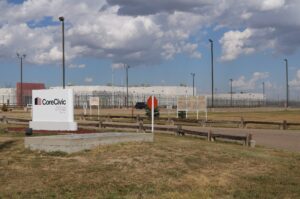
Kit Carson Correctional Center | Burlington, CO A view of the defunct correctional facility at 49777 County Road V, which was operational from 1998 until its closure in 2016. Date: Sept 19, 2019 • Photo by Jeffrey Beall
During Eaves’ time at Bent County, the staffing cuts went even further. Jobs that were crucial to run the facility were often offloaded onto inmates. During his time there, Eaves was directed to work in the kitchen, where his duties consisted mainly of processing and packaging food. Yet, Eaves was not employed by CoreCivic, nor by the Colorado Department of Corrections (CDOC) itself. He worked for Trinity Foods, an outside company which processes food for incarcerated populations.
While working for Trinity Foods, no rule explicitly forced inmates to work. Nonetheless, Eaves argues that his work in the kitchen at Bent County took place under coercive conditions. While he almost always complied with his employer’s demands, those who did not were routinely punished. They could have privileges revoked or face the threat of solitary confinement. The food he processed went to inmates in a separate wing of the prison where inmates were given special privileges for good behavior.
But there was a key difference between Eaves’ job with Trinity Foods and a traditional food packaging job: he wasn’t entitled to a minimum wage.
The arrangement was very profitable for Trinity Foods and CoreCivic; they could pay inmates significantly less than what was required for traditional workers.
“When we received our paychecks, we were being paid by Trinity Foods. The warden did not have to take money out of his budget to pay us,” said Eaves.
For inmates, the arrangement was less advantageous. “I made about 80 cents per day,” said Eaves. “It wasn’t even enough to pay my restitution.”
Eaves was held at Bent County on state charges, but CDOC had almost no control over his daily life during his stint at the prison. That power belonged to CoreCivic and Trinity Foods.
Many incarcerated Americans face similar circumstances. CoreCivic is the second largest corrections company in the United States, owning and operating 39 correctional facilities throughout the country (not including immigrant-detention centers). In Colorado, CoreCivic operates the Bent County and Crowley County Correctional Facilities. Their foremost competitor, The GEO Group, owns 99 prisons and detention centers across the country. In all, about 8% of the incarcerated population in the U.S. is held in for-profit prisons, according to civil rights group The Sentencing Project. In Colorado, 16% of prisoners reside in for-profit prisons.
Companies like CoreCivic and The GEO Group generate revenue by securing contracts with state and federal agencies to operate the facilities. In most cases, the contracts are purchased on a “per diem” basis, meaning that companies earn an agreed-upon rate per inmate. Both private Colorado facilities are at capacity, producing a tremendous profit for CoreCivic. They generated roughly $35 million in revenue from the state of Colorado from January to June 2025. CoreCivic can further cut costs through subcontracts with inmate employers such as Trinity Foods. Within this arrangement, CoreCivic pays Trinity Foods to operate at Bent County. They manage packaging and processing of the food which is later given to inmates. This way, subcontractors are able to utilize the cheap labor of prisoners. And CoreCivic does not pay salaries to the inmates who keep their facilities running.
While this may be a lucrative deal for the companies, for inmates, the reality is clear: corrections corporations and their subcontractors reap profits at the expense of the labor rights and safety of Colorado’s prisoners. The result is a process which inmates like Eaves feel fosters a form of modern-day slavery.
Despite the will of voters, slavery remains rampant in Colorado prisons
In 2018, voters in the state of Colorado approved Amendment A. For Colorado prisoners and civil rights activists, the ballot measure was a success. In the following years, the victory has failed to materialize.
The Colorado amendment repealed the long-standing exemption to the constitutional ban on slavery. The 13th amendment was ratified to the U.S. constitution in 1865. The amendment prohibited slavery, “except as punishment for a crime.” Amendment A ended the exception. However, Colorado has not adequately adjusted to the provision, and forced labor has persisted in Colorado prisons. A class action lawsuit alleges that forced labor practices in correctional facilities have remained in place, and that the Department of Corrections has effectively ignored Amendment A.
Stephanie Frisinger, a lawyer who represents Colorado prisoners in the case, argues that many Colorado prisoners are forced to work against their will.
“After the voters made their choice, we were hopeful that there would be changes in the prison system. That did not happen,” said

On Sept. 8, 2015, inmates at Coyote Ridge Corrections Center watered, fertilized and thinned sagebrush plants. Photos by Jeff Clark
Frisinger.
In Colorado prisons, failure to work is listed as a violation that constitutes a write up. Prison administrators may utilize a myriad of “tools in the tool-bag” to punish prisoners who receive a write up, which according to a motion from Frisinger’s class action lawsuit, can include harsh punishment.
For instance, write ups can lead to relocation, in which inmates are transferred into a higher security facility. High-security prisons often afford inmates fewer freedoms and are also more dangerous. Further, prisoners’ parole dates may be delayed for failure to comply with the work mandate. Inmates can even be threatened with restricted housing, a form of solitary confinement. A similar penalty which keeps them isolated for all but a few hours of the day may also be utilized.
“People are terrified of solitary confinement, they know about its effects,” said Frisinger. “The system is very coercive, to have that threat looming over you.”
Frisinger’s lawsuit alleged that these coercive practices are illegal under Amendment A, and a Colorado judge agreed. A state ruling in February declared that CDOC, along with Gov. Jared Polis, violated the state constitution by forcing prisoners to work.
According to Eaves, though, labor in Colorado prisons has yet to tangibly change in the wake of the ruling. In 2023, Eaves was transferred from Bent County to the state-run Sterling Correctional Facility in Sterling, Colorado, where he works as a janitor. According to him, although inmates at Sterling were optimistic that the ruling would halt coercive labor practices at the facility, they have yet to see meaningful improvement.
“They can’t threaten 22 straight hours of solitary [for refusal to work] anymore. But what they’ll do is threaten 20 straight hours instead,” said Eaves.
Eaves notes that inmates can be coerced into working in multiple ways. Often, inmates will be given the opportunity to “volunteer,” in which they are not paid for the work they complete. While volunteer jobs are not required, inmates can be disciplined for refusal to work for free. Eaves argues that the coercive volunteer work has continued even after the state ruling that prohibits forced prison labor.
But for civil rights activists, and for the inmates at Sterling, the ruling was nonetheless a small step in the right direction.
While the lawsuit was directed at the state of Colorado, similar labor practices occur at the private facilities in Bent and Crowley counties. Despite the will of Colorado voters, prisoners at the two facilities continued to be coerced into labor. Their labor consists of grounds work such as janitorial and kitchen duties. Inmates are hardly compensated for their labor; most workers receive under a dollar per hour.
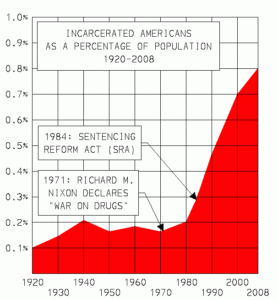
The relationship between CoreCivic and Colorado’s incarcerated population creates a troublesome correlation: more incarcerated Coloradans means a higher profit for CoreCivic. One of the company’s own internal reports confirms this dynamic. They write that any legislation which may decriminalize certain behaviors may reduce the number of prisoners and subsequently decrease the “demand for our facilities and services.” Further, they acknowledge that lower sentence lengths may also damage their profit margins. In Colorado, the result is a cycle of mass incarceration and a profitable partnership between CoreCivic and CDOC.
Colorado’s prisons are nearly at full capacity. Now, amidst a $1 billion state budget deficit, CDOC asks for upwards of $200 million to buy an inactive CoreCivic facility and open yet another Colorado prison.
For Colorado activists, the solution is not more incarcerated Coloradans and more cash for CoreCivic. Legal measures such as Frisinger’s ruling are an important start in mitigating the system’s harm. But in Colorado prisons, inmates like Rodney Eaves want to see more concrete change. They hope that the legal battles will bring public awareness to the plight of Colorado’s incarcerated population.
Yellow Scene’s 2026 Summer Support Drive is underway with a goal of 1,000 Sustaining Supporters by summer’s end.
For 26 years, we have remained fiercely independent, free from sponsored content and outside editorial influence.
Reader-driven support keeps local journalism unbossed, unbought, and our journalists fed. Become a sustaining supporter for $8/month and get Yellow Scene delivered to your home.
Join the Summer Support Drive and keep local journalism strong.