


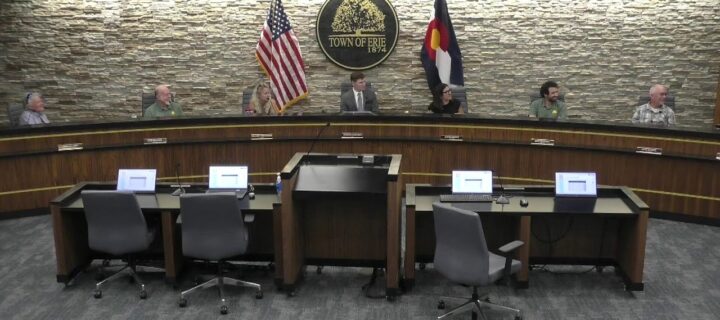

This letter was sent to Yellow Scene Magazine and the Erie Town Council. As with all Letters to the Editor, the views expressed are solely those of the author and do not necessarily reflect those of the publication. We value providing space for community voices.
Recommendation for July 15 Planning Commission Discussion
Establishing the Commission’s Frame for the Joint Study Session
Recommendation. The Planning Commission should use its July 15 preparation discussion to establish its own good-governance framework for the joint session with Town Council.
The Commission should participate fully in the proposed discussions of Proposition 123, the Comprehensive Plan amendment, the Planning and Development work plan, and Commission responsibilities. It should not, however, enter the joint session merely as a respondent to initiatives and assumptions already selected by others.
The Commission’s responsibility is to provide independent, evidence-based advice about Erie’s long-term land-use decisions. The joint session should therefore begin with the following principle:
Our responsibility is not to defend the 2024 Comprehensive Plan or to overturn it. It is to establish, in a record the public can follow, where the Plan reflects residents’ priorities, where it does not, and which proposed corrections will actually improve Erie’s long-term well-being.
1. Establish the purpose of the joint session
The Commission should ask Council to clarify the intended outcome:
- Is Council requesting implementation of the adopted Comprehensive Plan?
- Is it requesting clarification of particular policies?
- Is it considering a substantive change in adopted goals?
- Is it asking the Commission to help diagnose whether the Plan or its implementation departed from public intent?
- What decisions or recommendations will be expected from the Commission afterward?
The session should not assume that “realignment,” “restoring the base vision,” or correcting a mistranslation is already necessary. Those are legitimate possibilities, but they should remain conclusions to be tested.
A suitable opening agreement would be:
Previous statements by commissioners, councilmembers, staff, consultants, or members of the public concerning mistranslation, realignment, staff control, infrastructure failure, density, or small-town character will be treated as hypotheses to be evaluated against the public record, current conditions, and the consequences of available alternatives.
No participant would be asked to withdraw a concern. All participants would agree to let their concerns be tested by the same standard.
2. Request a Comprehensive Plan Perception-and-Performance Assessment
Before major amendments or UDC changes described as “realignment” proceed, the Commission should request a documented assessment comparing:
- What residents said during development of the 2024 Comprehensive Plan.
- How that input was translated into goals, maps, policies, and implementation actions.
- What Council expressly directed and ultimately adopted.
- What has and has not been implemented since adoption.
- What the August 2025 survey shows about resident preferences and experiences.
- What the survey cannot establish about causation or institutional responsibility.
- Current transportation, safety, water, fiscal, housing, and infrastructure conditions.
- Assumptions that have materially changed since October 2024.
- The effects and tradeoffs of retaining, modifying, or reversing existing policies.
The purpose would not be to delay every ordinary planning activity. It would be to prevent major policy reversals from being based on an untested diagnosis.
3. Define “small-town character” in measurable terms
The Commission should ask Council which components of small-town character it wants public policy to preserve.
- neighborliness and community identity;
- responsive and accessible government;
- neighborhood scale and building transitions;
- parks, trails, open land, and nearby nature;
- local businesses and a viable town center;
- manageable and reliable travel;
- safe streets for children and older residents;
- infrastructure readiness;
- fiscal stability;
- housing choices that allow different generations to remain in Erie.
These values should be respected, but their conflicts should also be acknowledged. For example, preserving open land may require concentrating some growth, while supporting local businesses may require nearby customers. Safe, quiet streets may sometimes conflict with maximizing vehicle speed and throughput.
The joint session should ask:
What observable conditions would show five years from now that Erie successfully preserved its small-town character?
4. Apply clear tests to the proposed Comprehensive Plan amendment
Before discussing whether the new residential categories or Future Land Use Map changes are desirable, the Commission should request:
- the exact 2024 Plan provisions being changed;
- the parcels or areas affected;
- the documented reason for each change;
- whether each change implements, clarifies, or reverses the adopted Plan;
- the public input supporting it;
- transportation, water, infrastructure, fiscal, housing, and open-space effects;
- alternatives considered;
- the measurable outcome expected from the amendment.
A side-by-side comparison of density categories is useful background, but it does not establish why a change is needed or what consequences it will produce.
5. Define “infrastructure before growth”
The Commission should ask Council and staff to convert this general principle into system-specific standards.
For each system – water, wastewater, transportation, emergency response, parks, schools, and other public facilities – the Town should distinguish:
- existing capacity;
- funded capacity;
- planned but unfunded capacity;
- developer-provided improvements;
- regional or outside-agency responsibilities;
- current deficiencies;
- projected deficiencies;
- perceptions that still require measurement.
The Commission should ask what event must occur before development may proceed: construction, funding, an executed agreement, demonstrated capacity, or completion of a particular improvement.
Without those definitions, “infrastructure first” may express a widely shared value but remain too indefinite to guide consistent decisions.
6. Evaluate Proposition 123 fast-track review through objective standards
The Commission should ask:
- What does “fast track” change in practice?
- Which review stages would be shortened and which substantive standards would remain unchanged?
- What legal or funding consequences follow from participation or nonparticipation?
- Which projects qualify?
- What level and duration of affordability is required?
- What infrastructure, design, fiscal, and public-notice standards continue to apply?
- How will processing speed, affordability production, project quality, and public participation be measured?
- What provisions should be reconsidered if the process does not produce the intended result?
The discussion should distinguish speeding administrative review from weakening substantive standards. A faster process can be appropriate where expectations are known, objective, and applied consistently.
7. Sequence the Planning and Development work plan
The Commission should ask Council to identify dependencies among:
- Comprehensive Plan amendments;
- growth-management planning;
- the UDC update;
- the Town Center PD update;
- Old Town visioning;
- the ADU incentive program;
- affordable-housing procedures;
- short-term-rental regulations.
The policy diagnosis should ordinarily precede the regulatory remedy. The Town should avoid completing a UDC “alignment” project before establishing precisely what adopted policy is being implemented or changed.
For each work-plan project, the joint session should identify:
- the problem statement;
- its authority and relationship to the Comprehensive Plan;
- the intended decision maker;
- required evidence;
- public-engagement points;
- dependencies on other projects;
- expected completion and performance measures.
8. Discuss Commission authority together with accountability
Any expansion of Planning Commission responsibility should identify:
- the specific decisions involved;
- whether the role is advisory or final;
- the standards the Commission would apply;
- public-notice and hearing requirements;
- appeal or Council-review procedures;
- training and staff support;
- treatment of ex parte communications;
- effects on elected accountability and administrative efficiency.
The objective should not be greater authority for its own sake. It should be placing each decision with the body best positioned to develop a complete record, apply adopted policy consistently, obtain public input, and remain accountable for the result.
The Commission should also request a meaningful role in setting the questions and evidence for matters on which Council later expects its advice.
9. Agree on concrete joint-session deliverables
The Commission should seek agreement with Council on the following outputs:
- An engagement-to-policy decision trace.
- A full interpretation of the August 2025 survey, including methodology, open-response coding, and available cross-tabs.
- A perception-to-evidence matrix for major resident concerns.
- A Comprehensive Plan implementation report.
- A register of assumptions that changed after adoption.
- A coordinated fiscal, water, transportation, safety, housing, and infrastructure assessment.
- A list of conflicts among adopted goals requiring elected policy choices.
- Clearly identified targeted amendment options.
- A public annual performance dashboard.
- A plain-language explanation of what was found and who is responsible for each future decision.
Recommended Commission consensus on July 15
Because the preparation item is brief, the Commission should at minimum reach consensus on three points:
- The Commission will enter the joint session with its own independent advisory frame.
- Prior interpretations of public intent and current conditions will be treated as testable hypotheses.
- The Commission will ask Council to authorize a traceable perception-and-performancecassessment before major “realignment” changes are treated as established policy direction.
This approach does not presume that the 2024 Comprehensive Plan was correct. It also does not presume that it was distorted. It gives Council, the Commission, staff, and residents a fair process for determining what occurred, what conditions now require attention, and which remedies are most likely to work.
Matthew Logan