



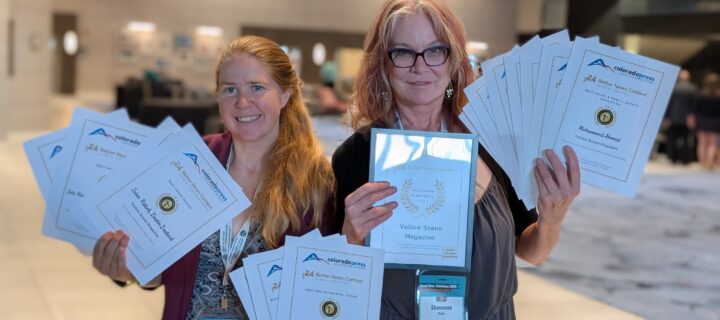

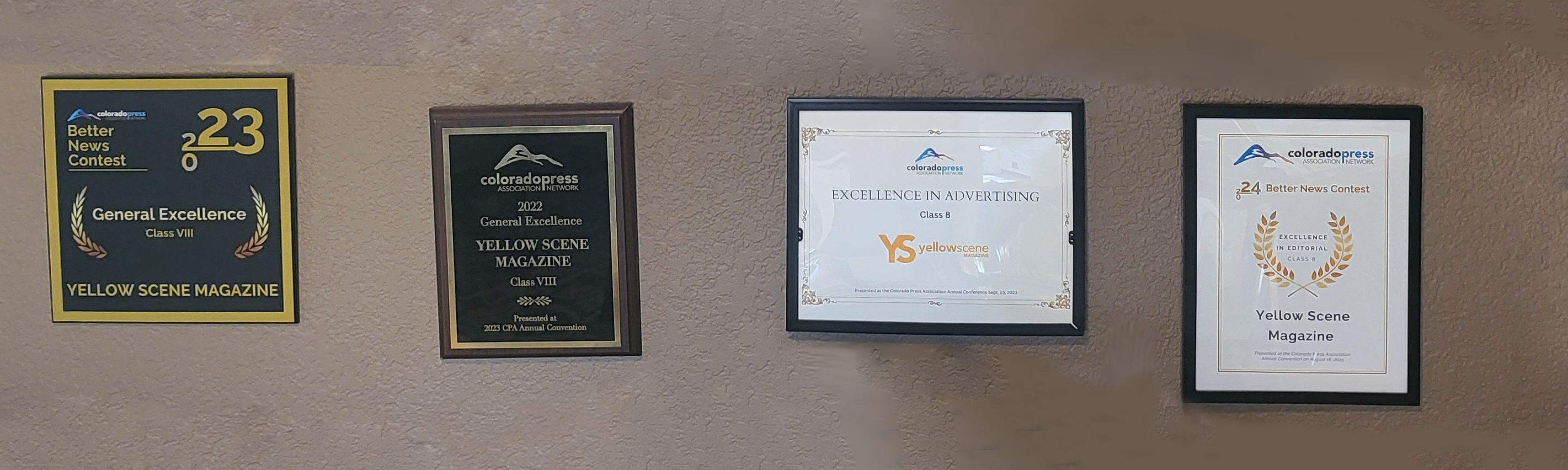
This weekend, Yellow Scene Magazine was honored with 18 awards for excellence in reporting and design at the Colorado Press Association’s annual Better News contest. We also brought home a 19th award for Overall Excellence in Editorial in our class. Nine of those were first-place and nine were second-place. These prizes bring our total awards from various media organizations to 209 since our founding.
It’s always an honor to be recognized by fellow journalists; Wisconsin newsrooms did this year’s judging, and the awards feel good. But, on the same weekend we celebrated, we were also confronted with some hard truths.
Boards vs Bucks
At the convention, funders made it clear: the odds of Yellow Scene receiving operational grants from large donors are slim to none. The reasons?
- Boulder County’s perception. We’re seen as too wealthy, not a news desert. (Never mind that we’re the last independently owned news platform serving the county.)
- Ad sales success. We sell advertising, which makes us look “too successful” for help. In reality, we do a lot with a little.
- We’re A “Political Project.” That’s the label leveraged against us. Grants are typically from large donors who favor outlets that stay as apolitical as possible, which often means just reporting what happened without asking why or showing how it impacts the community. However, that’s exactly the part of journalism we refuse to abandon.
At the convention, I listened to industry veterans speak passionately about journalism’s legacy; about holding truth to power, never giving up, always asking why. It was inspiring, and it reminded me why I chose this work. Yet it also left me asking: How meaningful is our role if we remain neutral about harm? I was taught that journalism asks: Who has the power, and who is causing the harm? At its best, journalism doesn’t just tell you what happened, it also helps you understand why it matters, who holds the power, and who bears the cost.
This is why some platforms focus more on reporting what happened. Asking why and exposing impact is costly. It’s true that many outlets in smaller communities are struggling even harder than we are, but that doesn’t mean we’re rolling in dough either. Over the past three years, we’ve applied for grants repeatedly. Except for the support we’ve gratefully received from AAN, which champions narrative and community journalism, and LION, which helps independent publishers build sustainable businesses, we’ve not made it into the final round. That confirmed what I’d been telling my staff: our future depends more on sustaining supporters than on foundations.
There are some wonderful nonprofit news outlets doing good reporting. Several are even doing hard-hitting investigative journalism. However, what was reiterated at the convention was an expectation for news to focus on appearing as apolitical as possible, which is concerning to me. We witnessed how NPR was treading cautiously in how it reported after Trump was reelected. Now the Corporation for Public Broadcasting has been targeted for defunding by the current administration, a reminder that public media can be impacted by which administration is in power or by big donors, both of which can change rapidly, as we are witnessing. Meanwhile, major outlets have faced firings and lawsuits filed by Trump.
As I see some of the new nonprofits form, the reporting often consists of feeds of city council meetings, court updates, and police reports, which is important work, but often stops there. That approach may feel safer for large donors.
Nonprofits also cannot endorse candidates in elections, which means one of the most traditional functions of media, helping voters evaluate their choices through the lens of an editorial board, is restricted. I don’t want to just read politician-speak in an election guide; there’s plenty of advertising doing that already. Yellow Scene has won several awards for our Election Guide. We require a phone or virtual interview (no email interviews), and we absolutely provide our Editorial Board’s endorsements. This is a major reason I do not want to become a nonprofit.
American journalism has always wrestled with questions of influence. Once it was advertisers, today it’s increasingly philanthropic donors. I can’t help but wonder if this wave of nonprofit funding, however well-intentioned, creates new levers of control over what gets reported, or what doesn’t. Project 2025 and other political agendas remind us how dangerous it can be if independent reporting is slowly pushed into narrower lanes.
This is why local journalism, supported by sustaining donors, fundraising, and advertising, can often remain more independent than larger outlets impacted by which administration is in power or the foundations providing funding.
That’s why we chose a fiscal sponsor instead. Your donations are still tax-deductible, but without a Board or large donors shaping our direction, we remain fully independent.
Advertising Alone Isn’t Enough to Fund the Newsroom
Some argued at the convention that advertising no longer works as a model. I disagree. Local businesses still need local platforms more than ever; social media isn’t enough. We are beyond grateful to the many local businesses that value our audience reach and continue to advertise locally. Moreover, a growing number of businesses that were once local are now becoming corporate-owned, so small businesses in a variety of industries are now facing the same challenges of corporatization that we do. That’s why supporting local mom and pop shops matters more than ever. (A commitment to shopping locally is also the most powerful message you can send.)
Yellow Scene maintains advertiser independence with a straightforward policy: we reject all sponsored content. If we wanted to churn out sponsored content or AI-written stories, it would be cheaper and easier, but we won’t. For 25 years, our readers have trusted what they find in Yellow Scene. Today, we remain the only platform in Boulder County that refuses both.
 A Fundraiser for the Work Ahead
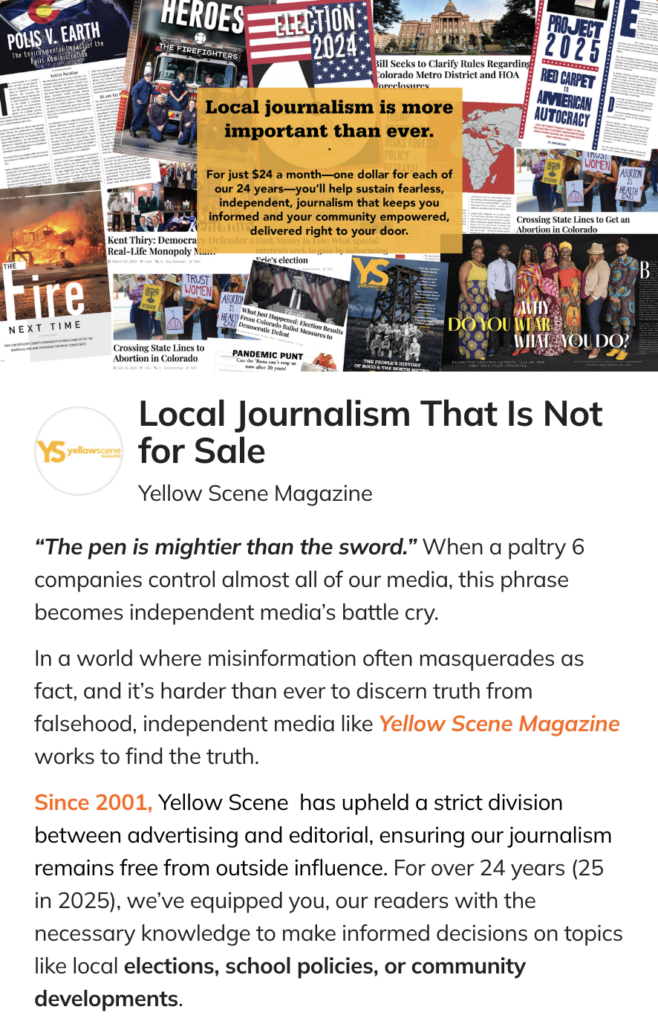
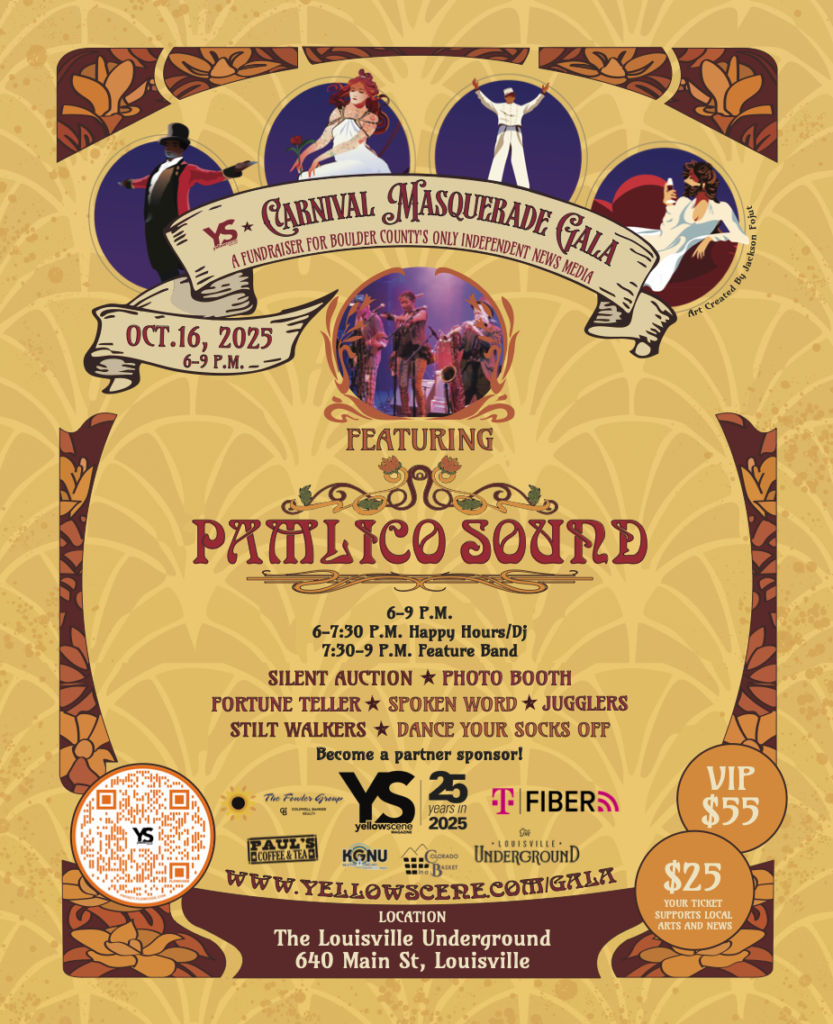
Our annual Carnivale Gala is coming up, there are only 150 available tickets, priced at $25 and $55. It’s our biggest fundraiser of the year, but it’s not the only way to support Yellow Scene. Whether or not you can attend, a $8 monthly donation makes a lasting difference in sustaining award-winning journalism that asks why, holds power to account, and sheds light on those causing harm. We will never put up a paywall. Informed communities make stronger communities, and free access to information is essential.
Tickets & Support: fundrazr.com/YSGala2025.
Currently, we have one of the strongest teams in years, comprising two brilliant associate editors, loyal designers, and an army of freelancers who truly care. Still, everyone except one staffer is part-time or contract. We are fundraising both to fill those gaps and to provide unique, hard-hitting journalism. Currently, we are supporting our Emmy-nominated journalist, Vincent Chandler, as he zigzags across the country for his series These American Crossroads, documenting resistance in Trump country. What we’ve learned is that we’re not alone—that no act of resilience is too small, that it matters to go where big media won’t. That’s the work we do every day locally, and it takes real resources to make it happen.
How does independent, local media stay afloat then?
Since launching the Sustaining Supporter program two years ago, we’ve been figuring it out as we go. It was new for us. For 25 years, Yellow Scene has been free, because while democracy may die in the dark, it does no good behind a paywall. We believe in informed communities, and that means keeping our reporting accessible to everyone. For a long time, advertising alone covered both free distribution and the newsroom. But today, our choices are:
- Become a different kind of newsroom to qualify for grants.
- Accept sponsored content (paid articles).
- Do less.
- Turn to readers for community-driven support. It’s still tax-deductible.
The first three would mean changing who we are, to our community, and to ourselves. The fourth is the path forward. While we plan to eventually replace free home delivery with copies mailed to sustaining supporters, today we still mail a large share of our distribution free of charge. Since we can’t reach every home, we rotate routes every few months, hoping readers who’ve grown used to receiving us will choose to keep us coming by becoming sustaining supporters.
Yes, Yellow Scene is successful under the circumstances. But ad sales don’t always cover the costs of paying staff on time, keeping the presses running, maintaining the website, and paying the mortgage. For the curious, I pay myself a modest salary, and in lean times I’ve even relied on personal loans to bridge gaps. That’s the reality of running an independent newsroom.
But here’s the bigger truth: things are better than they were three years ago. We’ve weathered the blows of digital disruption, corporatization, and the pandemic, which were challenges that have gutted journalism and shuttered thousands of newsroom doors. Being in this business has never been easy, but we’re still here, and we’re moving forward. In spite of the unsteadiness of the world, we’re investing in a thriving tomorrow. Reaching 25 years feels lucky, but it wasn’t just luck. It came from the dedication of our team and the trust of our readers and was built on three principles: exceptional content, design, and distribution.
On Neutrality
We’ve been told nonprofit news must appear apolitical. Fine, but we’re facing a corporate-fueled assault on our democracy, and we’re expected to treat it like business as usual? Racism and police shootings of Black men still happen disproportionately, and we’re supposed to just report another death without asking why? ICE is creating detention camps and snatching people off the street, and we’re expected to avoid calling it unjust?
Truth-telling comes with real sacrifices, and I’m willing to make them. But I will never compromise our journalism standards. Yellow Scene is bold and brave, even if we don’t fit the models large donors tend to favor. We won’t water down our reporting, we won’t accept sponsored content, and we won’t replace journalists with AI.
Now, Onto Those Awards
Huge congratulations to our team for producing these important stories despite the challenges. What makes these honors meaningful is not just the recognition itself, but the impact these stories have had on our community. This year’s awards reflect excellence in both editorial and design—made possible by the dedication of the YS team.
Editorial
- Best Arts & Entertainment Column Writing (2nd Place): Red Shadows Brings MMIR “Artivism” to Lafayette — Rona Goody
- Best Breaking News/Deadline Reporting (1st Place): Colorado’s Reproductive Rights Revolution — Ray Manzari
- Best Breaking News/Deadline Reporting (2nd Place): Aurora Apartments Make National Headlines: Landlords Blame Migrant Gangs for Public Safety Concerns — Ray Manzari
- Best Crime & Public Safety Reporting (1st Place): Blue Immunity: Holding Law Enforcement Accountable — Mohammed Ahmad
- Best Data Journalism Reporting (1st Place): Is Remote Work Dying Out? — Mary-Beth Skylis
- Best Environmental Story (1st Place): The Colorado River Water Emergency — Doug Geiling
- Best Feature Story (2nd Place): Boulder Housing Coalition Brings Back Parts of the ‘Old Boulder’ with Communal Living — Katie Mackinnon
- Best Health Enterprise/Health Feature Story (2nd Place): The Role of Spirituality in Substance Use Disorder Treatment — Lexi Miller
- Best News Story (1st Place): A Nation in Flux: Local Elections, National Debates, and a Polarized Future — Mohammed Ahmad
- Best Opinion Writing (1st Place): Uncomfortable Truth — Steve Nelson
- Best Opinion Writing (2nd Place): Trump as Jesus — Steve Nelson
- Best Politics Reporting (2nd Place): A Local Erie Ruling May Indicate a Statewide Shift Away From Fossil Fuels — Katie McHinnon
- Best Public Service Project (1st Place): 2024 Election Guide — Zoe Jennings, Austin Clinkenbeard, Lexi Miller
- Best Series or Sustained Coverage (2nd Place): Reporting on Draco Fossil Fuel Development in Erie, CO — Natalie Kerr
- Best Social Justice or Equity Reporting (2nd Place): The Black Cowboys of Colorado — Doug Geiling
Photo & Design
- Best Cover Design (1st Place): March 2024 SuperKids Issue: Best of BOCO — Irina Ratsek, Dustin Doskocil
- Best Cover Design (2nd Place): November Issue — Irina Ratsek, Dustin Doskocil
College
- Best News Story (1st Place): “Rocky Horror” in 2024: Can it Still be Relevant for a New Generation? – Julie Rivers, Morgan Taylor, Owen Houtakker
The Answer Is Community
I believe in the journalism we do because everywhere I go, I hear from people who are grateful we exist—people whose lives were impacted by stories others wouldn’t tell. I feel confident asking local businesses to advertise because I know we have an engaged audience that wants to read what we publish. That’s what keeps us going.
The answer to many of the world’s challenges is community. You need us, and we need you.
Gala Tickets & Sustainer Support: fundrazr.com/YSGala2025