




Update: This article was updated to clarify that the Seven Principles of Kwanzaa (Nguzo Saba) are expressed in Swahili, a pan-African language.
This year was my first Christmas alone. My son and sister live overseas, and I ended a long relationship in July 2024. Over the past year and a half, I’ve been giving myself space to process that grief, and for the most part, I’ve been okay being alone. But nothing sharpens that awareness quite like the holidays.
Rather than staying home through them, I asked my friends in Denver if it would be appropriate for me to attend the opening celebration of Kwanzaa. The answer was immediate and clear: of course.
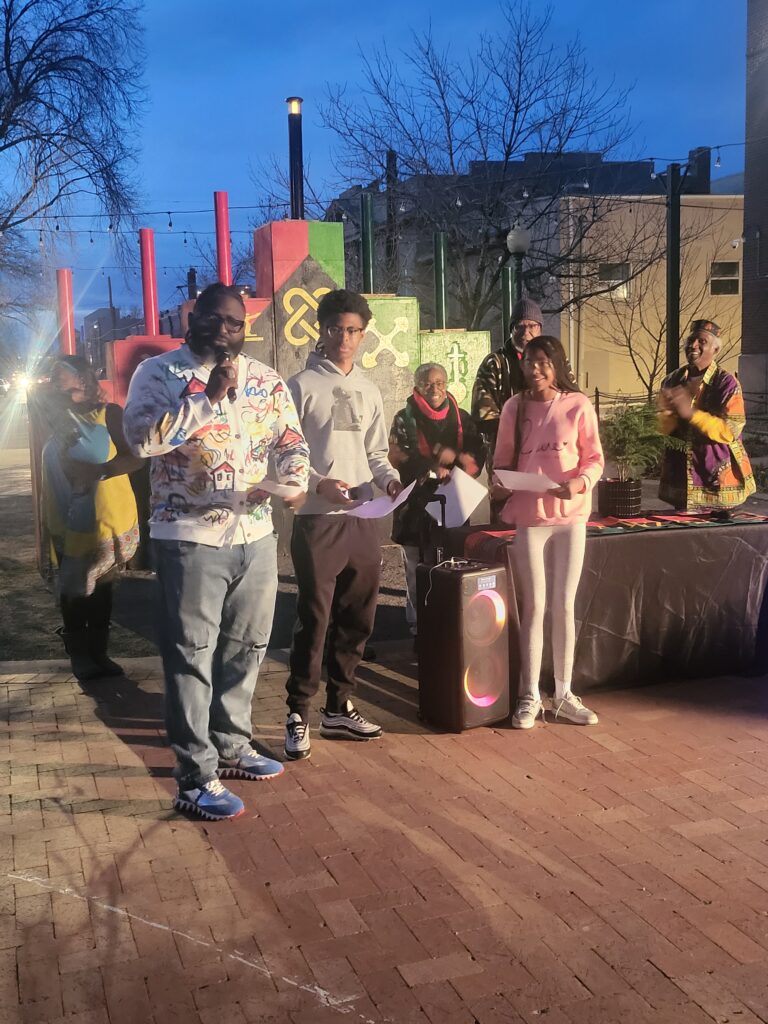
We recognize that we are on the traditional and ancestral lands of the Arapaho, Cheyenne, Ute, Apache, Comanche, Kiowa, and Lakota peoples. We honor the Indigenous communities who have lived on, cared for, and stewarded this land for generations, acknowledge the histories of displacement and broken treaties, and recognize the ongoing presence and contributions of Indigenous peoples today. Photo Credit: Shavonne Blades
I drove down from Erie to Denver and joined the lighting of the 12-foot kinara at the Grande Kinara gathering in Five Points, where the candle of Umoja was lit. Cha’Rel CJ Ji’Cole sang the Black National Anthem, Lift Every Voice and Sing, and Ryan E. Ross (Urban Leadership Foundation of Colorado), delivered the Land Acknowledgement. Libations were offered as part of the ceremony, poured intentionally into a living plant in honor of ancestors and the responsibility carried forward.
From there, we headed to the Cleo Parker Robinson Dance School, where the celebration continued.
As people milled about in the lobby, I was greeted by MiDian Z. Shofner, of the Epitome of Black Excellence and Partnership. She asked what had brought me to Kwanzaa. My first reaction was surprise. Me? You want to hear from me? She did. And when I thought about it, the answer was simple. I was there because I had found myself part of a community I’d grown close to, rooted in relationships, trust, and shared presence, and because I wanted to learn about Kwanzaa.
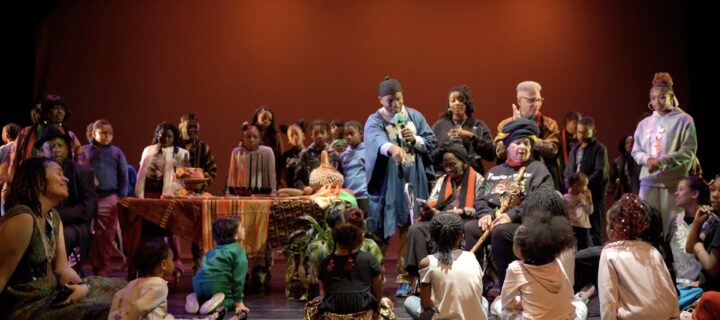
Inside the theater, the room was full. Traditional drumming and dance filled the space, and the energy was unmistakable. The Black National Anthem opened for a second time, this time led by Chrissy Grant of Spirit of Grace, and the audience rose together, standing shoulder to shoulder and singing in unison. Elders, adults, and children stood side by side, not as spectators, but as participants in something collectively held.
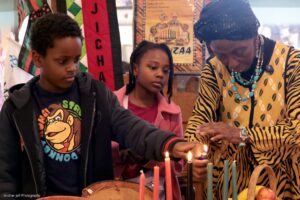
Lighting the Kinara. Photo Credit: Jeff Fard
Children were centered throughout the evening. They moved easily among elders and adults, watching closely and joining in as the evening unfolded. The dances that followed carried both joy and discipline, rhythm and intention. Drumming and movement spoke to one another as a shared language, and elders were honored as living teachers whose presence anchored the room.
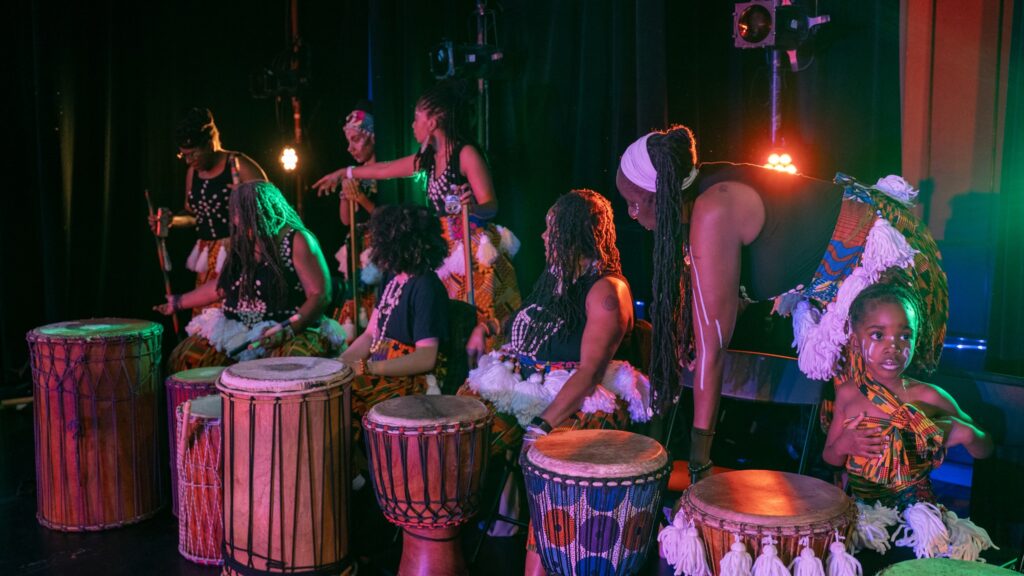
Djembe drummers. Photo Credit: Jeff Fard
I felt grateful to be welcomed into a space where I could learn about the meaning of Kwanzaa, and I’m very glad I made the drive down to be part of it.
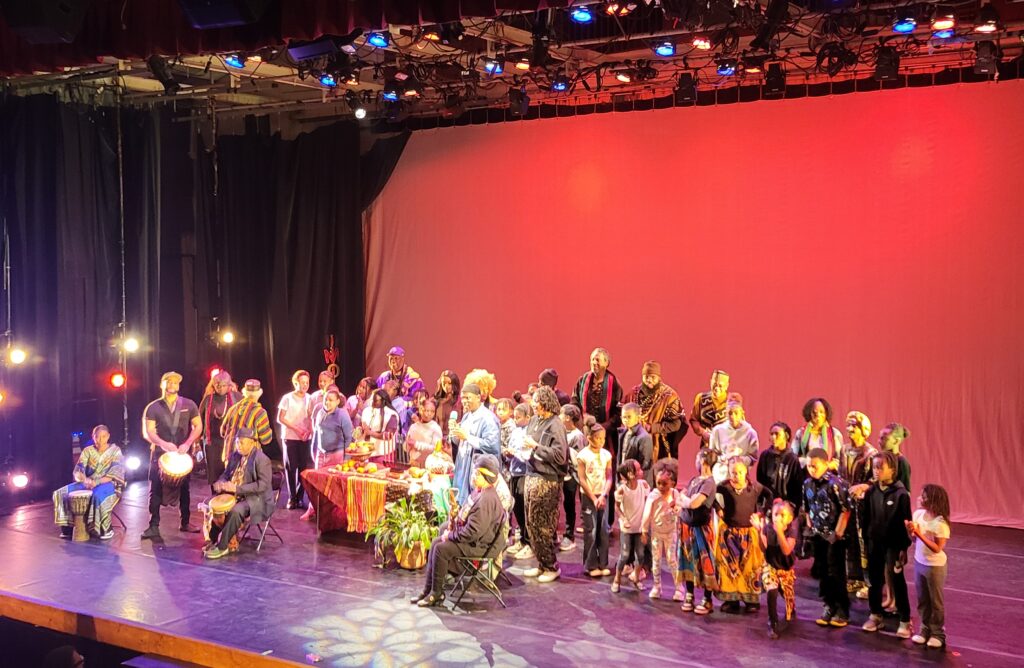
Closing celebration. Photo Credit: Shavonne Blades
I’ve been familiar with Kwanzaa in the past, but only in a limited way. I didn’t know all the words, and I didn’t have the seven principles memorized. But I am learning. During the evening, one gentleman remarked that if everyone practiced these principles more widely, the world might look very different.
One of the people whose teachings helped ground that learning is Jeff Fard, known as brother jeff, a longtime Denver cultural educator and community voice. I saw his post about opening night, and then a comment beneath it that immediately got under my skin. It dismissed Kwanzaa as illegitimate, reduced it to its founder, and framed it as something suspicious rather than cultural.
I responded publicly, pointing out that if we invalidate cultural traditions based on the flaws or violence of people tied to their origins, many mainstream holidays would not survive the same scrutiny. Columbus Day centers a man responsible for enslavement and mass violence. Valentine’s Day and Father’s Day were shaped through deeply patriarchal institutions. Even Christmas, as it is commonly practiced, carries the legacy of imperial Christianity and conquest. Yet those traditions are rarely dismissed outright. Black cultural expression is treated differently.
As I paid more attention, I began seeing the exact same language appear verbatim under other public posts about Kwanzaa. It was an unfortunate, familiar ecosystem of right-wing Christian nationalism and online harassment.
Not long after, I saw brother jeff post a reminder not to argue with people who are not interested in understanding. Instead of engaging the backlash, I chose to listen more closely.
During Kwanzaa, brother jeff shared a seven-day lecture series, one for each principle. One in particular, Day 4, which centers on Ujamaa, stayed with me.
In that lecture, Jeff talks about money not as an abstract system, but as a tool. He explains how our current economic system is built around scarcity, the idea that there is never enough, that competition is inevitable, and that accumulation by a few is the end result. Ujamaa offers a different framework, one rooted in the belief that there is enough for everyone when resources are shared, circulated, and cared for collectively.
Cooperative economics, in this context, is about how money moves, who controls it, and whether it serves community stability or constant extraction. Jeff places this within a long history of systems designed to drain labor, land, and wealth from Black communities, while also noting that a scarcity-based economy ultimately distorts relationships for everyone. It teaches people to see one another as competitors instead of collaborators and separates them from the value of their own labor and land.
Ujamaa challenges that logic. It asks what becomes possible when communities invest in one another rather than in systems that profit from disconnection. It reframes money as a means of sustaining life, not measuring worth.
Jeff also addresses a common misconception that Kwanzaa exists to pull people away from Christianity. In practice, Kwanzaa is secular and observed by people across many faith traditions, including Christians. It is often celebrated alongside Christmas, not in opposition to it. What it insists on is cultural self-definition, the right to name values, priorities, and futures outside systems that were never neutral to begin with.
If you’re like me and know very little about Kwanzaa, brother jeff, and MiDian Z. Shofner have shared photos, videos, and reflections on each of the seven days. Their posts offer context, history, and lived meaning, and provide a deeper understanding of how Kwanzaa is practiced and carried forward in community.
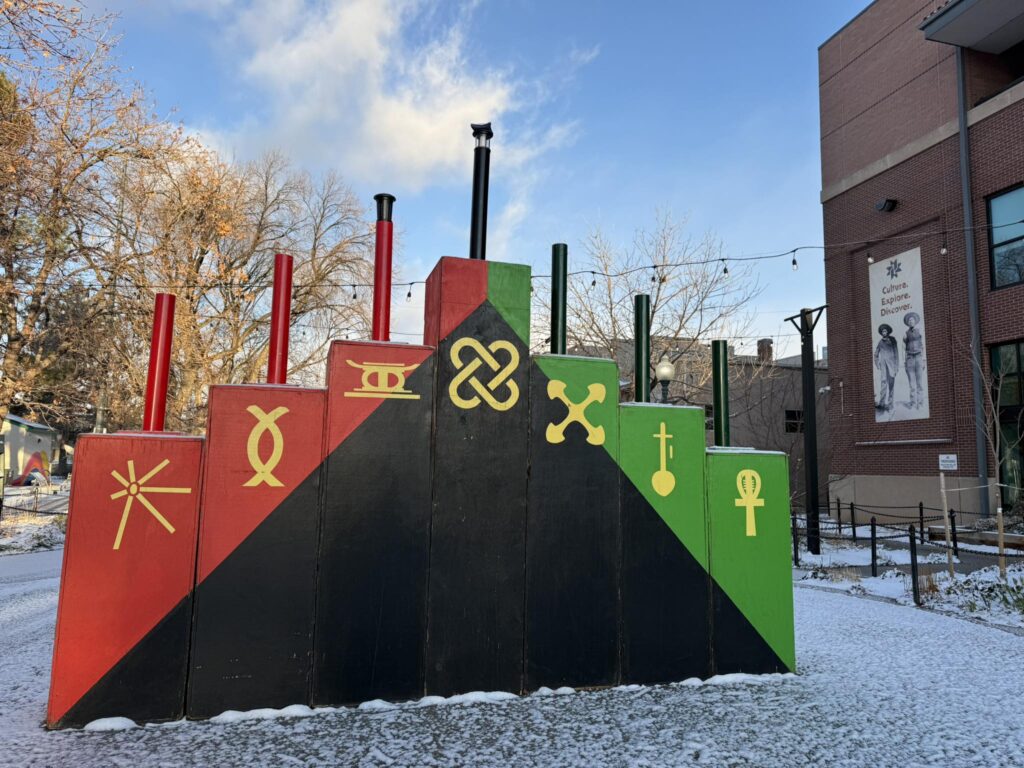
Grande Kinara, Five Points. Photo Credit: Jeff Fard
What are the Seven Days of Kwanzaa and what do the words mean?
Kwanzaa is observed over seven days, from December 26 through January 1. Each day centers on one of the Nguzo Saba, or Seven Principles. The principles are expressed in Swahili, a pan-African language spoken across East and Central Africa. It was chosen by Maulana Karenga to emphasize a shared African identity rather than a single ethnic group. Swahili was also widely used in African liberation and cultural movements during the 1960s, when Kwanzaa was created.
Umoja (Unity) emphasizes togetherness within family and community.
Kujichagulia (Self-Determination) focuses on defining oneself and shaping one’s future.
Ujima (Collective Work and Responsibility) calls for shared problem-solving and mutual care.
Ujamaa (Cooperative Economics) centers on shared ownership and circulation of resources.
Nia (Purpose) asks participants to consider their role in building and restoring community.
Kuumba (Creativity) encourages expression that leaves communities more whole than we found them.
Imani (Faith) speaks to belief in people, in struggle, and in the possibility of justice and dignity.
Taken together, the seven days ask not just what we believe, but how we live those beliefs. Not only during Kwanzaa, but in the ordinary choices we make about community, care, and responsibility, knowing we all share the same origin.