




Correction (5/13): A previous version of this article incorrectly referenced Rachel Friend in connection with Laura Gonzales; that reference has been removed.
A Boulder resident is being targeted with criminal charges for protesting Israel and their occupation of Gaza. Her attorneys argue the prosecution is a direct violation of her right to free speech.
A Boulder resident since 2011, Laura Gonzalez has spent the last three years as a prominent advocate for Palestine at city council meetings. Her activism is rooted in a complex personal history: she is the youngest of ten children, the first American born to undocumented immigrants, and the child of a survivor of the Guatemalan genocide. Gonzalez, who is Indigenous with Mayan ancestry, views her vocalism as a direct resistance to the erasure of marginalized people.
“Silence is erasure,” Gonzalez said. “We have 500 years of white-washed history in the United States and I don’t want that to happen to Palestine.”
Gonzalez now faces multiple legal hurdles, including a felony charge following an incident with council member Matt Benjamin. Police arrested her at her home the day after that encounter. She also faces a misdemeanor and a separate accusation of graffiti.
Represented by attorneys Cameron Bedard and Andy McNulty, Gonzalez noted that rules of decorum changed quickly before she was hit with charges like “harassment of a public official.” She maintains the legal action is targeted. “I’m being used as a scapegoat,” Gonzalez stated. “But this is all about Palestine.”
Gonzalez was referencing Boulder’s $35 million dollar portfolio holdings in corporations profiting from Israeli military occupation. Boulder’s portfolio includes Microsoft, which has supported the Israeli military and settlement’s technological needs, and Caterpillar, which supplied bulldozers used in Israel’s ground invasion of Gaza that allegedly buried wounded civilians alive.
“Boulder is more focused on investments and corporations than it used to be,” Gonzalez emphasized.
Cameron Bedard, Gonzalez’ defense attorney, also expressed disappointment in Boulder’s shifting priorities. “This fits a growing trend nationally using the legal system to discourage activism,” Bedard remarked. “Boulder is a seemingly progressive bastion, but when over a hundred other progressive cities like Atlanta, San Francisco, and Detroit passed a symbolic ceasefire, Boulder refused to do so.”
Gonzalez, among other Boulderites, publicly protested the council’s decision, and for three instances of protest she is facing legal retaliation. Andy McNulty is Gonzalez’ civil rights attorney for a charge of “graffiti” for writing “Boulder City Council invests $30m/yr in genocide and ecocide in Palestine” in washable chalk on Pearl Street Mall. McNulty explained, “Freedom of speech violations are broad, but 1st Amendment violations are much narrower [to claim]”
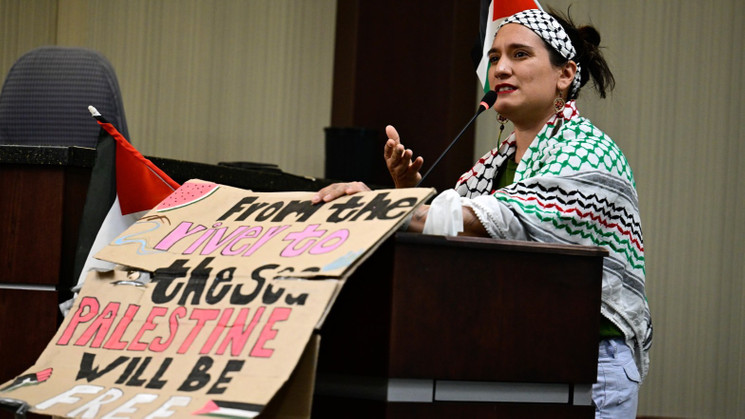
In a direct response to pro-Palestinian’s protests and increased intensity at city council meetings following the June 1st Pearl Street attack targeting Jewish community members, rules for public comment changed: the time for each speaker was reduced from three minutes to two, the visual component of recording speakers was removed, and a randomization system to pick 20 speakers from the public comment list was put in place. Removing visual components from speakers made it so protestors couldn’t use signs to convey their messages, or fly Palestinian flags, as noted by Gonzalez.
The randomization system does not have a transparency statement on the city of Boulder’s website, but the city clerk did provide details on the process upon request, including the use of Formstack and Excel’s randomization formula. City Clerk Elesha Johnson said, “The data is sorted after community members that were selected to speak at the last meeting are removed in accordance with our Council Rules of Procedures that prohibits speakers to be selected for 2 consecutive meetings.”
McNulty, responding to the changes made to public comment, stated “There are no First Amendment violations in changing the rules of public comment. There is no First Amendment reason that city councils have to have a public comment portion at all.” Places like Weld County have removed public comment from their board meetings altogether. He continued, “But what is a first amendment violation: that Laura is banned for a year from city council meetings for speaking out against Israel. That is viewpoint discrimination.”
One of the incidents for which Gonzalez faces charges, she asked a council member over a megaphone whether “the hundreds of thousands of children that are dead because of your money” mattered. This amongst other pointed questions were cited as “true threats” or “fighting words”, and begs the question of what the line is between dissent and harassment.
Gonzalez responded to claims of harassment from elected officials, saying “The difference between [the council member’s fear] and my anger is that my anger comes from pain and trauma, and their fear comes from the fear that [pro-Palestinians and Indigenous] are going to do to them what their ancestors did to us, which is not true. All we want is freedom.”
While free speech is being threatened nationwide, Gonzalez’s lawyer Cameron Bedard supports her and others’ right to be politically outspoken, stating, “This is a righteous case. A state institution prosecuting apparatus targeting a person for voicing their concerns and speaking out against genocide is wrong.” He continued, “I don’t care which side of the equation you’re on – if you are pro Zionism or anti-Zionism. The First amendment doesn’t care.”
As Boulder leaders and residents navigate the legal and social fallout of these cases, the focus remains on the intersection of municipal law and constitutional rights. Gonzalez and her legal team argue that the prosecution serves as an attempt to silence opposition to the city’s financial and political ties to the conflict in Gaza. They contend that the outcome of her case carries implications for all Boulder citizens, regardless of their political stance on international issues.
“They don’t have to like me, or my tone, or my opinions,” Gonzalez said. “I’m still fighting for their rights [to free speech] and if they don’t fight with me and I go down, they’re going to go down too.”
While the city maintains that the charges are a matter of public decorum and safety, the defense insists the criminalization of these protests sets a dangerous precedent. The proceedings continue to draw attention to the boundaries of protected speech within local government chambers.
Like journalism like this? Consider becoming a sustaining supporter — and get our print edition delivered to your home each month.
Democracy needs journalism more than ever. For 25 years, we’ve told the truth — your support helps us keep doing it for the next four and beyond. Administrations come and go. Our team stays ready to lead, no matter who’s in charge.