



Following Erie citizens’ approval of home rule in 2023, supporters argued that moving to the new system would empower Erie with better decision-making ability as the town continued to grow rapidly. However, less than two years after this historic vote, Erie continues to make crucial decisions in which the town’s future increasingly becomes defined by a stable four-member coalition on the Town Council that has consistently banded together on several of Erie’s major controversies.
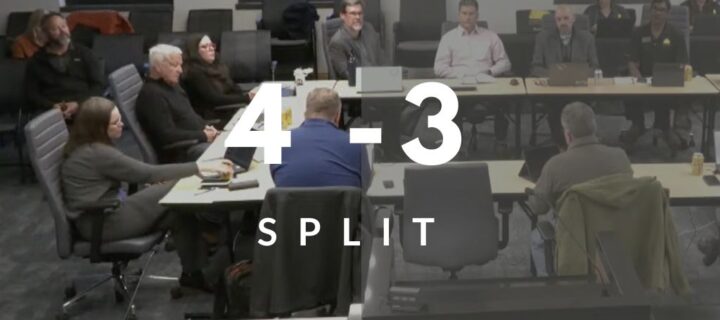
These voting patterns have been observed on multiple occasions. Mayor Moore, Mayor Pro Tem Bell, and Town Council Members O’Connor and Mortellaro vote in favor; Town Council Members Pesaramelli, Baer and Hoback vote against the motions. During debates over Pride Flag policy, community grant programs, urban renewal financing, marijuana regulations, board reconfiguration, sustainability plans, annexation agreements, and redevelopment tools, the pattern is consistent.

Not all council decisions pit the two factions against each other, especially on issues related to the town’s physical development. Erie’s council has routinely agreed on road construction, water utility infrastructure upgrades, flood management initiatives, policing services, and even some development applications. It is primarily on issues relating to governance, civic identity, administrative structure and financing initiatives that these opposing factions tend to form.
Erie’s post-home-rule Town Council is clearly showing two sides when it comes to the future of the fast-growing town. The four-member majority seems to support policies that facilitate institutional expansion, structured governance, and regional cooperation, while a three-member minority consistently opposes these types of initiatives. The disagreements extend beyond headline-making issues like Pride Flag policy and marijuana legalization to other lesser-known policies such as board reconfigurations, grant oversight, metro district management and redevelopment tools.
Erie’s council appears committed to increasing the town’s use of urban renewal authorities, tax increment financing, redevelopment districts, and urban planning agreements as tools for long-term growth planning.
For instance, the council unanimously approved the town’s urban renewal plan for Erie Town Center and related tax increment financing agreements with Boulder County, the St. Vrain Valley School District, the Mountain View Fire Protection District and other entities. The plan officially designated certain areas of Erie Town Center as redevelopment areas and allowed for financing arrangements where any increase in tax revenue can be used for those purposes.
This represents another in a string of initiatives that use urban renewal and tax increment financing as tools to finance infrastructure and redevelopment efforts. The year prior, Erie Town Council had already approved a comparable urban renewal plan and associated tax increment financing mechanism for the Erie Gateway. Supporters believe these are necessary tools for the town to remain competitive with neighboring communities along the Front Range.
However, critics increasingly wonder how much oversight is possible once these complicated financing districts are created.
Some of these debates emerged over annexation and development agreements.
For example, during March 2024, the Town Council approved an annexation and zoning agreement for the controversial multi-family housing project proposed by Thompson Thrift for 111th Street and Arapahoe Road after widespread opposition over concerns about density, flooding, increased traffic congestion, and strained infrastructure systems resulting from rapid growth. Despite the opposition, the council voted to approve the annexation of the parcel.
The vote illustrated the lack of perfect ideological consistency when it came to growth.

Dan Hoback often aligns himself with the council minority on governance and civic-policy disputes but was supportive of this annexation, which shows Erie Town Council doesn’t have exact ideological consistency regarding growth policies and initiatives.
However, in general, what seems more apparent in these voting patterns is that the Town Council is divided regarding governance and civic philosophies rather than over the topic of growth.
Indeed, the recurring majority seems to be united behind one particular vision for the town – one that sees Erie transitioning into a metropolitan-style community.
This vision has appeared throughout multiple discussions involving sustainability planning, transportation coordination and administrative governance reformation.
The council adopted Erie’s Climate and Sustainability Action Plan Agreement in January 2025 and went on to adopt initiatives related to beneficial electrification, air quality agreements, and floating solar energy systems at the Erie water reclamation facilities. The council also unanimously approved a range of agreements related to regional transportation coordination.
These include an RTD inclusion plan, the launch of Erie Flex Ride Transit Service, and Southwest Weld County Transportation Coordination.
On top of all of this, the majority has also repeatedly supported procedural and governance changes within town government.
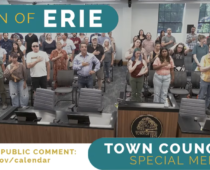
An example of this appeared during the September 2025 special council meeting when the council decided by a vote of 4-3 to reduce board and commission terms. This happened following the restructuring of the entire municipal governance framework after home rule approval.
The vote occurred after a heated discussion between Council Member Emily Baer and the rest of the council in which she argued the initiative showed disrespect toward volunteers serving on the town’s various boards and commissions.
Nevertheless, the council decided to go through with the reorganization as directed by staff. In addition to this governance reform, the majority has approved tightening the rules for Erie’s community grant programs and non-profits.
After adopting more detailed procedures in August 2025, opponents expressed concerns that the town will burden local cultural events with unnecessary bureaucratic requirements. The council, on the other hand, believes that these are necessary measures to ensure accountability among taxpayer programs.
Many of these debates around accountability and governance were brought to head during one of the most divisive council meetings in 2025 – the Pride Flag Policy meeting.
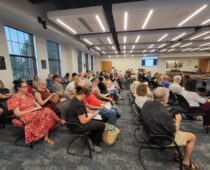
As the crowd packed the chambers, Council Member Emily Baer introduced a motion to add a discussion regarding the installation of Pride Flags at Town Hall to the meeting agenda. This was quickly approved by the council in a 6-1 vote where the Mayor alone voted against adding the motion.
However, the issue of what should be done regarding Pride flags was left unresolved.

In response, Mayor Andrew Moore introduced the motion to direct the Town Attorney to draft policies regarding these Pride flags. The measure received 4-3 support from the council, with Andew Moore, Brandon Bell, Brian O’Connor and John Mortellaro approving the direction to staff while the minority trio opposed the motion.
This vote echoed an earlier disagreement over marijuana policy in September 2024. The council passed regulations related to marijuana land use and licensing after months of deliberation, with council members Sawusch and Bell opposing the policy.
The marijuana policy discussion highlighted yet again the fluid nature of alliances based on policy. However, it also illustrated the fact that the topics of civic identity and governance seem to generate the sharpest divisions.
Moreover, Erie’s most ambitious redevelopment projects continue to receive broad support from the council majority.
The council unanimously approved multiple agreements tied to Erie’s Town Center Development Strategy, including amendments to development agreements with Evergreen-County Line & Erie Parkway LLC. Council members also approved additional agreements related to Colliers Hill urban renewal financing, flood-control infrastructure, roadway feasibility studies and redevelopment-related land acquisitions.
Most of the aforementioned votes were unanimously approved by the council, however, their cumulative effect amounts to multi-million dollar commitments to infrastructure development and redevelopment.
This combination of ambitious redevelopment projects coupled with divisive political debates reflects the very nature of Erie’s political transformation.
Erie is no longer just a semi-rural town governed locally.
Rather, it’s a growing municipality that makes decisions involving regional transportation agreements, urban renewal districts, annexations, sustainability strategies, regional water infrastructure coordination, and multi-million dollar redevelopment financing projects.

The political question, therefore, is no longer whether Erie should undergo development.
Erie is developing.
What needs to be addressed instead is how Erie’s growth priorities are shaped, who controls those decisions, and how those projects are financed.
The majority faction at the council appears comfortable facilitating Erie’s transition to a more metropolitan-style community using the new home-rule powers.
The minority faction, however, opposes moves toward increasing government complexity, suggesting that Erie risks losing transparency and its traditional character in the process.
This struggle will define the next phase of Erie politics. As redevelopment projects begin, annexation fights escalate, and more sophisticated financing tools are used, Erie residents will be called upon to trust more than just developers – they’ll also have to trust their elected representatives in directing Erie’s future.
Journalism That Answers To Readers