




The first dinosaur appeared before we even left Denver
It wasn’t a fossilized one, but a five-year-old Cedar donning his beloved T.Rex costume as our car climbed into the foothills west of the city. Beside him, his two-year-old brother River was making his own dinosaur noises from a car seat piled high with snacks, picture books, and enough toy trucks to survive a cross-country expedition.
The destination was Dinosaur Ridge in Morrison, but for the boys, every rock formation already looked like dinosaur country.
That wasn’t entirely wrong.
A Trip Through Time
Long before Colorado became known for ski resorts, mountain towns, and fourteeners, much of the state looked dramatically different. Roughly 150 million years ago, during the Late Jurassic Period, this landscape was covered in floodplains, rivers, and dense forests. Massive Sauropods wandered through fern-covered valleys while predators stalked prey through wetlands.
Dinosaur-themed roadside sign.
Those ancient waterways would ultimately preserve one of the world’s richest dinosaur records.
As animals died, layers of mud, sand, and sediment buried their remains. Over millions of years, bones fossilized beneath the earth creating a prehistoric archive stretching across Colorado and into neighboring Utah. Today, those fossils tell the story of a vanished world.
For families, amateur paleontologists, and curious travelers alike, they also provide the perfect excuse for a road trip.
Following an Ancient Trail
Over several days, Cedar, River and I traced Colorado’s dinosaur trail from Morrison to Fruita, across Dinosaur National Monument and back through Cañon City and La Junta. Along the way we encountered fossilized footprints, towering skeletons, active research sites, and enough dinosaur-themed gift shops to convince two young boys they had discovered paradise.
Morrison: Where the Dinosaur Rush Began
At Dinosaur Ridge, Cedar pressed his hand against a sandstone wall containing fossilized dinosaur tracks.
“They’re real?” he asked. The question seemed reasonable. Children’s museums are full of replicas. Theme parks are full of replicas. Even many dinosaur skeletons displayed in museums are casts of original bones.
But these footprints were real.
Millions of years ago, a dinosaur stepped into soft mud. The mud hardened into stone. Tectonic forces eventually tilted the rock upward, leaving the tracks exposed along the ridge where visitors can still see them today.For a moment, even the adults in the group became quiet. The distance between a child and a dinosaur suddenly felt much smaller.
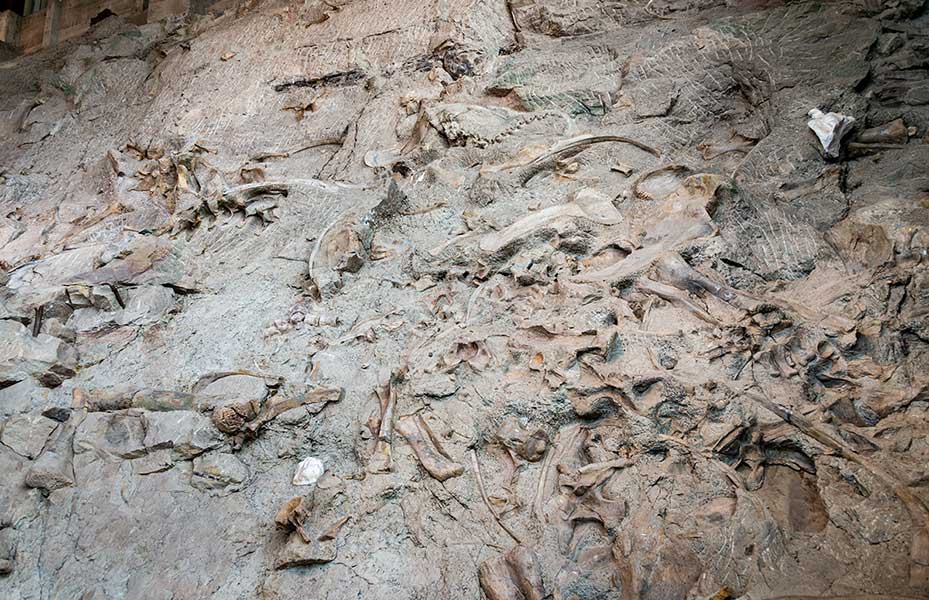
Dinosaur fossils preserved in rock.
Fruita: Digging Into the Jurassic
By the time we reached Fruita, the boys had developed strong opinions about dinosaurs. Cedar favored Tyrannosaurus Rex despite repeated explanations that T. Rex lived millions of years after the Jurassic dinosaurs we were seeing. River remained committed to whichever dinosaur toy happened to be in his hand at the moment. At Dinosaur Journey Museum, both became temporarily speechless.
A life-sized Allosaurus skeleton towered overhead. Fossils lined the galleries. Through viewing windows, paleontologists worked in laboratory spaces, cleaning and preparing specimens.
The museum does something particularly valuable: it shows that paleontology is not merely about discovering bones. It is about asking questions: Who lived here? What did this environment look like? How did these animals survive?
Children ask these questions naturally. Good museums encourage adults to ask them again.
Dinosaur National Monument: The Moment Everything Became Real
Road trips have turning points. For this one, it happened inside the Quarry Exhibit Hall at Dinosaur National Monument. Photographs fail to prepare visitors for the fossil wall.
More than 1,500 dinosaur bones remain embedded in a cliff face exactly where paleontologists found them. Vertebrae the size of tree stumps protrude from the rock. Massive ribs disappear into stone.
Cedar stood silently for nearly a minute. For a five-year-old, that may be the strongest review possible. Even River, who generally measured museum visits in minutes rather than hours, stared upward.
The quarry creates an unusual effect. Instead of imagining paleontology, visitors witness it. The fossils remain partially hidden in the earth, creating a sense that discovery is still underway.
For young travelers especially, it feels less like a museum and more like stepping directly into the story.
Cañon City: Following Footsteps
Children understand footprints instinctively. Bones require explanation. Footprints tell their own story.
At sites near Cañon City, fossilized tracks preserve moments of movement from millions of years ago. Here, a dinosaur walked. There, another changed direction. A few yards away, multiple animals crossed the same stretch of mud.
The boys immediately began comparing their own footprints to those preserved in stone. One of the enduring appeals of trackways is their intimacy. A skeleton tells us what an animal looked like. A footprint reminds us it was alive.
La Junta: Walking With Giants
The final stop brought the longest hike.
Picketwire Canyonlands requires commitment. Visitors travel miles across grassland and canyon terrain before reaching the famous trackway.
As often happens with young children, the journey alternated between excitement, complaints, snack breaks, and sudden bursts of energy.
Then the tracks appeared.
Hundreds of footprints stretched across exposed stone.
Some measured more than a foot across. Others formed long pathways that disappeared into the distance.
River immediately began stomping from one track to another.
Cedar crouched beside several prints, tracing their outlines with his fingers.
The scene felt remarkably similar to what generations of paleontologists must have experienced when encountering fossil sites for the first time: wonder mixed with disbelief.
Because despite everything we know about dinosaurs, standing beside evidence of a creature that walked here 150 million years ago still feels impossible.
A Journey Through Deep Time
Road trips often promise a change of scenery.
This one offered a change of perspective.
Traveling with Cedar and River transformed the experience in unexpected ways. Children approach the world with fewer assumptions. They ask obvious questions adults forget to ask. They notice details we overlook.
Were dinosaurs lonely? Did they have families? Why did this one walk here? How do we know?
The questions echoed through museums, fossil quarries, and desert landscapes across Colorado. And perhaps that is what makes the state’s dinosaur trail so compelling. It is not merely a collection of fossils. It is an invitation to imagine.
To stand in places where rivers once flowed through Jurassic forests. To trace footprints left before the Rocky Mountains existed. To recognize that the landscapes we consider permanent have transformed countless times before.
For Cedar and River, the adventure was about dinosaurs. For me, it became something slightly different: a journey through deep time, viewed through the eyes of two boys discovering just how large the world can be.