




The soft patter of the morning drizzle spattered on the pavement, the mid-Missouri humidity confounding the senses. The mind plays tricks, is it raining or simply the dampness in the air? As the trickle slows, it’s replaced by one of steadily arriving people, bringing with them an impending energy.
One pulls a child’s wagon laden with poster board, another carrying flags still furled. Waves and smiles are exchanged; calls of recognition. Another Saturday morning showing up for democracy in the show me state.
Missouri, a +18 President Trump state, seems to be in-line with many of the MAGA authoritarian decisions when looking at electoral politics. When voting for candidates with a party identity, for a representative, the GOP consistently wins statewide.
When the people are asked about policy, though, there are breaks from party platform standards. With practically an inverse voter split on the same 2024 ballot which gave the state’s ten electoral college votes to President Trump, voters overwhelmingly chose to raise the state’s minimum wage – also mandating that workers’ wages will increase with inflation – as well as requiring paid sick leave.
By an even wider margin they chose not to divert court fees to fund law enforcement retirement benefits. Those same voters also narrowly called to create a state constitutional amendment guaranteeing access to abortion.
The state’s Republican-controlled State House and courts, mirroring the federal administration’s authoritarian behavior, immediately got to work undoing the will of the voters. In July, Governor Mike Kehoe signed into law the bill repealing the voter-chosen paid sick leave decision and the workers’ wage increases with inflation.
On August 12, the state’s Supreme Court declined to decide on Republican Attorney General Andrew Bailey’s challenge on the voter approved abortion amendment, deferring to a lower court. That particular attack on the rationale of the electorate will continue while the power individual voters can have will be brought into question.
Following the Texas legislature’s lead, the MAGA state house will begin to explore options to fulfill President Trump’s direct request to intentionally gerrymander Republican-led states in an effort to add party members to the U.S. House of Representatives. The legislature is responding by carving a changed district around Kansas City, Missouri, to fulfill the President’s request for only party loyal members being added to Congress.
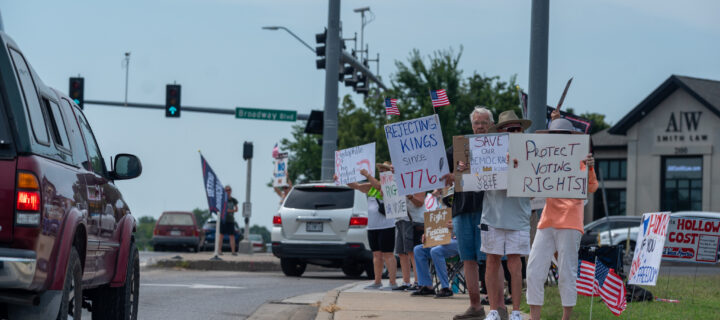
With the decision of whether the voices of Missourians will be reflected accurately at the polls being made by their representatives, the people are finding consistent and constant ways to be heard in the streets. On this particular morning, about one hundred of them are lining the sidewalks holding signs, flags, and cowbells with speakers playing patriotic protest anthems raising their volume in support of saving their republic.
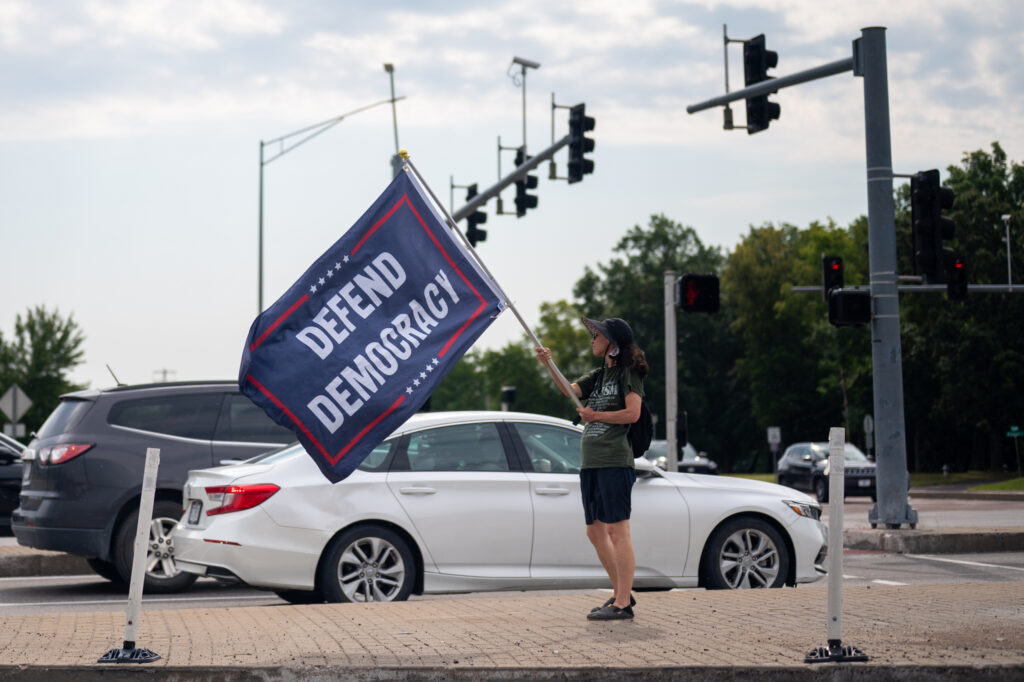
About one hundred Missourians gathered at a busy intersection minutes from the Mizzou campus in Columbia to demonstrate in defense of democracy. Issues like the Epstein Files, loss of due process, cuts to education and health care, global war and genocide brought the community together, united in their opposition to the creep toward authoritarian fascism by President Trump’s administration. (Photo by Vince Chandler / Yellow Scene Magazine).
The rain now entirely ended, the pavement dries quickly as the sun raises the heat. Standing on the sidewalks and medians, people surrounded the intersection calling for the restoration of due process and to heed the voters’ voices. Many cars passing enthusiastically met the demand of one sign reading “honk if you love democracy” while drivers smiled and waved to the activists. Some, with sour faces, chose to shout and respond with a more rude gesture.
Many of the sign wavers were traditional retirement age, lamenting the loss of the America they had grown up with. A 98-year-old lifelong Republican joined the crowd aghast and vocal. Veterans, grandparents, the group of elders made the handful of students from the local university stand out. A contemporary imagination may conjure a protest crowd as mostly young faces, but the morning’s action did not reflect that presumption. Some asked why more young people weren’t attending.
“I know so many people who can make it out on a random Friday, or who can make it out maybe one Saturday a month, but we’re tired, we’ve worked all week to survive,” 20-year-old Grace told Yellow Scene while reflecting on the weekend’s movement work from a downtown coffeeshop the following day after a hike. “And I get that, I understand where people are coming from. But, it’s worth it, because every one person that comes out and sees what it’s like is one more person that is less afraid of doing it again, you know?”
After a little more than an hour on the corner, the crowd stowed their signs and quickly started toward their cars. They were not headed to brunch or back home, though. They were headed to the next spot to make more noise. Some to an interstate overpass to hang a banner and picket to the passing cars and others to the Columbia City Hall to join another sign waving event in the town’s downtown corridor.
At the Keys to the City Sculpture, more familiarly known as The Keyhole, some from the previous protest joined a core group of activists who have held the space every day for more than 500 consecutive days. Organized by the Mid-Missouri Peaceworks, this daily demonstration originally began in support of peace and dignity for the Palestinian people. Since the re-election of President Trump, it has expanded to include the slew of issues arisen by his executive orders and policy decisions.
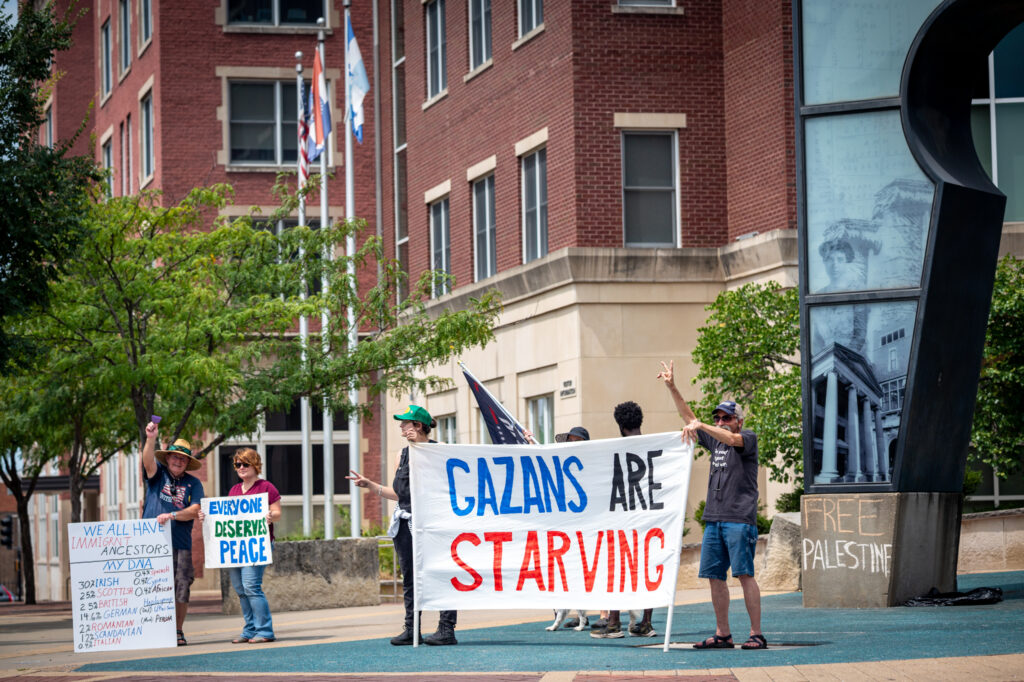
For more than 500 consecutive days, organizers from Mid-Missouri Peaceworks and Columbia community members have occupied the space during the noon hour in front of their city’s municipal offices calling for an end to the genocide in Occupied Palestine. Since the re-election of President Trump, they’ve also welcomed messages voicing dissent to his regime’s attacks on immigration, free speech, and civil liberties. (Photo by Vince Chandler / Yellow Scene Magazine).
“We have democratic input, but we’re at threat of losing it,” said Mark Haim, director of Mid-Missouri Peaceworks to Yellow Scene. They operate Columbia’s Peace Nook, and Mark is the organizer of the daily protest. “Of losing the most vulnerable, people who are undocumented and people who could be subjected to deportation – Trump has made no secret of his Islamaphobia, his transphobia – and we have all these losses of things that are so basic like health care, SNAP and food benefits, these things that people depend on to stay alive and be healthy.”
As the handful of humans on this corner ended the lunchtime hour they made their plans for the next protest. Not the weekend to follow, not the next day, but which one they would attend for the afternoon or the evening. The soonest opportunity to voice their dissent to federal decision making started in only an hour, organizers were readying for a march starting on the Mizzou campus at their first amendment zone, a space where a permit is not required to speak or rally.
The inalienable American right to free speech of course needing a space to be guaranteed at a university which has previously tried to ban certain topics.
Students, community members, and international activists were a part of the building crowd. This march was to garner continued attention to the ongoing Israeli forced famine in Occupied Palestine. There would be – however – no chanting, no yelling, and no banging of pots but for one lone percussive pulse. Walking in absolute silence and carrying banners, signs, and flags the protest made for a haunting, unsettling, visual as they walked off campus and into Columbia’s business district.
One passerby exited their vehicle to call the group ignorant, stating that half the crowd would be killed by a Palestinian. The bombastic and unfounded threat was greeted with no pushback, no audible anger, but with continued silence and a few peace signs. Frustrated that the ludicrous statement had not garnered the response anticipated, they returned to their car fuming. The experience and restraint shown by the solemn column was a powerful response, forcing the antagonist to either continue the attack or to leave still angry. They left.
“Silence can be just as powerful as words, if not more sometimes,” Rasha A. told Yellow Scene after the protests ended. “They want you to fall into that trap of arguing with them, they want you to get frustrated. So why not turn it around on them and let them get frustrated. When you don’t respond, it really gets to them because they suddenly hear how childish they sound. You’re a grown man or woman yelling at people walking quietly down the street protesting the killing of other human beings.”
“There is something reflecting on the inside of them that they do not want to admit,” the Missourians for Justice in Palestine organization leader concluded.
The marchers returned to Speaker’s Circle and broke their silence. Water and produce were made available for those who wanted some and announcements were made. Organizers were working with allies on the ground in the areas surrounding Gaza coordinating food trucks and the delivery of supplies when possible. Attendees plugged their daily and weekly picket events across Boone County, politicos invited attendees to their upcoming party events. It became clear that just like you were going to find a space to use your voice any day of the week, people were also actively engaged in the mechanics of the cause.
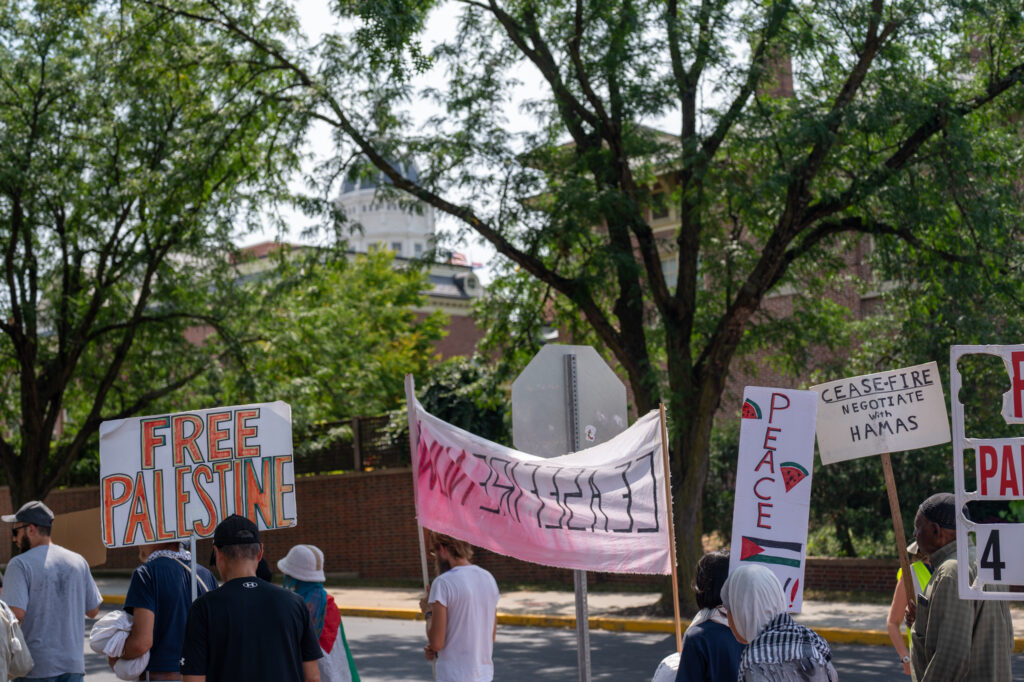
Marchers move in silence along the sidewalks of the University of Missouri, protesting in support of peace and dignity for the Palestinian people and an end to the genocide. Without any exchanged words, no chants, the soft shuttle of the steps and a solitary slow percussive ping of a pot to set the pace, the silence reverberated. (Photo by Vince Chandler / Yellow Scene Magazine).
“Try to look through the veneer that’s kind of stuck in front of us now, there’s so much inequality, inequities, even here in mid-Missouri there’s a ton of bigotry still, there’s a great deal of classism,” Jeff Stack told Yellowscene. He helps to coordinate the Mid-Missouri Fellowship of Reconciliation. “I feel that one of the greatest strengths of this society and country is its potential. That’s what kind of gives me hope, there’s a lot that can happen for the good.”
“There is so much to unlearn,” said Grace on that sun-soaked cafe patio the following day. “I like using joy as bait. And there’s nothing more recharging than having people talk to you about this and make you feel like ‘I’m not crazy.’ Set up something with friends, meet at a coffee shop and at a specific time just talk politics. I see my best friend every day, and we talk politics but all the time can be exhausting. People can’t be one thing all the time, it’s just not realistic. A specific time, and to gather in joy, I find it way more helpful.”
With two thirds of the day now gone, some still weren’t done. Dinner would be eaten while their quest for world peace continued. In classic midwest tradition, they were headed to a potluck in a park – one where politics, war, and organizing would all be openly discussed, surrounding the solemn topics with joy. In observation of the 80th Anniversary of the atomic bombings of Hiroshima and Nagasaki in Japan, Missourians from across the state gathered with the hope of ending nuclear war.
Retired state poet laureate, Aliki Barnstone, began the evening’s programming with an original piece. The rapt crowd listened intently as the expert wordsmith brought them on a journey remembering those fateful August days when the United States of America ended the lives of more than 200,000 human beings in two short instances.
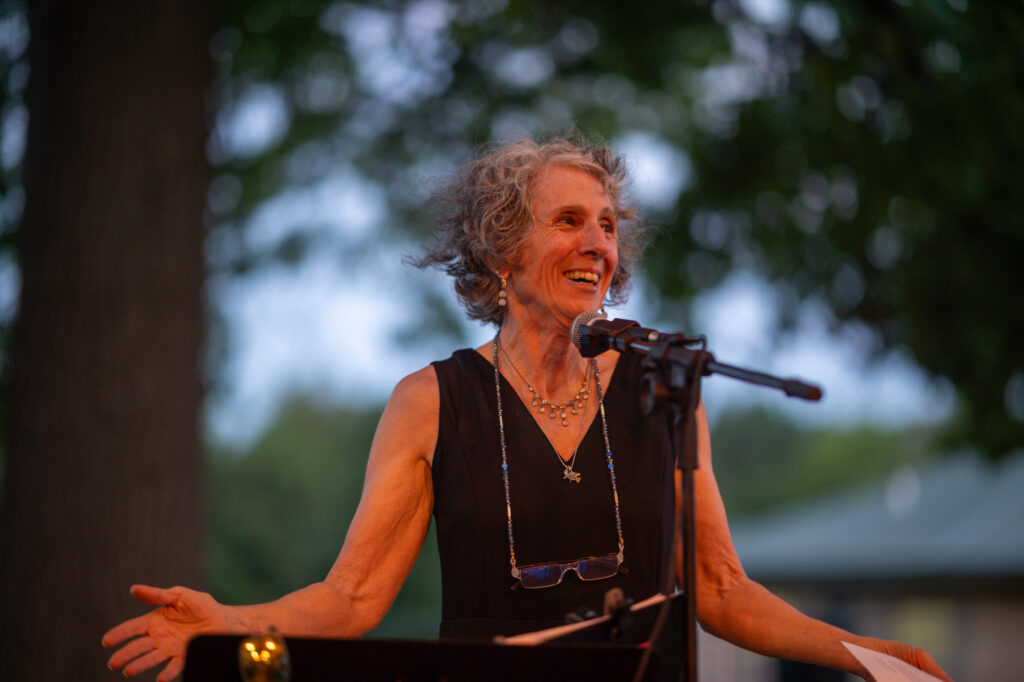
Recently retired Mizzou professor and former Missouri State Poet Laureate Aliki Barnstone smiles while greeting a gathered crowd recognizing the 80th anniversary of the American atomic bombing of Japanese civilians at Nagasaki and Hiroshima. She read a poem penned for the event’s event titled “On August 6,” rhythmically reflecting on the horrors of the violent days when hundreds of thousands of people were killed in an instant. (Photo by Vince Chandler / Yellow Scene Magazine).
“At 8:15 a.m. all simple, daily beauty is aflame. No justification.
Nothing, nothing,
Not I can
say. Yet I speak
anyway, anyway
any way I can.”
Student Kerra Lindbloom followed, delivering a fiery epitaph which left those gathered stunned for a moment in silence before erupting into applause. Ripples of reflection already passed through many attendees, her rhetoric delivered with a vehement prose emanating a maturity and experience beyond what could be anticipated from her young age.
Volunteers shared the words of survivors’ memories of those fateful days. Veterans for Peace President John Betz reflected on his time fighting in the Vietnam War, concluding that war will beget cruel tragedy, no matter the cause or weaponry. All day, attendees had constructed and decorated dozens of Japanese lanterns. Now, with presentations concluded, they headed to the park’s lake to ignite their candles and send them floating across the dark water. Watching them glow and glide, conversation turned to what was next. The day over, the next question now was more intangible than where to spend the following few hours.
It was whether there could be reasonable hope that their pleas for peace could be heard, much less met. Some had spent the day traveling between protests carrying the consistent call for a changed course. One day wouldn’t be enough, they knew that. But, could the seemingly steady growth of authoritarianism and warmongering in the United States be stopped?
Some would spend their following morning in houses of worship, asking their gods to bring peace. Some would be at family or friends gatherings, carrying memories of the day and sharing stories to try to persuade their communities to care. Others would be gathering in coffee shops to discuss partisan organizing, making plans to build political routes toward measurable change.
Many of the younger crowd planning for politics were not doing so in the binary systemic choices of far right Republicans or centrist Democrats. The Missouri Green Party was present at many of the protests, offering an option in experienced ballot organizing with institutional knowledge. With students returning to campus the following week, the Revolutionary Communists of America were planning recruitment drives for their organization. The Democratic Socialists held a large general meeting in the last days of the scholastic summer.
Paul Lehmann, who ran for governor on the Green Party ticket in Missouri, spoke with Yellow Scene during the day of protest.
“My view of the Green Party is that we’re like a voice in the wilderness. We have some solid principles, platforms that 80% of the people would endorse in a survey, but they’re afraid to,” Lehmann said when asked about the viability of parties outside the American partisan binary. “There’s a lot of hostility to the Green Party by the so-called progressives of the Democratic Party and that’s unfortunate that they don’t have enough courage to say that they’re wasting their vote.”
For most involved in any of the many political protests and actions taking place that day, it was clear that the work was far from over. In historically conservative-leaning Missouri, progressives project an understanding that change won’t be immediate. In a generational movement they maintain consistent and constant presence, utilizing diverse approaches to garnering attention and creating conversation. The protest isn’t the end, it’s the start, and they aren’t gatekeeping the instructions, encouraging those who want to to find their avenue to voicing their dissent.
“It’s literally as simple as treating other people as humans,” said Grace. “If you really feel like you can’t do anything about anything politically, you can at least feel the humanity. You can at least be there and feel it and recognize that. And if you deny yourself that, and deny yourself the joy of working to prevent tragedy, I think that you’re denying yourself a core part of the human experience.”
As the seasons begin to change and summer’s heat fades away, the Missourians with something to be heard are not going to spend their autumn preparing for a winter’s hibernation. They’re planning and building and ramping their efforts, recruiting their neighbors who are horrified by the federal administration’s stripping of due process, military occupations of American cities, or the defunding of medical and education systems. They don’t plan to let this slide happen in silence and the show me state is going to show up.
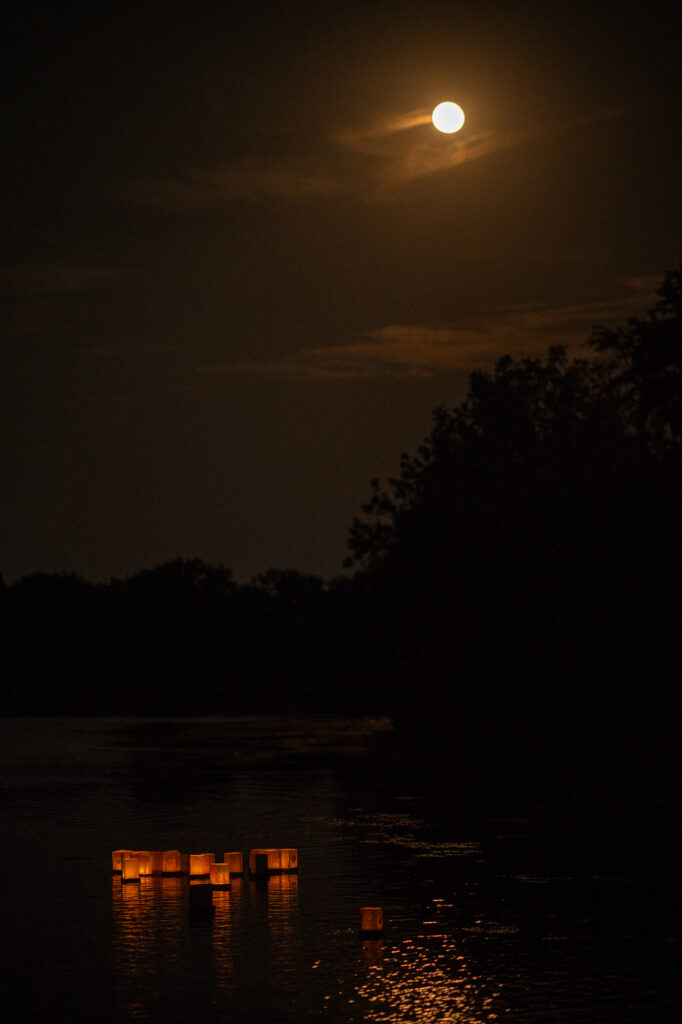
Candle-lit lanterns float across the water at Stephens Lake Park in Columbia, Missouri. The gathering is a call for peace everywhere as well as serving as a call for the mutual, verifiable, universal and incremental abolition of nuclear weapons. (Photo by Vince Chandler / Yellow Scene Magazine).
Best known for capturing striking content from the frontlines of social movements, Heartland EMMY-nominated filmmaker and photographer Vince Chandler has spent 20 years creating art and documentary visuals across the U.S. They served as Communications Director for Denver City Councilwoman Shontel Lewis, and Vince has earned national recognition for their work as a visual journalist for The Denver Post. Vince was the principal cinematographer for the feature documentary film Running With My Girls, which premiered at the 2021 Denver Film Festival.
______________________________
What does resistance & resilience look like in the Heartland of America?
Sometimes it’s a protest outside an ICE detention center. Sometimes it’s a rural nurse explaining how Medicaid cuts will shutter the town hospital. Sometimes, it’s a law professor teaching systemic racism at a University in a state where CRT is banned in public schools.
As Trump’s second term unfolds — and the One Big Beautiful Act guts healthcare, empowers ICE, and reshapes American life — independent journalism is more vital than ever. However, the national press rarely shows up in the places where policy has the most impact.
We do.
These American Crossroads is a collaboration between Vince Chandler, Emmy-nominated visual journalist, and Yellow Scene Magazine, Boulder County’s only independent newsroom.
Become a sustaining supporter for just $8/month: https://fundrazr.com/Crossroads