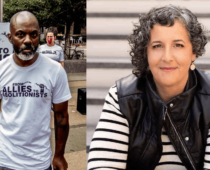




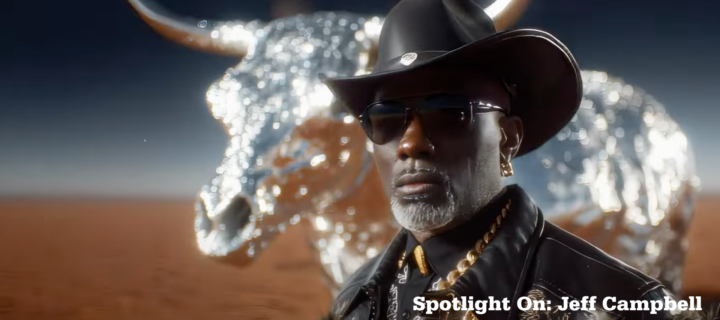

A couple of days ago I had the pleasure of interviewing Jeff Campbell, the talented and visionary playwright, actor, and producer of Emancipation Theater.
This isn’t my first interview with Jeff. I have attended many of his productions since Honorable Disorder, which starred Theo Wilson in 2018.
Generally, when I interview someone, I don’t write out a list of questions. Instead, I study my subject, dive into every article I can find on them, and learn who they are. I find the questions flow naturally that way. Such was the case with Jeff; we had an amazing conversation I thought I was recording. Alas, at the end, I noticed the recording button was not on, and we had to turn it on for the last few minutes.. But that’s okay, because every time I speak to Jeff, it’s unforgettable.
Raised in Longmont, Colorado, and one of the only Black students in his school, Jeff often speaks about how he longed to get into the hood while others were trying to get out. Raised in an all-white school environment, he sought out spaces where he could connect with people who shared his identity. Always involved in theater and performing, he eventually helped form a hip-hop act, Heavyweight Dub Champion. Touring the US and Canada, often playing large music festivals. As they grew, band egos emerged, prompting him to leave the industry for good and return to Denver.
Locally, he founded the Colorado Hip Hop Coalition, an after-school program for youth, and later Emancipation Theater. He has produced six plays (as playwright and producer) and two documentaries, all with a focus on telling stories of Black Americans first and foremost, but also of others who have faced oppression. His plays include Who Killed Jigaboo Jones; Honorable Disorder; Recipe; I Am Raverro; and In The Pocket: The Ballad of Bobby Trombone. His documentaries include Message to the Mayor, addressing the plight of the unhoused during the pandemic and former Denver Mayor Hancock’s treatment of them.
He performed alongside an all-star cast, each of whom wrote their own part, including Kid Astronaut (Jon Shockness), Bumpy Chill (Adrean Jones), Kingdom (Jeffery McWhorter), and Mizta Sandman (Shannon Richardson), in collaboration with producer Mic Coates. As Westword noted in its coverage, the message resonated deeply.
But having an all-star cast is what Emancipation Theater has always been about. Jeff tells me that he writes his characters with the actor in mind. This intentionality has made Emancipation Theater some of the most compelling work on Denver’s stage.
As a younger person, my parents took us to the theater a lot. Sometimes I enjoyed it, and sometimes it was just…long. But not in the case with Emancipation Theater. Every show I have attended has left me spellbound.
His latest production, Jedidiah Blackstone, is the central storyteller of real-life stories about pioneers and Black western history. One of the central characters is Clara Brown, a woman of remarkable resilience.
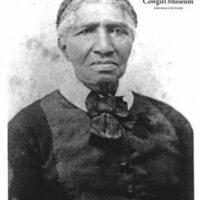
Clara Brown, National Cowgirl Museum & Hall of Fame
Clara was enslaved in 1800 in Virginia as an infant. After her husband and children were sold away from her, it shaped her life’s mission. In 1856, at the age of 56, her enslaver passed away, leaving her $300 in his will. She was able to buy her freedom but was forced to leave Kentucky as a free person. She joined a wagon train, which “politely” carried her pots, pans, and cleaning supplies, but forced her to walk behind the train—for 700 miles. She settled in Central City, cooking and cleaning for miners. Even though she prospered, she never gave up searching for her family. In 1882, she finally reunited with her daughter after a 50-year separation. She died in 1885, and her funeral was one of the largest the city had seen, attended by governors, mayors, and pioneers who recognized her role in building the young territory.
It was learning about Clara that sent Jeff down the rabbit hole of finding the lost stories of forgotten Black pioneers.
Jedidiah Blackstone is a modern-day retelling of those stories through the Jedidiah Blackstone character (who has his own backstory as well). Jeff says he is literally becoming Jedidiah Blackstone in everything he does, embodying the storyteller for the performance.
If the preview videos are any indication of what is to come, this show is bound to be another Jeff Campbell hit.
But successful theater aside, Jeff’s mission is what makes his storytelling so good. At the end of the interview, I asked him why people not directly affected should care about these stories, and why he needs to be so immersed in the character.
If the reasons aren’t already obvious, Jeff passionately explains why stories of our historical—and shameful—past are essential today:
“Clara Brown currently has a statue in the African American Museum of History and Culture in Washington, DC. From the words directly from this current administration, that may not be for long. Clara Brown and other very significant figures within our history could be taken out of that institution.
At the exact same time, the same administration is talking about renaming military bases and re-erecting statues of Confederate soldiers. So it’s not really lost on me that they’re doing this at the exact same time. They’re saying that one history is too hard and too harsh to learn about or paints a bad picture for America, while saying that this other history must be preserved and protected.
Well, I personally think that Clara Brown’s story is a far more and better story to tell about America than the one about insurrectionists who took up arms and tried to secede from the United States.
So we are at war for information. There’s a war on our minds—for our minds, for what we believe—and historical markers, monuments, street names, and all of these things shape our national narrative. That national narrative then shapes our identity. And if you can erase one side of history while elevating and celebrating another side of history, then you make generations to come indifferent about the suffering and the condition of the communities who have no recorded history.
We as artists must take up the mantle when we’re being censored in the classroom and erased in the museums. It is the duty of the artist to wield the power of the storyteller, because the storyteller wields its power through classrooms, courtrooms, newsrooms, boardrooms, and dictates who winds up in jail cells, hospital beds, and graveyards.
It’s first a war of words; they shape the narrative, to shape perspective, to shape opinion, to shape people’s beliefs.
And so, in the forefront of the civil rights movement in the third decade of the 21st century, narrative and information play a crucial role. Warfare is contextual, combat. This is exactly what we must do. And artists are the soldiers on that front line.”
At just $30, tickets are priced so that anyone can experience the storytelling of Black heritage—an act of accessibility in a nation that desperately needs more empathy.
Tickets to Emancipation Theater’s Jedidiah Blackstone.

Democracy needs journalism more than ever. We’ve been telling the truth for 24 years. Your support helps us keep telling it for at least the next four years.