




How Colorado’s Unhoused Fight for Care in a System Not Built for Them


On a cold Wednesday morning in Broomfield, the Refuge Café fills slowly, people shaking off frost, unwinding scarves, signing nothing more than their first names on a clipboard. No ID. No phone number. No insurance card. Just a name.
That small detail — a place that asks nothing more than proof of being human — is the first piece to understanding the core truth that emerged across every interview, campus, and shelter from Boulder to Longmont: Healthcare for people experiencing homelessness in Colorado is not defined by medicine but by access, trust, and survival.
And survival, nearly everyone said in one form or another, is fragile.
The moment everything changes
It takes only one medical diagnosis, one lost job, one unexpected bill, one abusive home — just one moment — for a person to slide from stability to homelessness. Providers repeated this over and over: It can happen to anyone.
The story that embodies this most clearly is the one that Kathy Escobar, co-founder of The Refuge community, which catalyzes The Refuge Café, tells with the kind of grief that never softens with repetition.
His name was Sasha. He was in his early fifties, living in his car while undergoing treatment for stomach cancer. Hospitals allowed him to park in their lot during chemo, but he had no stable place to recover, no warm room, no bed, no safe space for his body to withstand the pain, the nausea, or the exhaustion. He wasn’t sick enough for hospice, but he was sick enough to die.
He was trying to secure benefits but was told, “Let’s wait and see how your chemo goes first.” Without respite care, without consistent follow-up, without a clean place to rest, he deteriorated. One weekend, during the course of treatment, he died — alone, unhoused, in the margins of a system that couldn’t hold him.
His death was preventable, not because he lacked treatment, but because he lacked recovery, support, and a safe place to be sick. He suffered from what nearly every provider in Boulder County names as the most dangerous gap in the system: aftercare.
This is the fault line in Colorado’s homelessness and healthcare crises. And Sasha is far from alone.
The Refuge Café: What it means to meet people where they are
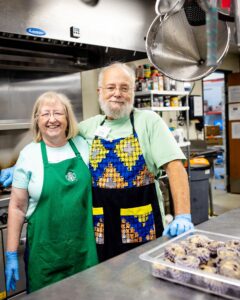
The Refuge Café was built to close those fault lines, not with grand budgets or government systems, but with the radical simplicity of presence.
Founded in 2006, the nonprofit has moved through multiple locations before landing in its current space in 2013. Today it holds more than 80 partnerships, functioning as a hub where the barriers that dominate healthcare — ID requirements, insurance, transportation, and appointments — are dissolved.
Walk inside, and one will find:
- Free lunch and hot coffee
- Couches and Wi-Fi
- Computers, art supplies, warm clothing
- Showers
- Narcan
- Social work interns
- Medicaid sign-up stations
- Harm-reduction clinics
- Mental-health interns from Naropa University
- Boulder County AIDS Project
- Clinica community health workers
- Peer recovery advocates
- Art nights and community dinners
- A space for children
- People who know each other by name
Everything is structured around the philosophy Kathy calls the preposition “with”: “Alongside, beside, everyone gives, everyone receives — not “to” or “for”, which are inculturated into most of our systems.”
Many people who come to The Refuge are living with cancer, autoimmune disorders, heart disease, chronic infections, or untreated disabilities. Many are autistic adults who were never diagnosed as children — undiagnosed conditions that quietly determine the course of a life: job instability, relational upheaval, burnout, debt, and eventually homelessness.
Healthcare for them is not simply inaccessible; it is often irrelevant when the urgent needs of the day are food, warmth, or safety. “Healthcare is sometimes the least of their worries,” Kathy said. “If you’re worried about where to eat tomorrow or where you’ll sleep, you’re not thinking about why your stomach hurts.”
And yet, physical ailments are everywhere: chronic pain, infections, untreated injuries, fungal conditions, respiratory problems, and dental abscesses. Nearly all of them worsened by living outside, exposed to cold, illness, and exhaustion. Worse yet, people often know something is wrong, but they are the ones feeling the symptoms. They’re not indifferent. They lack access. They lack a place to heal.
Youth on the edge: TGTHR and the barriers no one sees
A few miles away, providers at TGTHR see these realities unfold in younger bodies.
Together without the vowels — TGTHR — exists to end youth homelessness, offering supportive housing in Boulder and Denver and soon reopening a drop-in center and street outreach program. At their housing site, Director of Programs Paige Dennis explained how intimately health is tied to stability: “The stability, dignity, and long-term health of that person all depends on them having access to some kind of healthcare.”
But youth experiencing homelessness face obstacles so fundamental that many people have never considered them. “There’s the lack of ID,” said Cate Buck, an outreach case manager. “You need a birth certificate to get an ID, and that’s not easy to get when you’re unhoused.” Lack of ID prevents them from accessing Medicaid, establishing primary care, or getting prescriptions.
Transportation is another barrier. “People may not know how to get to a healthcare facility,” Cate said. “They may not have a bus pass. They may not be physically or mentally able to walk there.”
And then there is stigma, the invisible wall. “When you show up in the ER homeless,” Gianna Martin, TGTHR’s Peer Support Specialist, said, “you get that stamped on you. You get treated differently. You can feel it.”
She described youth who come in with an infected cut, only to let it worsen because the immediate priority is survival: “You’re trying to get food and shelter for the day, not thinking, ‘Let me go do this preventative thing, so I don’t die in a month.’”
Many fear clinics because walking into one could trigger child welfare involvement, police reports, or being sent back to abusive homes. For minors, the stakes are especially high. “If you’re 16 and try to go to the doctor, they’re going to ask questions about home,” Gianna said. “You have to lie. Why risk going back to a bad situation?” The barriers compound until long-term care becomes nearly impossible. Youth move constantly — between cities, shelters, and temporary beds — making consistent treatment unmanageable. “We see an overreliance on emergency healthcare systems,” Paige said. And yet, within this instability, TGTHR’s staff witness extraordinary resilience: youth who are philosophers, dancers, coders, poets, future nurses, and engineers.
“Just blossoms,” Cate said. “Ready to bloom.”
A life rebuilt: Andrea’s path through the gaps

Andrea
Where youth face the beginning of these systems, Andrea’s life shows what decades of navigating them looks like. Her story is not symbolic; it is literal. A tunnel through trauma, violence, undiagnosed ADHD, addiction, homelessness, suicide attempts, hospitalizations, and recovery.
She spent years living in cars, abusive households, and safe-parking programs. She survived relationships that were violent, controlling, or emotionally corrosive. She slept in places where she could hear people screaming, fighting, or overdosing outside.
The turning point came unexpectedly: a Sprouts grocery store, a $25 gift card from a child, and her brother spotting her in the aisle. She told him the truth — she was homeless — and he cried. But the cycles repeated. She escaped again. She fell, rose, fell again. Eventually, she reached The Refuge Café and began receiving care and connection consistently for the first time.
Mental Health Partners later told her something no one had said before: “I don’t think you’re bipolar. I think you have ADHD and always have.”
Medication changed her life. It softened the noise in her mind. It allowed her to focus, to breathe, to rest. It gave her enough stability to work as a shelter resident assistant, to complete training, and to become a peer support professional — someone who now guides others through the same tunnels she once crawled through alone.
Her recovery, she said, is like “The Shawshank Redemption”: “A tunnel full of shit, darkness, and fear—but when you crawl through it, you’re free.” Today, she speaks not from a place of bitterness but of transformation.
She forgave the people who hurt her, the systems that failed her, and the parts of herself that didn’t know how to survive any other way. Her life is now a testament: Homelessness is not a moral failure, it is often a medical one, an economic one, a systemic one. And it can happen to anyone.
At the systems level: Why healthcare and homelessness cannot be separated
 The structural analysis comes from Heidi Grove, division manager for Homeless Systems and Coordinated Response with Boulder County. She has the clearest language for the crisis: “Homelessness is a product of failed systems upstream.”
Healthcare failures such as insurance gaps, behavioral health shortages, hospital discharges to the streets, rising medical debt, undiagnosed disabilities, and a lack of medical respite are just the beginning of where the system is letting the people down.
Grove described meeting with Denver Health’s street medicine team, which houses people specifically to recover from acute medical conditions. “You can address someone’s heart attack or open wound,” Heidi said. “But the recovery piece is the challenge.” Without housing, people are discharged into environments where healing is impossible. Frostbite, infection, heart issues, and surgical wounds — none can recover outdoors, in tents, in cars, or on concrete.
Privacy laws that restrict release of medical information, while essential, create data silos that prevent coordinated care. Hospitals cannot always tell case managers who are cycling through their emergency rooms, even when patterns are obvious and costs astronomical. “Of all the systems,” she said, “healthcare is the one we have the weakest link.”
Yet she points to one success story: the Veterans Affairs Supportive Housing program. Its coordinated housing-and-healthcare model has reduced veteran homelessness by 50% nationally in 10 years. “When we hear that housing first is a failure,” she said, “it’s not a failure of individuals. It’s a failure of investment.”
The Refuge, revisited: Why connection saves lives
Kathy’s notes contain some of the starkest data in the region. Broomfield has over 300 people experiencing homelessness. As many as 83% of all deaths connected to The Refuge were attributed to individuals who were unhoused or previously unhoused. Mortality rates for people experiencing homelessness are nine times higher for men and 10 times higher for women than those of their housed male peers. People experiencing homelessness lack two of the five core social determinants of health: economic stability and health access. The third determinant — social connection — is what the Refuge cultivates with intention.
Loneliness is its own epidemic. Depression is its own disease. Both manifest physically. Both shorten lifespans. Both become accelerants for chronic conditions. Which is why The Refuge isn’t just a service hub. It’s a place to belong. A place to contribute. “If I asked anyone there to help me move a couch,” Kathy said, “almost everyone would offer.” This sense of purpose — the ability to give as well as receive — creates dignity. And dignity is not an abstract value. It is biologically protective. It is healthcare.
What the community can learn
Every provider interviewed — TGTHR, Boulder County, The Refuge — said the public must unlearn one thing: that people experiencing homelessness are somehow fundamentally different. “Look someone in the eye,” Gianna said. “Say, ‘Hey.’ Treat each other like humans.”
Cate added, “If we nurture and understand the trauma people have experienced, we can be there for them. For youth, we can prevent them from spiraling into chronic homelessness.”
What they wish more healthcare professionals understood is equally simple: People are not avoiding care; they are navigating systems not designed for them. They are avoiding judgment, police involvement, trauma triggers, difficult paperwork, inaccessible clinics, unaffordable medications, and unkindness.
They are avoiding what has harmed them before.
The road ahead: What real solutions look like
 Providers across the region agree on what would change everything:
- Mobile medical teams integrated with street outreach
- Medical respite housing for recovery
- Co-located clinics at trusted places like The Refuge and TGTHR
- Universal ID systems that don’t require documents people can’t safely keep ? Increased funding for behavioral health
- Transportation access
- Peer support as a standard of care
- Expanding partnerships between hospitals and housing
- Listening to lived experience
“Imagine having a doctor and a nurse on an outreach team,” Gianna said. “That would be a game changer.” Heidi echoed this: The future lies in integrated housing-and-health systems — not charity, not bandages, but infrastructure.
A final truth
There is something that must be said plainly: People experiencing homelessness in Colorado are not dying from their conditions. They are dying from lack of access to care for their conditions. And the difference between those two is a matter of systems, not character.
What happened to Sasha — the man who died while living in his car waiting for a safe place to recover — was not an anomaly. It was the system functioning exactly as it’s built.
But the very existence of places like TGTHR and The Refuge proves something else: With connection, dignity, and access, the cycle can be broken. Andrea put it best: “If I can hit rock bottom face-first, dig a hole with my teeth, try to die in it, and still get up — anyone can.”
And maybe that is the real story: not just the failures, but the miracles happening in cafés, shelters, safe parking lots, housing programs, and outreach vans — where people do not give up on one another.
Even when the system does.
Like journalism like this? Consider becoming a sustaining supporter — and get our print edition delivered to your home each month.
Democracy needs journalism more than ever. For 25 years, we’ve told the truth — your support helps us keep doing it for the next four and beyond. Administrations come and go. Our team stays, ready to lead no matter who’s in charge.