





Employees at Boulder Public Library announced their plans to form a union in September and months later, they are nearing a resolution. The process has been slow, but staff members are hopeful the outcome will restore their collective bargaining rights, and strengthen their voice. If the Boulder Library District grants bargaining rights, it will be voluntarily recognizing the library’s union.
The campaign to form a union with AFSCME Colorado was announced by library workers in September 2025. Since then, the employees have organized and collected signatures in preparation for the administration’s decision.
In February, the Boulder Public Library District Board of Trustees tabled a vote on the collective bargaining policy, moving the decision to March 10.
Doug Hamilton, a member of the Boulder Public Library District Board of Trustees, spoke to Yellow Scene Magazine ahead of the March 10 board meeting. He did not expect a final vote would be made, especially if the draft policy was amended in any way.
“They just wanted a union, is what they tell us,” Hamilton said. “They have publicly stated it’s not an issue of pay or benefits, although I’m sure that’s part of it. They said in today’s environment, they want the protection of a union to feel like safer employees.”
He did not see any potential downsides to library workers being unionized. He also notes that he views union’s formation as not motivated by intense grievances or poor working conditions.

“The library board has attempted to, and always, tried to make the library an employer of choice. That’s been our goal since the district was formed,” Hamilton said. “I believe our library staff is some of the highest paid, and has some of the best benefits, of all library workers in the state. We have a genuine respect and admiration for the library staff. We are just trying to maintain a great relationship with them and with their union representative.”
Hamilton added that the board also wants to act in the best interest of the library district. He is hopeful that moving forward, library workers and board members will continue working together with mutual respect.
The shift to a library district model fundamentally altered the professional landscape for Boulder’s library staff. Previously, as city employees, workers held collective bargaining rights; however, the separation transitioned them to at-will status. For many, like custodian Michael Serrano, unionizing is about reclaiming that lost leverage.
What that reclaiming that leverage would look likes is a different for every worker.
For Serrano having a union is important “restores our voice and a seat at the table” regarding decisions that directly impact the essential services provided to the community.
AFSCME notes that many employees want the job security that a union will provide.
And for employees like volunteer program coordinator Christine Burke, the move is an effort to “democratize” the workplace. Burke has emphasized that protecting the library’s future requires protecting its workers first. This sentiment is echoed in the union’s primary objectives, which focus on increasing worker retention, fostering better communication with administration, and maintaining a legacy of inclusion as the District grows.

To guide future discussions, the Boulder Public Library District has drafted a Collective Bargaining Policy built on five core principles: Good Faith, Mission Alignment, Continuity of Service, Fiscal Sustainability, and Equity & Inclusion. This framework aims to ensure that services remain uninterrupted and negotiations remain unbiased.
Under the current draft, the district will negotiate on:
-
Wages and salaries
-
Working conditions and benefits
-
Evaluation and grievance procedures
However, certain operational elements, such as budget adoption, hours of operation, and organizational structure, will remain outside the scope of bargaining. To ensure the policy remains relevant, it will undergo a formal review every three years.
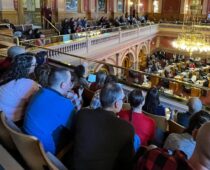
The energy for unionization was palpable at the March 10 board meeting, where staff and community members, many sporting AFSCME shirts, urged the board to refine the current policy. Key suggestions included expanding the union to include IT and finance departments and establishing a formal process for resolving negotiation deadlocks.
While a final vote was not held in March, the board is currently revising the draft to include potential amendments. Both board members and staff agreed that a special session was unnecessary, opting instead to hold the decisive vote on the collective bargaining policy during the April 21 meeting.