




This piece is part of Yellow Scene Magazine’s Opinion section. The views expressed here are those of the author and do not represent a reported news position. At Yellow Scene, opinion pieces speak freely, challenge assumptions, and say the quiet parts out loud.
Guest Contributor: Bernard Douthit
I wanted to thank Mike Broemmel for posting a thoughtful commentary about Governor Jared Polis and the broader question of political leadership in Colorado. I took some time to underscore Mike’s argument with some important details.
Like John Hickenlooper before him, Jared Polis has remained personally popular for much of his time in office. But popularity and branding are not the same as transformational leadership.
On some of Colorado’s most pressing challenges — healthcare costs, tax policy, housing affordability, and environmental justice — Polis often governed like a cautious purple-state technocrat rather than the leader of a state that has repeatedly shown a willingness to embrace ambitious public policy.
Colorado is not Mississippi or Alabama. This is a state that:
- Put single-payer healthcare on the ballot — 150,000+ signatures
- Repeatedly approved large transit expansions
- Legalized marijuana early
- Rejected hosting the Olympics
- Regularly supports local tax increases for schools, parks, and infrastructure
Yet Polis governed as though bold structural reform was politically impossible.
Healthcare is perhaps the clearest example.
Colorado Democrats repeatedly described healthcare affordability as an emergency, yet avoided the kind of political confrontation that real cost containment would require.
Instead of aggressively confronting hospital monopolies and market concentration, the state often relied on commissions, task forces, transparency measures, and heavily branded “public option” reforms that produced incremental change while leaving the underlying system largely intact.
According to multiple studies, including research from the RAND Corporation, Colorado still has some of the highest hospital prices and some of the most profitable hospital systems in the country. Polis governed more like a manager of the healthcare marketplace than a reformer willing to challenge entrenched economic power.
And contrary to the claim that Colorado is too moderate for ambitious healthcare reform, more than 150,000 Coloradans signed petitions to place single-payer healthcare on the ballot through Amendment 69. The measure ultimately failed, but it was also outspent by the healthcare industry by roughly 8-to-1. That history matters.
Tax policy presents a similar story.
Polis consistently opposed more progressive approaches to taxation and largely embraced Colorado’s libertarian tax culture rather than challenging it. Yet during the same period, homeowners across Colorado experienced dramatic increases in property taxes following the repeal of the Gallagher Amendment and the rapid rise in home values.
While Polis and legislators eventually passed relief measures, many homeowners still saw property tax increases far beyond what those policies offset. The response often felt technocratic and incremental rather than structural. And many Coloradans are still asking a simple question: with property values and tax collections rising so dramatically over the last decade, where exactly did all of that additional revenue go?
The same pattern appears with Suncor.
Colorado markets itself as environmentally conscious and climate-forward, yet one of the metro area’s largest and most controversial industrial polluters continues operating near densely populated communities. For decades, residents of north Denver and Commerce City have raised concerns about emissions, odors, and public health impacts, while Suncor has repeatedly faced fines and violations.
Why was there never a truly ambitious long-term plan to relocate, phase down, or fundamentally transform one of the region’s most problematic industrial facilities?
Important things are worth fighting for. Clean air for millions of residents should have been one of them.
The contrast between Polis and other Democratic governors is striking.
Tim Walz pushed universal school meals and labor protections in Minnesota. Gavin Newsom moved California toward state-supported insulin manufacturing and aggressive climate initiatives. Gretchen Whitmer repealed right-to-work laws and advanced major infrastructure investments in Michigan. Jay Inslee built one of the country’s most ambitious state climate agendas in Washington.
Compared with many Democratic peers in similar political conditions, Polis often appeared more focused on political positioning, branding, and technocratic moderation than on pursuing defining structural reforms.
I voted for Jared Polis twice. Like many Coloradans, I hoped he would govern with more courage and ambition than he ultimately did.
Competence matters. But at a time when healthcare affordability, housing costs, environmental risks, and economic inequality are worsening, competence alone is not enough. Colorado needed leadership willing to confront entrenched interests and pursue solutions equal to the scale of the problems we face.
Jared Polis Once Sold Colorado (and the Nation) a Shimmering Emerald City
Original article by Mike Broemmel
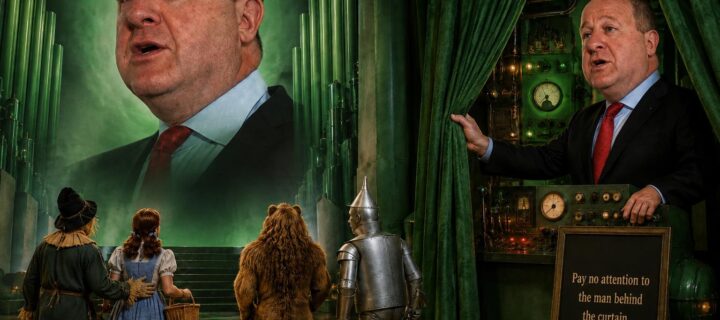
He was the libertarian-minded tech governor. The “different kind” of Democrat. The wealthy entrepreneur who promised efficiency over ideology, innovation over inertia, and a fresh political vocabulary that supposedly transcended the stale battles of the past. For a time, many bought the performance. The curtain stayed firmly closed.
But eventually, in politics as in The Wizard of Oz, the machinery begins to sputter. The smoke thins. The booming voice loses resonance. And somewhere in the back of the chamber, Toto pulls at the curtain.
What remains is not the great and powerful wizard. What remains is merely a man frantically working levers.
The Leader Who Never Was
History is crowded with political figures who mistook branding for leadership.
There was Ron DeSantis, once marketed as the inevitable heir to Trumpism before collapsing beneath the weight of his own synthetic persona. There was Michael Dukakis, whose technocratic competence could never ignite genuine public trust. There was British Prime Minister Liz Truss, whose ideological theater imploded in real time before the world’s financial markets.
And now there is Jared Polis.
The tragedy — or perhaps the farce — of Polis is not simply that his governorship appears to be collapsing. It is that the collapse reveals something darker: there may never have been much substance there to begin with.
Polis governed like a man permanently auditioning for a future role. A presidential run. A national media identity. A carefully focus-grouped brand called “reasonable futurism.” He floated above conflict, avoided moral clarity whenever possible, and cultivated the image of being smarter than the room without ever proving capable of leading it.
Colorado increasingly became a state managed through vibes, branding campaigns, and social media aesthetics rather than coherent civic vision. And eventually, voters notice.
The Emerald City Illusion
For years, Polis benefited from Colorado’s broader economic and demographic momentum. The state grew. Wealth poured in. Tech money expanded. Denver transformed into a glossy urban postcard marketed to affluent transplants.
But underneath the emerald glow sat worsening affordability, deepening housing crises, visible urban deterioration, and growing public frustration about safety, infrastructure, and basic governmental competence. The contradiction became impossible to ignore.
Polis often seemed less interested in governing Colorado than in narrating Colorado — endlessly promoting an image of innovation while ordinary residents confronted a state increasingly unaffordable to live in.
The Wizard projected grandeur on the giant screen. Behind the curtain? Panic. Improvisation. Hollow performance. The problem with governing as branding is that eventually reality insists on participating.
The Politics of Evasion
Great leaders absorb political risk when principle demands it. Polis perfected the opposite instinct.
Again and again, he positioned himself slightly outside the emotional center of consequential debates, forever triangulating, forever calculating. During moments requiring moral force, he often defaulted to managerial language and carefully sterilized ambiguity.
That instinct has now reached its grotesque culmination in the Tina Peters clemency debacle.
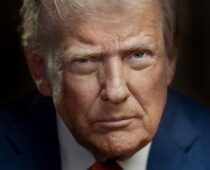
The decision to commute the sentence of the former Mesa County clerk convicted in an election security breach tied to 2020 election conspiracy theories detonated across Colorado’s political landscape. Even members of Polis’s own party reacted with fury and disbelief. Critics argued the move rewarded election denialism while signaling weakness in the face of pressure from Donald Trump and his allies.
Polis defended the clemency as a response to sentencing disparity concerns after an appeals court questioned aspects of Peters’s sentencing. But politically — symbolically — the damage may already be irreversible.
Because the issue is no longer merely Tina Peters. The issue is collapse.
The Final Flame in the Inferno
Every failed governing regime has its final defining image:
For Richard Nixon, it was the helicopter departure from the White House lawn.
For Rudy Giuliani, it was Four Seasons Total Landscaping.
For Jared Polis, it may well be the moment he chose clemency for Tina Peters.
Not because the legal arguments are entirely frivolous. Reasonable debate exists over sentencing severity. But leadership is not merely legal interpretation. Leadership is moral comprehension. It is understanding the symbolic weight of decisions within historical context.
And this decision landed like gasoline on an already raging fire.
At precisely the moment democratic institutions remain under sustained assault by election conspiracists, Polis handed one of the movement’s most celebrated figures a political victory. Trumpworld rejoiced. Election deniers claimed vindication. Colorado Democrats openly revolted. The wizard’s machinery exploded in plain view.
Pay No Attention to the Man Behind the Curtain
That line from The Wizard of Oz endures because it captures an eternal political truth: power often depends upon performance more than substance.
Jared Polis mastered performance politics. But performances cannot govern forever.
Eventually citizens ask harder questions. What did this administration actually build? What moral vision did it defend? What crises did it truly solve? What courage did it display when courage became expensive?
And increasingly, the answers feel uncomfortably thin.
The great irony is that Polis spent years cultivating the image of the pragmatic adult in the room — the sophisticated governor above partisan hysteria. Yet his governorship may ultimately be remembered for collapsing into exactly the kind of muddled opportunism he once implied he transcended.
The Emerald City flickers. The smoke machine dies. And standing behind the curtain is not a visionary statesman. Just another politician desperately pulling levers while the audience finally sees the truth.
—————————
From: Politix INK
https://mikebroemmel.com/politix-ink