





A community outcry against Flock Security Systems occurred at Longmont’s city council meeting last night. Nearly every seat was full and 90% of those in attendance were there to urge their city council to not renew their contract with Flock, some going further to request that all existing Flock cameras be removed.
Flock is the security system that’s been sweeping the nation with its Automated License Plate
Recognition programming (ALPR) and its concurrent controversies. According to Longmont’s transparency statement, ALPR is being used to capture computer-readable images of license plates to compare against those of stolen vehicles or cars present at a crime scene. Using ALPR police can determine if a vehicle was at a crime scene. ALPRs can integrate data from national or state crime databases for real-time alerts.
The controversy was sparked by multiple instances of Flock’s AI recognition program providing false positives or being mis-interpreted, as in the case of a Denver woman who was wrongly accused of stealing a package by Columbia Valley police. The presumption of guilt rested entirely on an image of her car driving through the same part of town where the package was stolen. The Denver woman then had to spend weeks proving her innocence.
There have also been troubling cases of data misuse. The Loveland Police Department granted account access to the Bureau of Alcohol, Tobacco, Firearms and Explosives, and ATF agents then used Flock data to run searches for Immigration and Customs Enforcement (ICE). This violated state law, which bars sharing this information with immigration authorities without a warrant or court order. Flock later acknowledged that as the owner of the collected data, it has a standing agreement allowing immigration agencies full access to camera data from any police department that accepts the invitation.
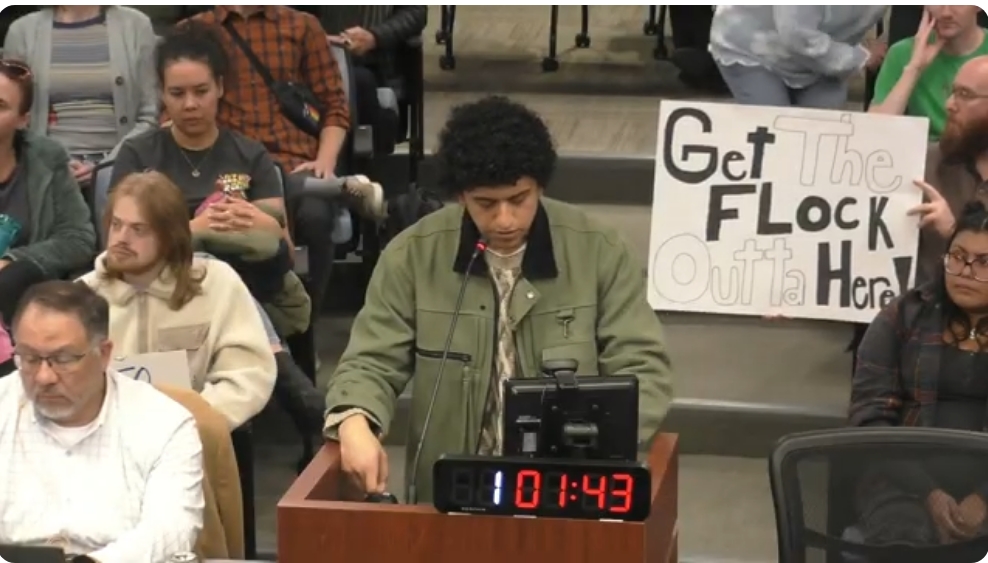
A Longmont resident gives public comment during the City Council meeting on Dec. 9, speaking out against Flock. Photo taken by Sprout Foster
Two of the biggest concerns expressed last night, however, were transparency and privacy.
Lead software engineer and Longmont resident Andrew Gentry noted, “Longmont’s websites states the community’s safety cameras do not perform predictive analytics or facial recognition. That same assurance is absent from the Flock page, leaving me to believe that this
privacy standard may have been quietly discarded with Flock’s adoption.”
Gentry went on to say, “Flock’s retention policy doubles the length of retention used for community canvas, from 14 days to 30 days, once again signaling to me that the Flock program has been a convenient way to stretch existing privacy standards.”
The city argues that renewing the Flock contract will improve community safety. Community members like Gentry point to the flat trend of car theft in Longmont since the cameras went up, and Diego Luis cites a 2021 Electronic Frontier Foundation analysis that looked at 63 police departments in California and found that only 0.05 percent of millions of scanned plates were tied to any suspected wrongdoing.
Luis also raised concerns about the technology’s accuracy, referencing an innocent Aurora family held at gunpoint and a San Francisco driver that was “handcuffed and humiliated,” only for police to later admit the car wasn’t even the same make or model of the suspect.
“Instead of requiring a warrant or individualized suspicion, Flock cameras allow police to conduct location tracking on everyone all the time. This turns what should be targeted, more base searches into mass surveillance systems that bypass judicial oversight entirely.”
Another lead software engineer, Kellen Lesk, spoke from a decade of experience and graduate-level machine learning training to emphasize how insecure Flock’s data protection systems are, saying, “It’s just as secure as your grandma’s email address.”
He outlined how easy it is to pull imagery from the cameras and how Flock’s privacy promises can be easily broken.
“They use internet connectivity to update these camera. How we do this in the software industry is we load all of the software that we could ever want onto the device, and then we use what’s called feature flagging to turn off and on features. [Flock] says they don’t do facial recognition and person identification, but I guarantee the software is on those cameras and they just have it disabled. And that is a five minute update to turn it on.”
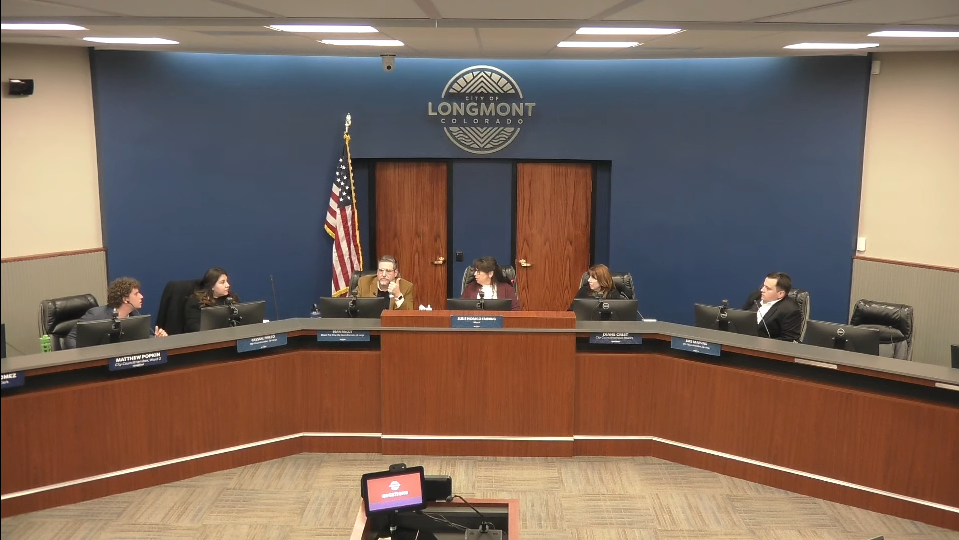
Longmont City Council members deliberate during the Dec. 9, 2025, meeting.
Photo by Sprout Foster
Despite Flock’s promises that private data won’t be shared, many companies rely on Data Clean Rooms, where information can be uploaded and cross-referenced. Only the final results are shared, allowing companies to claim they never “shared” the underlying data even as it’s used to draw detailed conclusions.
During public comment, many residents warned that Flock’s system enables constant monitoring that can build a detailed portrait of daily life. It can reveal who someone meets, where they go, and the routines that define their private world. Speakers pointed to real examples of abuse. In Texas, a woman seeking an out-of-state abortion was tracked and told she would be prosecuted if she returned. Officers elsewhere have used surveillance tools to stalk ex-partners, spy on neighbors, monitor activists, and look up journalists.
After four hours of testimony and debate, the council voted 5–1 to reject any future expansion of the city’s contract with Flock.
The ones who dared to fight City Hall.
When Boulder denied public access to police body-cam footage, we took it to court. Our fight for transparency is now before the Colorado Supreme Court — because accountability doesn’t stop at the city line.
Through December 31, every gift to Yellow Scene will be matched — dollar for dollar — through the Colorado Media Project’s Matching Grant.Give & Get Democracy this Holiday Season. Your $8 recurring monthly support not only gets you YS delivered to your house, but it’s matched for the entire year, bringing that $8/month to $192.
Because Independent journalism isn’t just about telling stories. It’s about protecting your right to know, holding power accountable, and keeping democracy in the light. This is #newsCOneeds Becoming a sustaining supporter today for $8 a month!