





Residents in Lafayette are pushing back against a proposed self-storage facility, arguing that the project would bring an oversized, industrial building to a site that does not fit the surrounding neighborhood.
1784 Capital Holdings LLC is proposing to develop a new 89,592-square-foot, climate-controlled self-storage building, with a caretaker dwelling unit, at 685 Aspen Ridge Drive. According to a Planning Commission memo, the project requires a Special Use Review (SUR) and a Site Plan and Architectural Review (SPAR). Staff analysis notes that SUR criteria include municipal code compliance, environmental impacts, and compatibility with the character of the surrounding area, hours of intrusion, and noise levels. Several residents, like Megan Rast and Christy Clarke, complain that this proposed unit fails to meet these criteria.
This friction stems from the fact that self-storage facilities do not fit neatly into residential or mixed-use districts, meaning developers need special approvals where the use is conditional. Compatibility concerns are the most consistently documented issue, and distance measurements between the building and adjacent homes remain disputed. Because planners increasingly view these facilities as “low-value” land that creates “dead zones” instead of contributing to active, walkable development, cities like Arvada and Denver have enacted moratoriums specifically prohibiting storage facilities in key growth areas.
Beyond land-use compatibility, neighborhood opposition is also driven by pressing safety concerns, particularly regarding fire risk. Colorado has seen multiple self-storage fires in recent years, demonstrating that even with modern construction, these facilities can pose challenges. Across the US, self-storage fires have resulted in major structural damage, destroying dozens to hundreds of units. A study released by the National Fire Protection Association (NFPA) in December 2025 found that these buildings present challenges to fire services due to “compartmentalization and unknown content loads.” The NFPA study argues that modern buildings are larger, more complex, and harder to access than older ones, concluding that departments and owners need to plan together before construction.
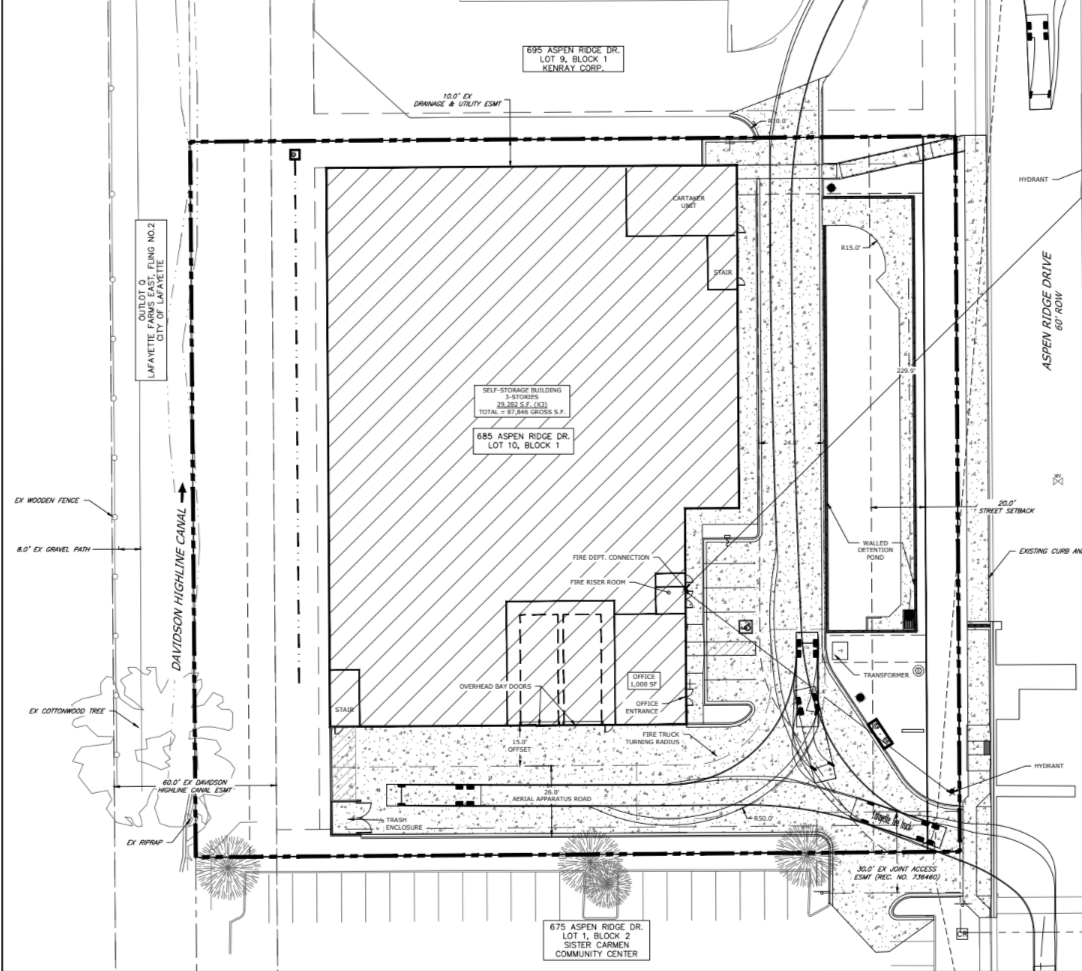
Mockup of site plan courtesy of the city
While the Lafayette Comprehensive Plan emphasizes a “connected, vibrant and walkable community” to guide future development, city officials ultimately determined the project met local requirements. In a statement to Yellow Scene Magazine, Lafayette officials said the city council carefully reviewed both the SPAR and SUR criteria before approving the application by a 5-2 vote with conditions. The city emphasized that the decision turned on the evidence in the record and the council’s discretion, particularly its finding that the proposed use was compatible with the surrounding area. Officials also noted that Black Diamond, where the property is located, was zoned industrial in the 1980s, while Anna’s Farm was approved for residential development in 2002–2003 with the acknowledgement that it bordered industrial land.
“City staff believes that the self-storage special use is less impactful to the neighbors than other industrial uses, which can be developed by-right in Black Diamond. Staff’s review was also influenced by the fact that another self-storage facility exists within the Black Diamond subdivision and was previously found to be compatible with the area. The fact that the by-right industrial uses would be more impactful to residents and were found to be compatible in 2002-2003 when residential development associated with the Anna’s Farm subdivision was approved could have been explicitly stated in the staff memo.”
This local dispute reflects a broader pattern for 1784 Capital Holdings, a Denver-based private equity firm that buys industrial and self-storage properties across the West. Its role in Lafayette sits within a larger, national conversation about how investor-driven development occurs on historically and culturally sensitive land. In Maryland, the Bethesda African Cemetery Coalition (BACC) has been struggling since 2017 to protect Moses Macedonia African Cemetery from what it terms “desecration” after 1784 Capital Holdings bought land covering the cemetery to build a multi-level self-storage facility.
“The Bethesda area has extraordinary demographics and extraordinary market fundamentals,” the company’s CEO said in a press release at the time.
“It is a significantly undersupplied market with three times the national average for rent. We chose the site because it’s one of the last zoned and developable parcels of land for self-storage in Bethesda.”
A statement by Kelly McKone of Capital Holdings said that the BACC is “spreading misinformation about the project,” but the coalition maintains that the site is historically significant and may contain human remains. A 2017 independent review by The Ottery Group found that the area was used as a burial ground, though it said more investigation was needed, and the company found evidence that the land was used as a cemetery beginning in 1911.
Capital Holdings did not respond to request to comment.
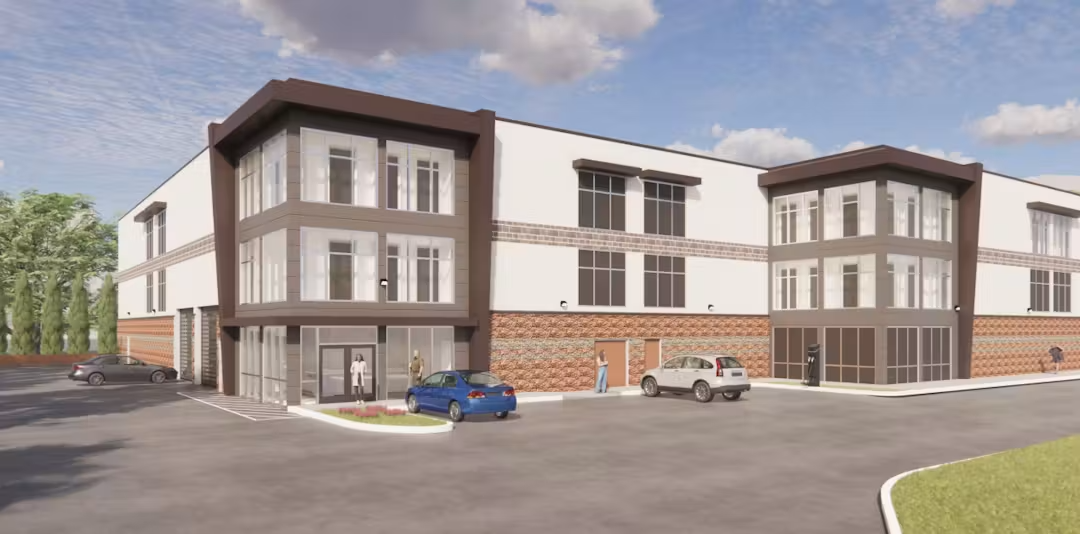 Back in Lafayette, residents worry that the city is prioritizing developer-driven industrial and storage uses over the day-to-day quality of life in nearby neighborhoods. Christy Clarke discussed this tension in an interview with Yellow Scene Magazine.
“One of the things that I am increasingly considering important is like, if not this situation, then when does public input really matter?” Clarke said. She noted that the bigger question is when public input actually matters if it does not seem to change the outcome, pointing to a perceived fear of litigation. “There seems to be a fear of litigation, with city decisions seemingly driven by the concern that a developer might sue. While legal risk does matter, it shouldn’t outweigh everything else in a planning decision.”
Despite the setback, residents maintain that organizing the opposition brought the community closer together. Clarke emphasized that even if residents ultimately lose this fight, the process has still been worth it if it strengthens community ties and helps future neighborhoods challenge questionable proposals more effectively. Their efforts have already brought people together, and she believes the message should not be that the efforts were wasted, but that residents participated in the democratic process, got to know their neighbors, and perhaps helped set a better precedent for what happens next.
Yellow Scene’s 2026 Summer Support Drive is underway with a goal of 1,000 Sustaining Supporters by summer’s end.
For 26 years, we have remained fiercely independent, free from sponsored content and outside editorial influence.
Reader-driven support keeps local journalism unbossed, unbought, and our journalists fed. Become a sustaining supporter for $8/month and get Yellow Scene delivered to your home.
Join the Summer Support Drive and keep local journalism strong.