





Driving down Public road in Lafayette, you may notice black tall cameras, adorned with a solar panel, taking continuous snapshots of vehicles’ rear license plates. These Automated License Plate Recognition (ALPR) Flock AI-cameras from Flock Safety have centered in community discourse due to growing concerns surrounding surveillance and risk of misuse by police and federal agents.
30 cameras were installed in 2022 by the Lafayette Police Department (PD) around the city, with no more installed since. Community interest for discussion around the cameras was not high at first, but Detective Commander Scott Emerson noticed more concern after an influx of social media posts and alleged “misinformation” around Flock, said Emerson.
Perhaps due to this growing interest, on June 17th, more than a dozen Lafayette community members settled into a dimly lit room in the Lafayette PD building as three officers and two Flock camera spokespeople put on “Cop Talks #2: Facts About Flock Safety Cameras.”
The Cop Talk, part of a series of presentations held by the Lafayette PD meant for conversations within the community, began with a presentation given by Detective Sergeant Jason Thompson. The PD began searching for a “law enforcement force multiplier” after a spike in car-related crimes in 2020.
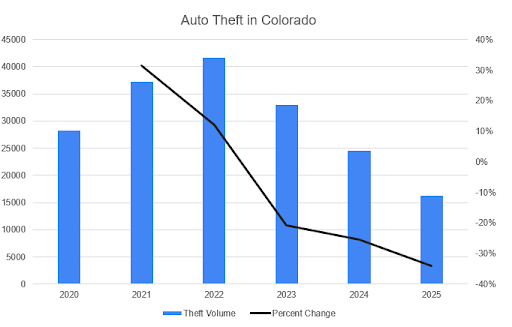
According to the Colorado Department of Public Safety May 2026 Newsletter, in Lafayette, auto thefts skyrocketed from 61 in 2020 to 120 in 2022, an increase of 64%. In Colorado overall, auto theft rates dropped from 18,450 in 2022 to 7,480 in 2025. Detective Thompson said this large drop can be attributed to the Flock cameras. Chart is courtesy of coloradocrimestats.state.co.us/tops
These cameras are different from the Blissway speeding cameras on Diagonal Highway. Unlike the speeding cameras in Boulder, Flock cameras are fixed, motion-activated ALPRs meant to investigate crimes and wanted persons. The PD originally hoped to use the cameras for traffic enforcement as well. Flock’s speeding cameras would require photos with identifying features in them. The public was concerned with the possibility of discriminatory policing based on these photos, as well as worries that these cameras would be abused by the department to profit from speeding tickets. Lafayette PD scrapped the idea after the backlash.
The current Lafayette AI Flock Safety system has two primary components: The hotlist and audits. According to the PD, Flock cameras can provide police officers with near real time alerts as well a hotlist, or a database of license plates and vehicle descriptors associated with the wanted car and photos of the rear of the vehicle.
Officers also have to click a legal agreement before signing into the Flock Safety system, pressing a small button saying “Accept and Continue” below a compliance message. In accordance with Colorado law, “We are not using this for unauthorized purposes,” said Thompson, “we’re not using it for immigration enforcement or reproductive care.” He said the legal agreement before sign-in is “an important accountability piece.”
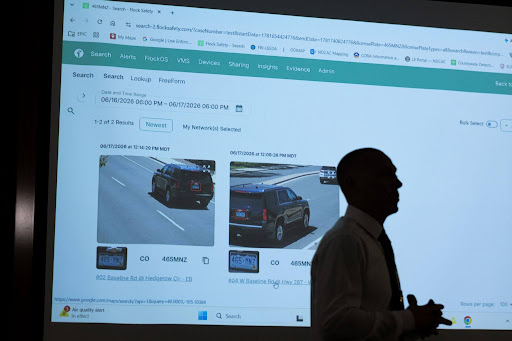
An example of a hotlist on the Flock Safety website, narrowed down to a specific timeframe. Flock provides a photo of the vehicle’s rear, the color/make/style/other notable descriptors of the vehicle, the date and time the image was captured, and the direction of travel. The Lafayette PD says this data is “common practice” to have. Photo courtesy of Finn Feldman
While these statements regarding how Lafayette intends to use Flock are important, their practical application faces a hard legal reality. As Yellow Scene Magazine has previously reported, the Electronic Frontier Foundation (EFF) emphasizes that local data protection claims are essentially hollow; regardless of what a city government promises, the federal government can demand access to their citizen data at any time, for any purpose, because state and federal laws prevent cities from withholding that information.
Lafayette PD says they looked at 9 different major ALPR systems and settled on Flock primarily for its proclaimed privacy concern considerations. Flock claims that it deletes photos taken after 30-days and that the company does not sell customer data. Flock also boasts that it has not had cloud data breaches. Contrary to these claims, local news reports demonstrate flock camera feeds have been exposed in an internet data breach, and their data on license plates have been accessed through search engines. Denver removed all its Flock cameras after it was found federal agencies have bypassed ICE/DHS restrictions by having PDs run searches for them. A blog post by Flock says “ICE does not have direct access to Flock cameras, systems, or data, unless the agencies that control their data expressly and deliberately allow it.”
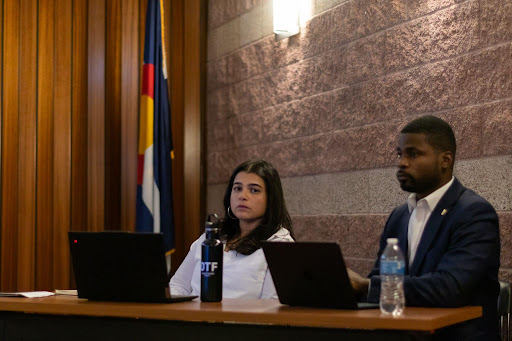
Flock Safety Public Affairs Officers Bia Campbell (left) next to Jalen Johnson (right) answered a few questions at the Cop Talk, ending off by promoting themselves as an honest company whose clients are both the PD and the community. Courtesy of Finn Feldman
Unlike many of its neighbors, the city of Lafayette currently has a five year contract with Flock that started in 2022 after four community meetings and a city council workshop. The Lafayette PD argues that departments such as Fort Collins, Denver, and Louisville will fall behind with their abandonment of Flock cameras after widespread criticism of surveillance and AI caused these cities to end contracts. With the use of AI in Flock’s vehicle search system, Lafayette PD says officers must check to see if the AI correctly got the license plate—for example, to make sure Flock’s AI doesn’t read a 0 (zero) as an O on the plate. Another alleged “safeguard” is Flock’s AI auditing system, used to track if any suspicious activity is occurring with officers’ searches. Flagged audit reports are then sent to a team of four Lafayette PD administrators to review, and then an audit completion report to Emerson.
Chris Anderson, a community member who works in IT, has concerns over the AI camera use and auditing practices, saying “AI is foulable right now.” Anderson pressed the PD to have an external group check their reports, worried about how “their own system is auditing it.”
The PD in their presentation said these twice monthly searches are being done internally and externally, but later during community discussion said only the four administrators are checking the AI flagged/human created audits. Emerson said after his main take away is to look into how other PDs may be using an external auditing system for “best practice.”
Lafayette City Councilor Annemarie Jensen confirmed an external auditing system was brought up at past town meetings, but says “Lafayette is a small town with a small budget” and thinks it may not be worth the cost.
Anderson also questioned the PD around controversies surrounding Flock, including 404 Media’s reporting of ICE agents using the cameras for immigration enforcement and alleged improper storage of data, asking “How are you holding Flock accountable?”
Emerson responded, “I have done my due diligence in looking into the matter,” and said all the claims were not verified. Spokesman Johnson responded as well, stating “these [allegations] are not verifiable.”
Despite these refutations, local advocates and residents continue to challenge the police department’s stance. Among them is Will Freeman, founder of the anti-ALPR website DeFlock, who has filed a class-action lawsuit against the neighboring city of Boulder over its use of the technology. Freeman and another Boulder resident, Gwen Steel, are currently awaiting a court order for class certification, signaling that community pushback against automated surveillance remains a growing legal hurdle for local governments.
Yellow Scene’s 2026 Summer Support Drive is underway with a goal of 1,000 Sustaining Supporters by summer’s end.
For 26 years, we have remained fiercely independent, free from sponsored content and outside editorial influence.
Reader-driven support keeps local journalism unbossed, unbought, and our journalists fed. Become a sustaining supporter for $8/month and get Yellow Scene delivered to your home.
Join the Summer Support Drive and keep local journalism strong.