




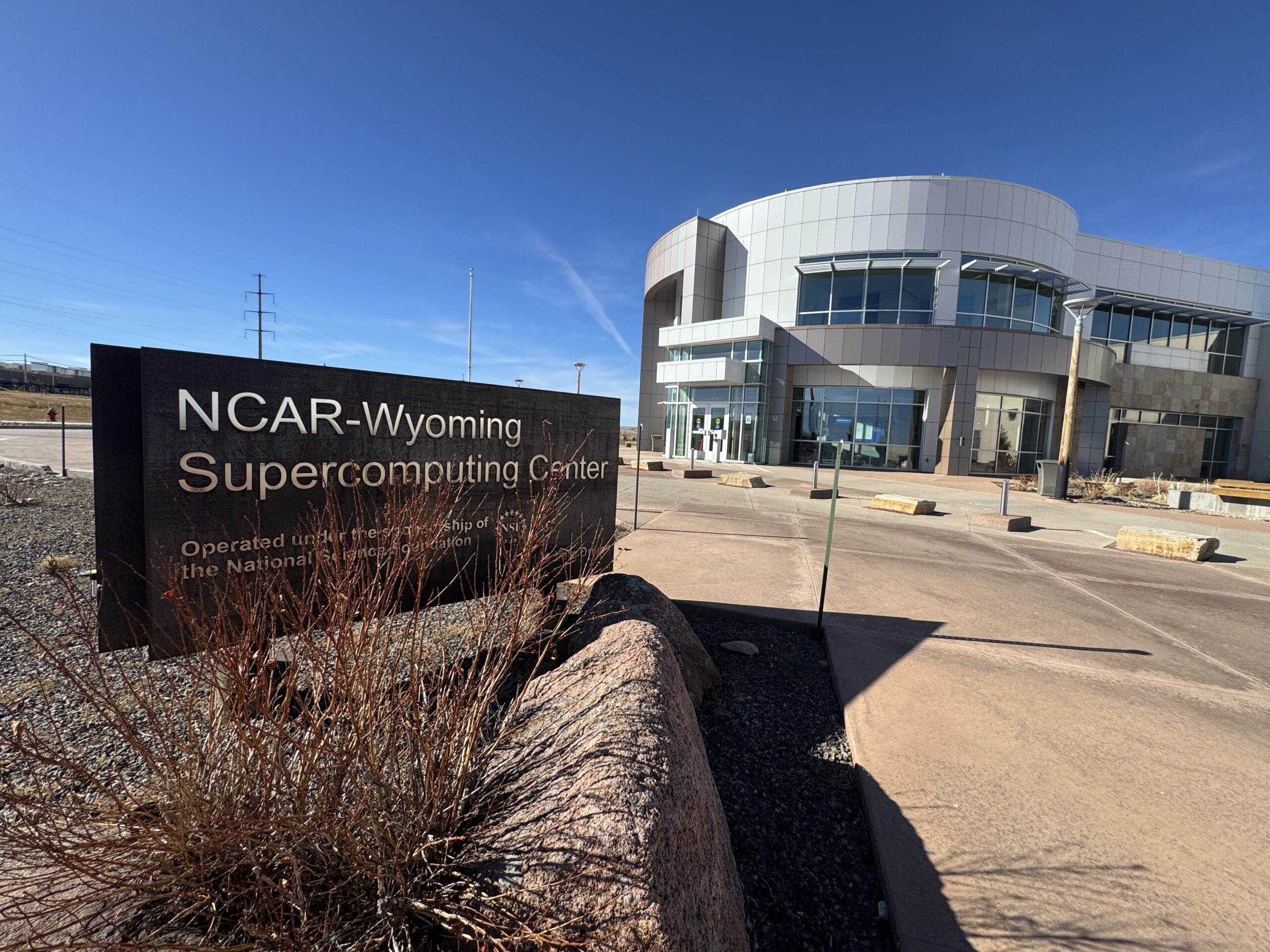
In the high prairie of southern Wyoming, just west of Cheyenne, a glass-fronted building houses one of the world’s most powerful supercomputers. Named “Derecho” by a Wyoming middle schooler, this house-sized machine can process every document in the Library of Congress faster than a human can blink.
Derecho “thinks” at a rate of twenty quadrillion calculations per second. But Derecho isn’t reading books in the Library of Congress. It has a more specific mission. Derecho is there to help us understand and predict the Earth’s weather and climate, taking in and analyzing massive volumes of input data from the Earth’s many weather-influencing systems and events.
For instance, it could calculate how smoke particles from a fire in western Colorado may interact with ice crystals in a Front Range thunderstorm to determine the likelihood of a hailstorm. It can analyze and visualize the patterns of “sub meso-scale” ocean eddies (little swirls in the ocean just a few kilometers wide) across the entire Pacific Ocean to simulate rates of oceanic carbon absorption.
Derecho is just one part of the scientific infrastructure overseen by the Boulder-based National Center for Atmospheric Research (NCAR). Recently, the Trump administration has signaled the possible dismantling or relocating of NCAR. The center is funded by the National Science Foundation (NSF), an independent federal agency that reports directly to the Executive Office of the President.
While the political motivations behind such a move warrant their own investigation, this article delves into NCAR’s inherent value in its current form and the impracticality of its relocation.
“Science thrives when politicians, Democrat or Republican, stay out of it,” said Dr. Roger Pielke, Professor Emeritus at the University of Colorado at Boulder.
Dr. Pielke is a former NCAR scientist, founder of the Center for Science and Technology Policy Research (CSTPR), and a longtime Fellow at the Cooperative Institute for Research in Environmental Sciences (CIRES). He took the time to speak with me while traveling in Australia.
As Dr. Pielke explained, while NCAR is primarily funded by the NSF, it is managed by the University Corporation for Atmospheric Research (UCAR), a consortium of about 130 North American colleges and Universities. Two of those universities sit at NCAR’s doorstep: the University of Colorado Boulder (CU) and Colorado State University (CSU) in Fort Collins. Both universities are among the best in the nation for weather related research.
The Trump administration has argued that research institutions like NCAR should be relocated from “elite” coastal or mountain locations to the “industrial heartland.” But NCAR didn’t land in Boulder arbitrarily. It sits at the center of one of the densest concentrations of atmospheric and environmental science in the country — and moving it would sever those connections entirely.
Within a roughly 50-mile radius, NCAR neighbors:
- National Oceanic and Atmospheric Administration (NOAA) in Boulder
- The Earth System Research Laboratories (ESRL) in Boulder. They monitor global carbon dioxide levels
- Space Weather Prediction Center (SWPC) in Boulder. They are the nation’s source for alerts on solar flares and magnetic storms
- Cooperative Institute for Research in Environmental Sciences (CIRES) in Boulder in partnership with CU
- Cooperative Institute for Research in the Atmosphere (CIRA) in Fort Collins in partnership with CSU
- National Renewable Energy Laboratory (NREL) in Golden
- National Wind Technology Center (NWTC) just south of Boulder
Furthermore, the combination of top universities and infrastructure means that the Front Range arguably harbors the highest concentration of atmospheric science talent in the world.
NCAR employs over 800 people in the Boulder area, many of whom would likely choose not to relocate to an “industrial heartland,” due to the likely smaller talent pool for this kind of specialized knowledge . Consequently, moving NCAR’s headquarters would likely trigger a major “brain drain” in a highly complex, data-heavy discipline.
There is precedent for this. In 2019 two U.S. Department of Agriculture agencies were moved from Washington D.C. to Kansas City. In that instance approximately 75% of the impacted workforce chose to resign or retire rather than move. While the reduction in staff through “forced attrition” may have been part of the goal, the result was a substantial set-back to the progress and effectiveness of these agencies.
One of the reasons why it’s important that NCAR remains on the leading edge of global atmospheric research is because of international competition in the sciences. “There is a need in the U.S.,” said Dr. Pielke “to ‘up the game’ in weather prediction.” Attempting to decommission or relocate NCAR would substantially reduce America’s global competitiveness in weather and climate science precisely at a time when accelerating scientific advancements are most needed. “The view from thirty-thousand feet is that any scientific institution can be improved upon,” said Dr. Pielke, “but what the Trump Administration is doing is not helping that.”

National Center for Atmospheric Research (NCAR), Boulder, Colorado. Designed by architect I. M. Pei with landscaping by Dan Kiley. Photo: Daderot, September 2005 (CC BY-SA 3.0)
Furthermore, the combination of top universities and infrastructure means that the Front Range arguably harbors the highest concentration of atmospheric science talent in the world.
NCAR employs over 800 people in the Boulder area, many of whom would likely choose not to relocate to an “industrial heartland,” due to the likely smaller talent pool for this kind of specialized knowledge . Consequently, moving NCAR’s headquarters would likely trigger a major “brain drain” in a highly complex, data-heavy discipline.
There is precedent for this. In 2019 two U.S. Department of Agriculture agencies were moved from Washington D.C. to Kansas City. In that instance approximately 75% of the impacted workforce chose to resign or retire rather than move. While the reduction in staff through “forced attrition” may have been part of the goal, the result was a substantial set-back to the progress and effectiveness of these agencies.
One of the reasons why it’s important that NCAR remains on the leading edge of global atmospheric research is because of international competition in the sciences. “There is a need in the U.S.,” said Dr. Pielke “to ‘up the game’ in weather prediction.” Attempting to decommission or relocate NCAR would substantially reduce America’s global competitiveness in weather and climate science precisely at a time when accelerating scientific advancements are most needed. “The view from thirty-thousand feet is that any scientific institution can be improved upon,” said Dr. Pielke, “but what the Trump Administration is doing is not helping that.”
The competition is, in fact, strong. In Europe, NCAR’s equivalent is the European Centre for Medium-Range Weather Forecasts (ECMWF). It is an intergovernmental organization supported by 35 nations and widely considered the leader in global numeric weather prediction.
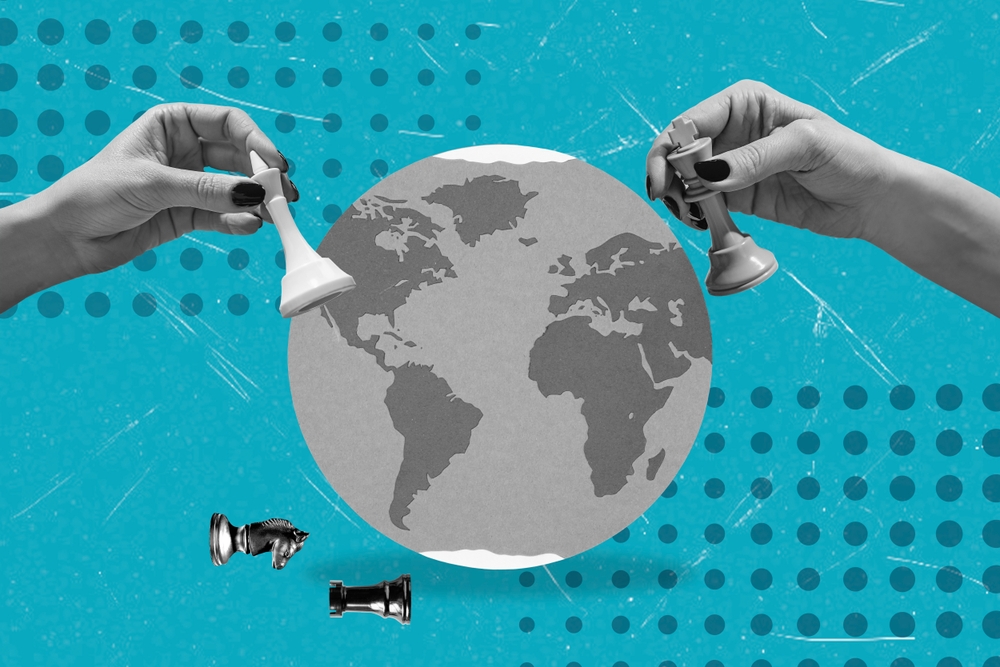
The Europeans utilize a multinational cluster of supercomputers that is more scalable and powerful than Derecho or the operational U.S. forecasting systems, Cactus and Dogwood, which operate out of Arizona and Virginia, respectively. When fully utilized, the European supercomputers can outpace Derecho, Cactus, and Dogwood multiple times over, partly by leveraging Finland’s LUMI system. LUMI by itself is currently the world’s fifth most powerful supercomputer with a peak performance of 380 sustained petaflops (compared to Derecho’s 20 petaflops).
LUMI is being utilized for the European Commission’s Destination Earth (or DestinE) Initiative, an ambitious plan to create a complete digital twin of the Earth and all of its “systems” by 2030. Europe’s digital twin Earth will bring the scale of their geographic modeling down to 1 kilometer which will allow for the real-time simulation of individual clouds and urban heat islands among other very granular weather features.
On the other side of the planet lies China and its own very ambitious equivalent to NCAR, the Institute of Atmospheric Physics (IAP), a division of the Chinese Academy of Sciences (CAS). China’s equivalent to NCAR and ECMWF is their Earth System Numerical Simulator Facility, or EarthLab, opened in Beijing in 2021. Its goal is similar to Europe’s DestinE platform—to simulate the atmosphere, ocean, land, cryosphere (ice), and biosphere of the Earth as a single unit.
These global competitors are well-organized, highly funded, and poised to race ahead of American atmospheric science innovation should we let politics blow headwinds into our progress. American innovation has long been rooted in world-leading scientific research. Losing our competitive edge in atmospheric science research may shift the focus of innovation to other world regions. Those competing regions will then gain the economic opportunities that always follow scientific discovery and innovation.
What NCAR Means to Those Who Rely On It
Kody Wilson is a Colorado-based independent meteorologist. His Facebook page, Denver & Front Range Weather, now has over a half-million followers, myself included. By going independent, Wilson is able to provide the depth and nuance to weather forecasting that traditional news station meteorologists just can’t match with a 5-minute weather segment on the evening news. Wilson’s large local following is a testament to his work ethic and the simultaneously entertaining and educational ways he presents our complicated weather.
It’s also a testament to the fact that people love to talk about the weather. A weather event is often at the center of extraordinary life experiences—both good and bad. Perhaps it was the Christmas Eve Blizzard of ’82, or the Limon tornado, or Hurricane Andrew, or some other weather experience, but just about everyone can point to a weather-related event in their lives that impacted them in a major way.
For some of us, these weather-related experiences lead to a lifetime career in meteorology. Wilson explained to me how, as a middle school aged kid, “a powerful microburst hit our home and farm in eastern Oregon. The damage was so intense we initially thought a tornado had come through. One hundred-year-old cottonwood trees were ripped out of the ground. The roof of our calving shed was torn off and thrown across the yard. Two by fours were driven into a storage freezer in our shop.”
“Moments like those didn’t scare me away from the weather,” Wilson said “They deepened my curiosity and strengthened the path I already felt called to follow.”
NCAR has been instrumental in Wilson’s career. “Many of the models, datasets, and forecasting tools I rely on, including advancements in the Weather Research and Forecasting (WRF) system, originate from NCAR’s research,” Wilson said. “Their work turns complex atmospheric science into usable guidance, and my role is to translate that guidance into clear, real-time information that helps communities make decisions… In that sense, NCAR provides part of the scientific backbone, and I carry that science across the finish line into the real world where it protects lives and supports local communities.”
I asked Wilson what he thinks NCAR’s value is to Colorado: “NCAR isn’t just a building in Boulder, it’s one of the engines behind the tools meteorologists rely on every day to help protect lives [and] property… across Colorado and beyond,” Wilson said. “It also supports major research investment into the state, making it a tangible asset for Colorado taxpayers. Dismantling NCAR would be a costly step backward, not just for science, but for public safety, economic resilience, and the future of weather preparedness in the West.”
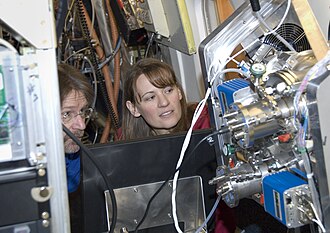
Climate researchers from the NCAR preparing for the ARCTAS mission.
As I write this, Dr. Scott Denning, Professor Emeritus of Atmospheric Science at Colorado State University, is on a ship somewhere in the Indian Ocean teaching undergrads in a “Semester at Sea” program. He was kind enough to take the time to answer my questions about NCAR and how it relates to his life work.
Early in his career, Dr. Denning worked closely with the late Dr. William Gray, CSU’s pioneering hurricane scientist. The fact that the world’s foremost hurricane scientist operated from a university about as far as one can get from the ocean is a testament to the value of CSU’s proximity to the atmospheric research facilities in Colorado’s Front Range, like NCAR.
“He was a warm, funny, brilliant man,” said Dr. Denning of Dr. Gray. “And he was my friend and neighbor.” According to Dr. Denning, Dr. Gray had “worked out the structure and function of these storms based on his own personal field work before anybody had ever seen a satellite image of a hurricane!” Dr. Gray’s pioneering pencil-and-paper theoretical work was complemented by NCAR’s tools in data and airborne instrument measurements to create a legacy of hurricane forecasting and modeling that persists to this day.
Dr. Denning, of course, has his own long history in working with NCAR. “I’ve worked closely with both land-surface modeling and biogeochemistry groups [at NCAR] for decades,” said Dr. Denning. “It’s been just fantastic to collaborate ‘right down the road’ for all these years! Great people, great facilities, and a concentration of expertise that’s just unmatched anywhere in the world.”
“The new frontiers [at NCAR],” said Dr. Denning, “include fusion of satellite remote sensing, numerical modeling, and AI. I’m especially interested in how these new tools relate to the study of the fate and transport of atmospheric CO2.” I asked Dr. Denning why Colorado’s Front Range is the ideal location for NCAR, and his response reinforces my research: “The Front Range is a great place for NCAR and its work because of the tremendous concentration of scientific work here: NOAA, the USDA, the USGS, and our great universities and people.”

Show more 11:46 PM View of Boulder, Colorado from the NCAR mesa, southwest of the city. Photo: Laurascudder, December 1999 (CC BY-SA 3.0)
Clearly there is a passionate community here in Colorado and around the world for atmospheric science. But, some of it can seem a little abstract. The idea of creating an Earth digital twin or the ability to simulate a single cloud may not seem like they have much everyday use. But NCAR’s historical value has often been found in common-sense solutions to big problems.
“Climate change is important,” said Dr. Pielke, “but it’s really a small part of NCAR’s portfolio. Much of what NCAR does has practical applications.”
Improvements to Air Travel Safety
These days we don’t hear much about airplane crashes caused by strong winds, but that wasn’t always the case. Prior to the 1990s, low-level wind events—specifically wind shear and microbursts–were the leading cause of major U.S. airline accidents, including a Delta flight in 1985 that crashed while attempting to land in Dallas due to a sudden microburst, killing 137 people.
This and other weather-related crashes prompted NCAR scientists to lead field studies that resulted in the creation of new detection systems like the Low Level Wind Sheer Alert System (LLWAS). As a result of this work, airports around the world now have a perimeter of low-level wind detection devices and specialized radar systems that detect surface-level winds and immediately alert cockpits to threats. Since 1995 there have been zero major U.S. airline crashes caused by microbursts, and only one (Little Rock, 1999) where wind shear was a contributing factor. These NCAR-led solutions have saved thousands of lives and made air travel substantially safer in recent years.
NCAR’s work towards aviation safety continues today as they are currently working with the airline industry and the Federal Aviation Administration (FAA) to outfit aircraft with turbulence-detection devices that automatically report and feed into air traffic control alert and communication systems. Without this solution, pilots are asked to voluntarily report turbulence to air traffic controllers, a slow and ineffective system. The new automated detection system for turbulence will utilize the “big data” of thousands of simultaneous airborne flights to model flight path turbulence risk, giving air crews better real-time information on turbulence and alternative flight paths to find smoother air. This could save the aviation industry tens of millions of dollars annually by avoiding turbulence-related damage, injuries, and delays.

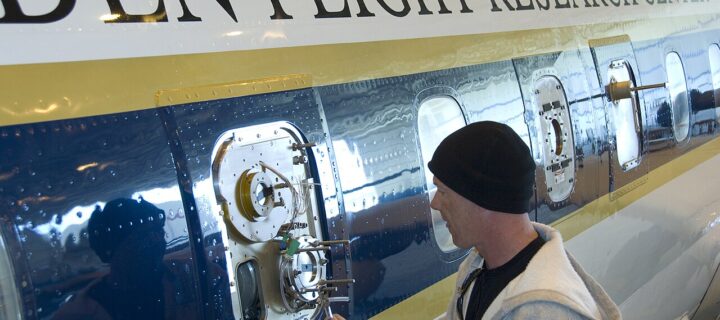
Climate researchers from the National Center for Atmospheric Research (NCAR) and several universities install and perform functional checkouts of a variety of sensitive atmospheric instruments on NASA’s DC-8 airborne laboratory prior to beginning the ARCTAS mission.
Innovations in Wildfire Detection and Mitigation
The practical contributions of NCAR go well beyond low level wind detection. In the early 2000s, NCAR developed the Coupled Atmosphere Wildland Fire Environment (CAWFE). Large wildfires create their own weather. This model allows meteorologists and on-location firefighting agencies to better predict fire behavior, improving firefighting strategies and public safety measures. This technology contributes to the smoke forecasting we’ve seen in recent years where forest fires in Canada, for example, create bad air quality in New York.
A visitor to the NCAR facility in Wyoming, where Derecho resides, offers the opportunity to see first-hand the wildfire modeling that massive supercomputing can accomplish. Right there in the visitor area you can watch a precise simulation of the behavior of the December 2021 Marshall Fire as it jumped and spread into the northern Denver metro suburbs by hurricane-force chinook winds.
The future of fire weather science through NCAR involves AI applications that can accelerate mitigation and firefighting responses through real-time simulations of fire behavior that take into account micro-scale inputs like low-level winds, urban street topology, and the impact of “ember storms” that can ignite new spot fires across highways and fields.
Agriculture
Two of the most compelling recent initiatives from NCAR combine weather and climate science with tangential interests like agriculture and disease prevention. For agriculture, NCAR is working on a program called CropSmart, a digital twin solution presented pragmatically as a decision-making tool for sustainable agriculture. The modest nature of that description hides a very sophisticated technology-centered solution for vastly improving the efficiency and sustainability of agricultural production, one of the planet’s most impactful systems on climate and the human condition.
CropSmart will provide growers with an end-to-end application and web-based tool for planning and decision making based on the digital simulation of their land combined with the inputs of local precipitation, soil conditions, and irrigation flows.
Disease Prevention
The mosquito is the deadliest animal on Earth. It kills almost a million people every year by transmitting disease. The prevalence and spread of disease-bearing mosquitos is heavily influenced by climate and weather patterns.
NCAR has helped pioneer modeling systems that predict where and to what extent mosquito outbreaks will occur so that public health officials and municipalities can proactively mitigate or reduce the risk to their communities, saving lives and improving overall public health.
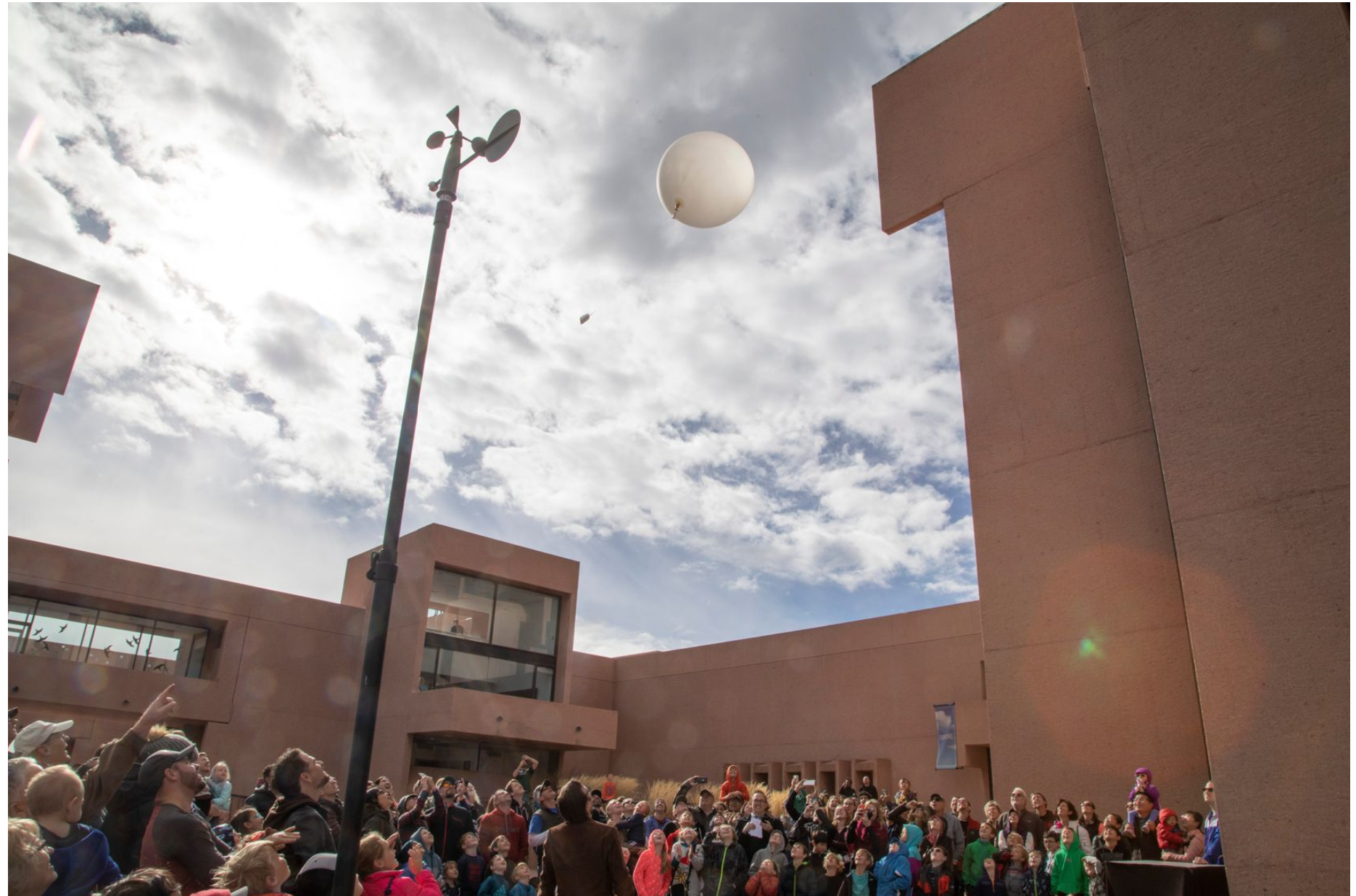
Balloon launch at Super Science Saturday, Mesa Lab, NCAR. Photo: C. Calvin / UCAR, November 2018 (CC BY-NC 4.0)
These are just a few examples of the practical value that NCAR has produced over the last several decades. Rapidly advancing power in raw computing combined with near-term opportunities to apply AI-based solutions, has created an opportunity for the atmospheric sciences to have an enormous positive impact on the future of humanity and the Earth in the coming years and decades.
Relocating or dismantling NCAR would fracture the powerful scientific brain trust built in Colorado over the last several decades. Such fragmentation would stifle American innovation, ceding our competitive advantage to Europe and China while degrading the safety and resilience of our local communities.
Like journalism like this? Consider becoming a sustaining supporter — and get our print edition delivered to your home each month.
Democracy needs journalism more than ever. For 25 years, we’ve told the truth — your support helps us keep doing it for the next four and beyond. Administrations come and go. Our team stays, ready to lead no matter who’s in charge.