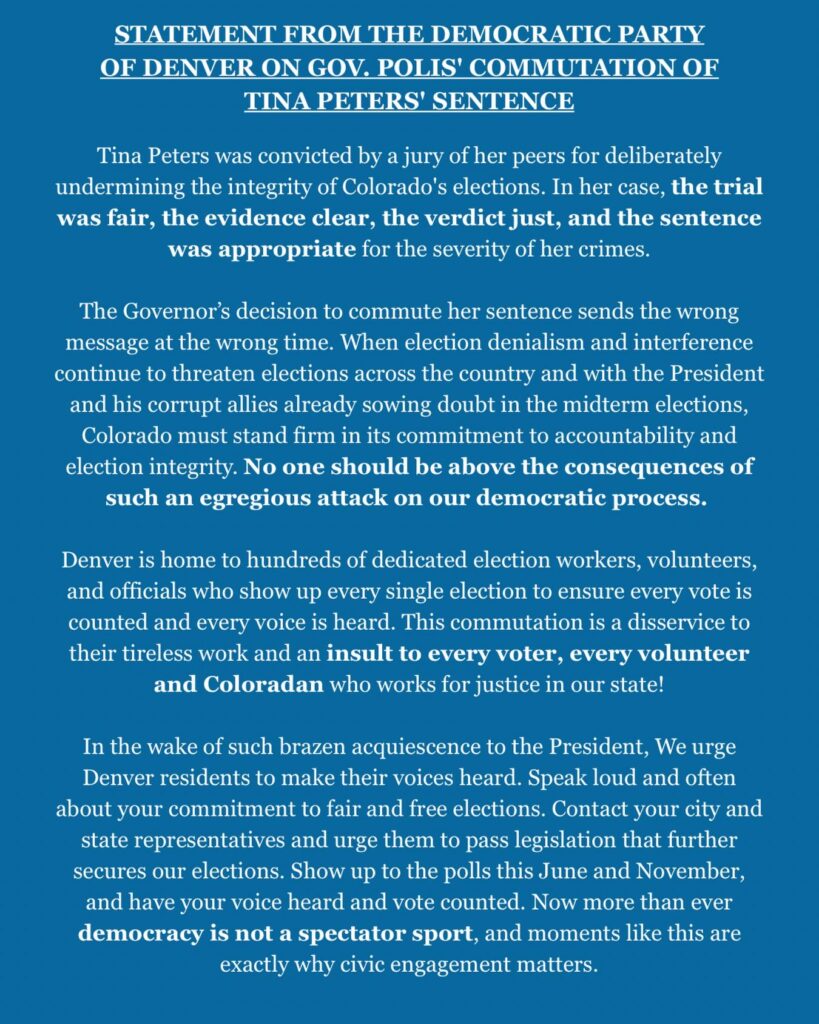






Update to include the Democratic Party of Denver statement.
Former Mesa County clerk and prominent election denier to be released after months of pressure from Trump and allies.
Colorado Gov. Jared Polis has commuted the prison sentence of former Mesa County Clerk Tina Peters, ordering her release on parole effective June 1.
Peters, a former Mesa County clerk who became one of the nation’s most prominent election deniers, was convicted in 2024 for allowing unauthorized access to election equipment after promoting false claims that the 2020 election had been stolen from Donald Trump. She was sentenced to nearly nine years in prison.
Polis said Friday that Peters committed a crime and deserved prison time, but argued her sentence was too harsh and may have improperly considered her protected speech. The Colorado Court of Appeals upheld Peters’ conviction in April but ordered that she be resentenced, finding concerns with how the original sentence was reached.
However, the decision also comes after months of sustained pressure from President Donald Trump and his allies, who repeatedly called for Peters’ release and portrayed her as a political prisoner. Trump publicly praised Peters and launched a barrage of criticism and political pressure directed at Colorado and Gov. Jared Polis over her imprisonment. Polis’ commutation effectively cuts her sentence to four years and four and a half months.
Polis repeatedly emphasized that the action was not a pardon.
“She’s a convicted felon. She deserves to be a convicted felon. She will remain a convicted felon,” Polis said.
Trump’s push for Peters’ release extended far beyond social media posts. Following his return to office, Colorado officials increasingly argued that Peters’ case had become intertwined with broader political retaliation against the state. State leaders pointed to disputes involving federal funding, proposed cuts and policy actions affecting Colorado, including fights over disaster aid, environmental transportation grants, efforts to dismantle NCAR in Boulder, SNAP requirements and the relocation of U.S. Space Command. Critics argued Peters had become a recurring flashpoint in broader political battles between Trump and Colorado.
Peters’ case also unfolded amid years of attacks on Colorado’s election system from Trump and election denial advocates. Trump repeatedly claimed, without evidence, that Colorado’s mail-in voting system and election process were vulnerable to widespread fraud or manipulation. Election officials across the political spectrum have pushed back on those claims, noting that Colorado’s system has long been regarded as one of the nation’s strongest and most secure. The state’s election process includes paper ballots, signature verification, ballot tracking and post-election audits, and repeated reviews have found no evidence of widespread election fraud.
The reaction across Colorado was immediate. Election officials, Democratic leaders and many residents flooded social media and political channels with criticism, with some calling the decision reckless and others accusing Polis of capitulating to pressure from Trump allies. The controversy places the governor at odds with many within his own political coalition during the final year of his administration.
Colorado Attorney General Phil Weiser called the commutation “mind-boggling and wrong,” arguing that Peters was convicted by a jury for tampering with election equipment and undermining public trust in elections. Weiser warned that “caving to this president will only lead to more abuse from the bullying Trump administration.”
Colorado Secretary of State Jena Griswold also sharply criticized the decision, calling the commutation “an affront to our democracy, the people of Colorado, and election officials across the country.” Griswold warned the move could “validate and embolden the election denial movement” and leave “a dark, dangerous imprint on American democracy for years to come.”
Griswold also pointed to the real-world impact of Peters’ actions. According to the Secretary of State’s office, the Mesa County voting equipment breach forced the county to replace nearly $1 million in election equipment and led Colorado to adopt new protections against insider threats involving election systems.
Matt Crane, executive director of the Colorado County Clerks Association and a Republican, warned that the decision sends a dangerous message to election workers. The organization accused Polis of “bending the knee” to political forces undermining confidence in elections and said county clerks felt abandoned by the governor’s decision.
Polis said Peters privately admitted wrongdoing in her clemency application, writing: “I made mistakes four years ago. I misled the Secretary of State when allowing a person to gain access to county voting equipment. That was wrong.”
Peters later thanked Polis publicly and said she plans to continue supporting what she describes as election integrity efforts and prison reform after her release.
A larger question may now follow the commutation: if months of pressure surrounding Tina Peters included threats, funding disputes and public attacks directed at Colorado, what happens next? Critics repeatedly argued that granting clemency would not halt broader political pressure from Trump or his administration. If those pressures continue after Peters’ release, the debate around Polis’ decision may shift from whether it was politically costly to whether it changed anything at all.
Democratic Party of Denver Statement: