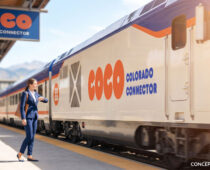




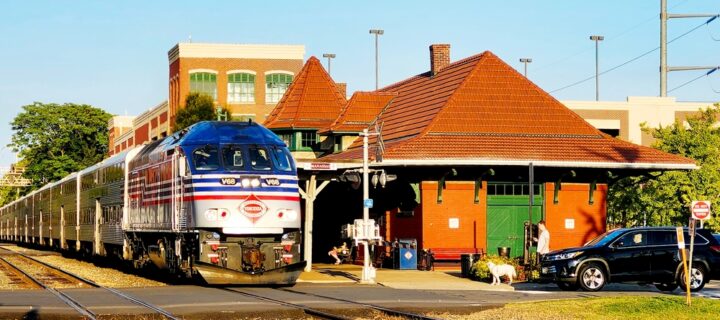

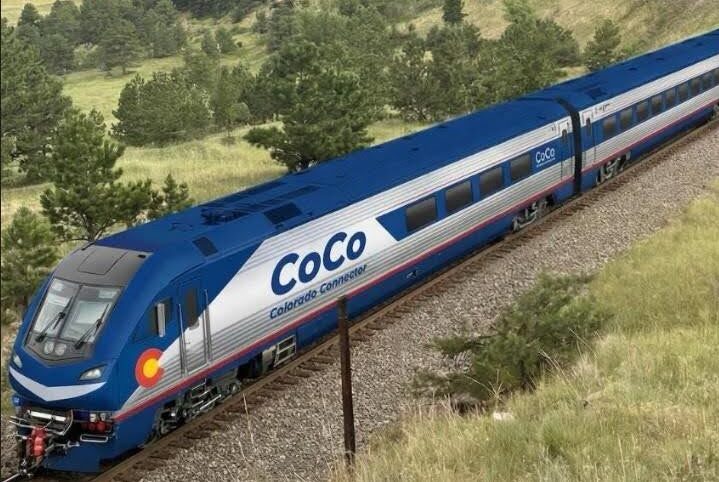
For years, Colorado’s Front Range passenger rail proposal, a long-running effort to create a rail alternative along the heavily congested Interstate 25 corridor, has existed as one of the state’s most persistent transportation ambitions. Now branded the Colorado Connector, or “CoCo,” the project is shifting from concept to early-stage development, bringing renewed scrutiny over cost, funding structure, environmental claims, and long-term viability.
Supporters describe the proposed system as a long-overdue investment in regional mobility that could reduce traffic congestion, improve transportation access, and support economic growth across one of the fastest-growing corridors in the western United States. Critics, however, argue the project carries financial risks and operational uncertainties that could leave taxpayers absorbing long-term subsidies without guaranteed ridership returns.
At the center of the debate is a core question: can Colorado build a passenger rail system that is both functional and financially sustainable?
The Front Range Passenger Rail District envisions a phased rail system connecting Fort Collins, Denver, Colorado Springs, and eventually Pueblo.,The current focus is an initial starter service between Fort Collins and Denver, which planners describe as the most viable first step due to existing infrastructure and population density along the northern Front Range. Recent regional funding actions include approximately $332 million in approved support through RTD and the Colorado Infrastructure Office for early-stage development tied to the starter corridor.

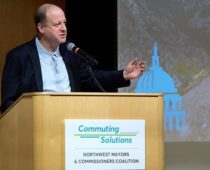
Sal Pace pictured
According to Sal Pace, General Manager of the Front Range Passenger Rail District, the starter service is designed to begin operations in 2029, with three daily round trips between Fort Collins and Denver.
“The initial starter service for the Colorado Connector is estimated at approximately $330 million and will deliver round-trip service between Fort Collins and Denver three times daily beginning in 2029,” Pace said in a statement provided to Yellow Scene. “What makes this approach different is that Colorado is leveraging existing rail infrastructure and partnering directly with freight rail operators, rather than building an entirely new rail corridor from scratch.”
Pace added that the long-term vision includes expansion southward toward Colorado Springs and Pueblo, with potential service extensions targeted around 2032. The phased approach is central to the project’s funding and political strategy, allowing officials to demonstrate early service viability before committing to full corridor buildout. However, the broader financial structure of the project continues to generate debate. Depending on infrastructure requirements, service frequency, station development, and long-term corridor improvements, publicly discussed estimates for the Colorado Connector range from hundreds of millions for initial service to multi-billion-dollar projections for full Front Range expansion. Transportation infrastructure projects of this scale routinely require long-term public investment, but critics argue passenger rail presents unique financial exposure because operating costs continue indefinitely after construction is complete. These costs include staffing, maintenance, fuel or power supply, equipment replacement, insurance, and ongoing infrastructure upkeep.
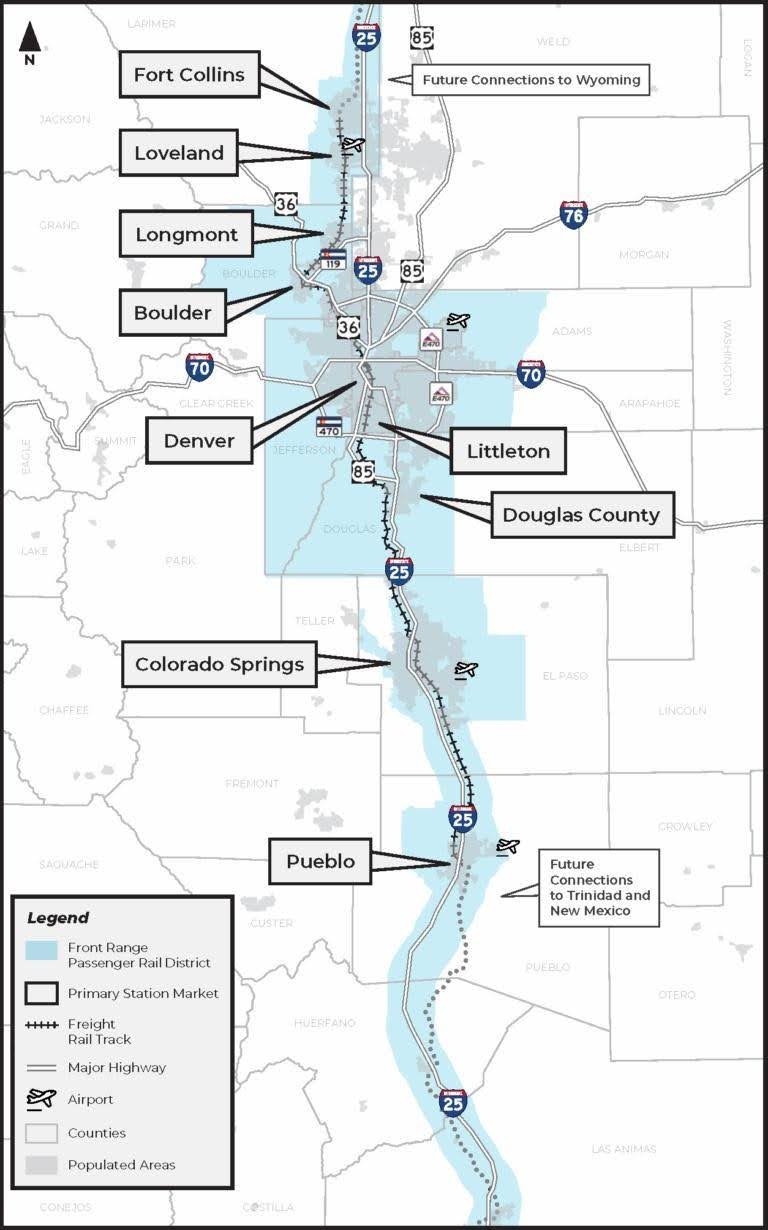
Drafted path for proposed Railway.
One of the most contested concerns is the potential long-term subsidy required per rider. Some critics have pointed to analyses suggesting costs could approach or exceed $1 per passenger mile depending on final ridership performance and operational conditions. While not an official projection from the district, the figure has become a focal point in broader public debate about rail efficiency compared to other transportation modes. Critics argue that when full lifecycle costs are considered — including infrastructure, operations, and maintenance — passenger rail systems can become significantly more expensive per traveler than driving or commercial air travel on a per-mile basis, particularly if ridership falls below projections. Supporters counter that such comparisons often ignore the broader context of transportation funding in the United States. Highways, airports, and roadway systems also rely heavily on public investment and ongoing subsidies, even if those costs are less visible in fare structures.
According to Pace, the Colorado Connector is designed as a cost-conscious model that prioritizes existing infrastructure to reduce upfront construction costs and accelerate delivery timelines.
“What makes the Colorado Connector notable is that we have intentionally structured it as a cost-conscious public-private partnership that leverages existing infrastructure rather than pursuing far more expensive new rail construction,” Pace said.
He added that all major transportation systems require sustained public investment and that passenger rail should not be evaluated differently in that regard.
The debate ultimately reflects a broader policy question: whether transportation systems should be evaluated by direct cost recovery or by broader impacts such as congestion relief, mobility access, environmental benefit, and long-term economic development.
Colorado’s Front Range corridor continues to experience significant population growth, placing increasing pressure on Interstate 25 and surrounding road networks. Commuters regularly experience variable travel times between Fort Collins, Denver, and Colorado Springs, with congestion driven by population growth, tourism, construction, and accident-related delays. Rail supporters argue that highway expansion alone cannot sustainably accommodate future demand. However, operational challenges remain central to skepticism towards the Colorado Connector as a solution.
The Colorado Connector is expected to rely heavily on existing freight rail corridors during its initial phases, rather than constructing dedicated passenger rail lines. While this approach reduces construction costs significantly, it also introduces limitations related to scheduling coordination, freight priority, travel speeds, and service frequency. Passenger trains operating on shared freight corridors must often navigate dispatch constraints that can affect reliability and consistency compared to dedicated passenger systems Critics argue these constraints may reduce the system’s competitiveness against driving, particularly if service frequency or travel times do not meet public expectations.
Environmental considerations are also a major part of the project’s public messaging. Passenger rail is generally promoted as a lower-emission alternative to single-occupancy vehicle travel, and Colorado Connector has been framed as aligned with broader state efforts to reduce transportation emissions. However, the planned use of diesel or diesel-hybrid equipment during early operations has drawn scrutiny. At the time of publication, the Front Range Passenger Rail District had not provided additional comment from Tara Trujillo regarding the diesel implementation phase. District leadership has stated that diesel-hybrid equipment is intended to provide operational flexibility across existing freight infrastructure while reducing startup costs and allowing service to launch more quickly.
Though Pace noted, that future technological improvements in rail propulsion may allow for cleaner operating systems down the line.

The tension between long-term environmental goals and near-term operational realities remains one of the most closely watched aspects of the project.
As Colorado moves toward potential implementation, the success of the Colorado Connector will likely depend less on initial branding and more on execution — including ridership levels, service reliability, and long-term financial performance. For now, the project remains suspended between vision and verification, with its ultimate outcome still uncertain. Whether it becomes a defining transportation investment or a costly lesson in infrastructure ambition will depend on whether projected benefits align with real-world performance once service begins.
Like journalism like this? Consider becoming a sustaining supporter — and get our print edition delivered to your home each month.
Democracy needs journalism more than ever. For 25 years, we’ve told the truth — your support helps us keep doing it for the next four and beyond. Administrations come and go. Our team stays ready to lead, no matter who’s in charge.