




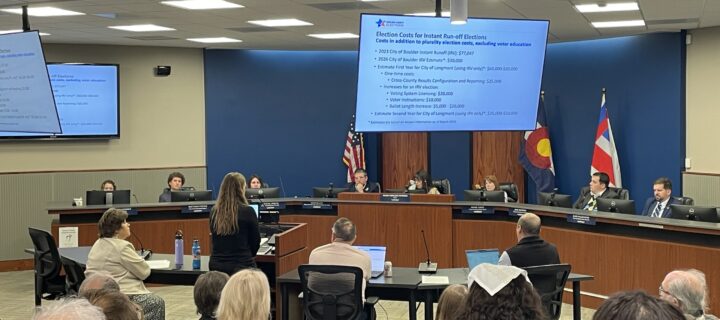

Ranked choice voting (RCV) dominated last Tuesday night’s Longmont City Council meeting, drawing an outpouring of public support and setting the stage for a potential ballot measure that could reshape how the city conducts its elections. Several residents touting “RCV 4 Longmont” signs shuffled in just as the Study Session began.
RCV is a type of voting system in which voters have the option to rank candidates in order of preference (first choice, second choice, third choice, etc.). If a candidate receives more than 50% of the first choice votes, that candidate wins. If votes are spread out more evenly between three or more candidates, and no candidate receives more than 50% of the vote, the candidate with the least votes is eliminated. For voters who selected the eliminated candidate as their first choice, their votes would be transferred to their second choice candidate. This process is repeated until a candidate receives more than 50% of the vote.
Former mayoral candidate Shakeel Dalal set the tone in the council chambers that evening, describing how the current voting system requires residents to “become game theorists,” adding “Anyone who’s ever been pressured to not throw away their vote on a third party candidate or told that they must vote for the lesser of two evils to avoid a spoiler has been a victim of this game.”
Dalal was not alone, as twenty residents stepped up to the public comment microphone on the topic, with seventeen speaking in favor of some form of ranked choice voting. Three speakers voiced concerns or opposition to the proposed change.
Residents found creative ways to express their support for RCV, with arguments in favor of the system ranging from fairness criteria in discrete mathematics to The Dark Knight getting snubbed at the Oscars. Many speakers expressed the desire to see their elected officials working together more and felt that moving toward RCV would be a positive step in that direction.
One resident tied their frustrations with the federal government back to Longmont, arguing “Anything short of RCV in our election is anti-democracy, anti-science and antihuman.”
Local middle school teacher Thomas Baker shared about his familiarity with RCV in school. Baker explained that his students naturally gravitate toward RCV due to it feeling “incredibly fair.” He added that his school uses RCV for a variety of contests, including student government races and science fair presentations. “A bunch of kids like this so it must be a cool idea.”
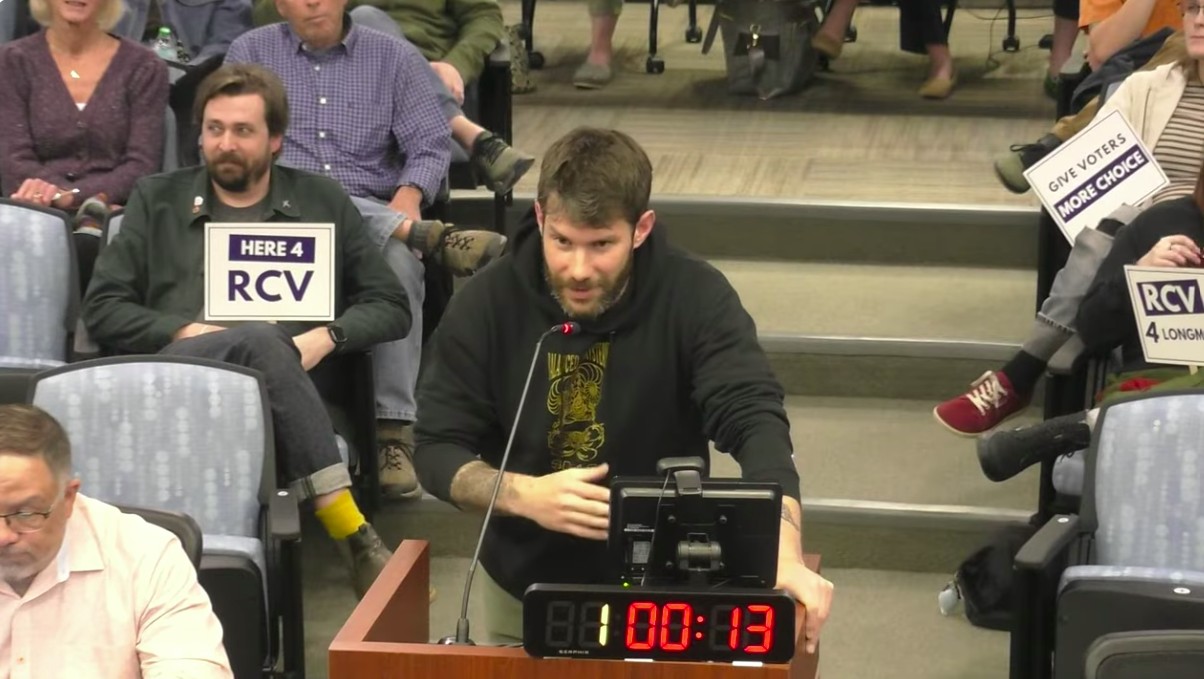
Local teacher Thomas Baker speaking during the meeting
Following the public comment period, council received an informational presentation from Dawn Quintana, Longmont city clerk, and Stephanie Gnoza, Boulder County elections director. The two officials walked through which RCV methods are currently certified in Colorado, the financial costs associated with switching voting systems, and the voter education requirements that would need to accompany any implementation of the new method.
Mayor Susie Hidalgo-Fahring reminded those in attendance that any change to the city’s voting system would not be a simple administrative decision. Because it would require a revision to the city charter, the question would ultimately need to go before Longmont voters directly in the form of a ballot measure.
What followed was a spirited debate among council members about what a reasonable timeline might look like. Mayor Pro Tem Sean McCoy emphasized the importance of allowing adequate time for a successful voter education campaign before any ballot measure referral.
Despite differing views on pacing, there appeared to be consensus that if community members gathered enough signatures on a petition before the next election cycle, council members indicated they would treat that as a clear signal to place the measure on the 2026 ballot.
The discussion underscored a growing appetite among residents for electoral reform, even as practical questions, including cost, certification and public readiness, remain to be worked through. No formal vote was taken Tuesday night, but the conversation signaled that ranked choice voting is unlikely to fade quietly from the agenda.
Like journalism like this? Consider becoming a sustaining supporter — and get our print edition delivered to your home each month.
Democracy needs journalism more than ever. For 25 years, we’ve told the truth — your support helps us keep doing it for the next four and beyond. Administrations come and go. Our team stays, ready to lead no matter who’s in charge.